


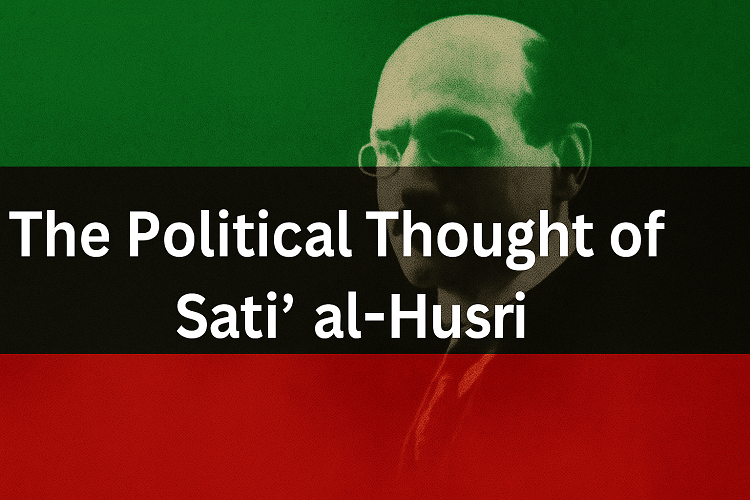
Introduction: Why Is a Reappraisal of the Political Thought of Sati’ al-Husri Necessary Today?
The Political Thought of Sati’ al-Husri is among the most influential—yet simultaneously the most controversial—discourses formed in the modern Arab world. Emerging during the period between the collapse of the Ottoman Empire and the rise of Arab nation-states, it played a pivotal role in defining the region’s political and cultural identity. However, revisiting al-Husri’s intellectual legacy is essential not only for understanding the roots of Arab nationalism but more than ever for analyzing contemporary identity challenges, minority crises, and the failures of nation-states in the Middle East. Many of today’s debates about language, ethnicity, social cohesion, and cultural policymaking—whether consciously or unconsciously—operate under the shadow of the same intellectual frameworks that al-Husri developed.
Therefore, the present article aims to provide a comprehensive analysis of The Political Thought of Sati’ al-Husri—an analysis that clarifies both his historical and interpretive viewpoints and, with a critical and scholarly approach, delineates the boundaries and limitations of his theory. In this process, we will examine the theoretical foundations he established regarding language, education, and nation-building, and compare them with contemporary movements such as Islamism, leftist thought, and Arab liberalism. Such a comparison helps us understand how each of these movements tried to offer a different answer to the question of “collective identity” in the Islamic world.
Furthermore, al-Husri’s cultural–historical approach to the concept of “nationhood” requires principled critique. Nationhood is not a pre-existing truth but a “constructed,” “contractual,” and socially–politically negotiated phenomenon. When theorists define the nation based solely on one element—such as language, race, history, or religion—they inevitably move toward negating pluralism and suppressing differences. The political history of the twentieth century has shown that such approaches can quickly escalate into radical nationalism, minority exclusion, or even violent forms of ideology such as fascism or ideological terrorism. From this perspective, critiquing al-Husri is not merely a historical exercise but a necessity for building the pluralistic societies of today.
Ultimately, this article seeks to present a comprehensive, analytical, and methodologically coherent narrative that helps the reader understand the roots of identity crises in the Middle East within the context of al-Husri’s ideas and those of his opponents. The article also attempts to propose a new model for understanding nationhood in the Islamic world—one that relies neither on a single determining element nor on the erasure of ethnic, linguistic, and religious diversity, but instead emerges from an open society grounded in social contract principles.
-
Life, Era, and Contexts of the Formation of the Political Thought of Sati’ al-Husri
The Political Thought of Sati’ al-Husri cannot be analyzed without understanding the historical and social context in which this thinker matured. Born in 1880 in Sana’a and raised within the multiethnic and multilingual structure of the Ottoman Empire, al-Husri lived during an era when, in the late nineteenth and early twentieth centuries, the empire not only faced external pressures from European powers but also grappled with internal tensions among its diverse ethnicities, religions, and languages. Thus, al-Husri’s earliest lived experience was an encounter with a world in which “identity” surfaced as a deeply challenging and decisive question.
Al-Husri received his education in Ottoman military schools, environments where order, discipline, and structured, education-centered systems carried great significance. This early experience later permeated his entire intellectual life: the idea that the “educational system” is not an ordinary institution but the principal pillar of nation-building. From his youth onward, he observed that the Ottoman state—due to the lack of a unified and modern educational system—was unable to create a cohesive identity among its peoples. For this reason, The Political Thought of Sati’ al-Husri regarding the central role of education has its roots in his lived experience within Ottoman official institutions.
Meanwhile, during the Tanzimat reforms and the wave of modernization, al-Husri became acquainted with new discourses on nation, identity, and citizenship that flowed from Europe into the Ottoman world. These discourses—including French nationalism, German unification ideology, and the concept of the modern nation-state—were intensely debated in the intellectual circles of Istanbul and Damascus. Yet Arab intellectual reactions to these concepts were far from uniform: some, such as reformist Islamists, interpreted nationhood as a continuation of the natural unity of the Islamic ummah; certain liberals emphasized individual freedom and civil rights; and leftists focused primarily on class justice. Al-Husri, however, developed his own particular conception of nationhood based on “common language and culture.” He believed that if Europeans had built stable nation-states by relying on shared language, the Arab world must follow the same path.
From this perspective, the formation of The Political Thought of Sati’ al-Husri was inspired by a combination of internal and external factors. Internally, the Ottoman Empire faced deep social and ethnic fractures; externally, European influence, the expansion of colonialism, and territorial division projects in the Middle East doubled the urgency of redefining Arab identity. Thus, al-Husri did not think in a vacuum—he formulated his ideas in direct confrontation with the real crises of the Arab world. He sought an answer to the question: “What can unite the Arabs after centuries of fragmentation?”
With the collapse of the Ottoman Empire and the establishment of new Arab states under British and French mandates, al-Husri’s concerns about nation-building took on a more practical form. As an educational administrator and later a political thinker, he became part of a project aimed at constructing a new national identity for future generations. In Iraq, Syria, and other Arab countries, his presence in state institutions allowed his theories about language and education to move from abstract discussion into actual policy implementation.
Nevertheless, the political conditions after World War I were both an opportunity and a constraint for his thought. On one hand, he believed the Arab world could finally build modern states based on shared cultural identity; on the other hand, the region’s political realities—ethnic, religious, and local diversities—stood in contrast to his unifying theory. This gap between the “cultural conception of the nation” and the “multicultural reality of the Middle East” later became the central weakness of his theory, a point that will be examined in detail in the critical sections of the article.
In sum, to understand the context of the formation of The Political Thought of Sati’ al-Husri, one must recognize that his thought resulted from three simultaneous experiences: living within a multiethnic empire, encountering European models of nation-building, and engaging in practical efforts to construct national identity within newly founded Arab states. These three experiences shaped al-Husri’s intellectual framework and led him toward a theory that, despite its appeal, also held significant limitations.
-
The Theoretical Foundations of the Political Thought of Sati’ al-Husri
The Political Thought of Sati’ al-Husri is built upon a set of key concepts that may appear simple and clear at first glance, yet within the political and social context of the Arab world they have produced significant and sometimes complex consequences. The most important of these foundations are language, history, education, and Arab unity. Understanding these components is possible only when both the internal logic of al-Husri’s intellectual system and its relationship to the concrete realities of Arab societies are clarified.
With this in mind, this section provides a precise, step-by-step explanation of these foundations, showing how al-Husri attempted to construct a coherent project for Arab nation-building through these elements.
2–1. Language: The Central Pillar of Nation-Building in The Political Thought of Sati’ al-Husri
According to al-Husri, the “nation” is defined based on a single essential element: language. Inspired by nineteenth-century German nationalism, he believed that a nation is not primarily a legal or political structure but rather a “cultural–linguistic community.” Therefore, a shared language is not merely a tool of communication; it shapes historical memory and collective identity.
For this reason, al-Husri often elevated language to a sacred status—an element that forms the core of culture, shared emotions, and national consciousness. He writes:
“Language is the mother of the nation, and a nation that forgets its language has forgotten itself.”
This statement was the point of departure for his entire interpretation of “Arabness.”
However, this excessive emphasis on language led him to overlook the historical diversity of the Arab world: societies such as Iraq, Sudan, Morocco, or Syria possess complex combinations of local languages, diverse ethnicities, and mixed identities. Despite this, al-Husri believed that such diversities should be “absorbed” into Arab culture, because the survival of the nation depends on linguistic unity.
This viewpoint later became the foundation for Arabization policies in several Arab states—policies that will be examined in detail in the critical sections of the article.
2–2. A Shared History: A Memory That Must Be Reconstructed
In the Political Thought of Sati’ al-Husri, history holds an important place alongside language, but in a very particular sense: history is not a “natural phenomenon” or an “objective truth,” but something that must be reconstructed to give the new states a national character. In other words, history functions as an educational tool, not as a scientific narrative.
Al-Husri believed that all Arabs share a common history—from the pre-Islamic era to the Abbasids and into the modern age. This shared history, in his view, must be reconstructed in textbooks and the educational system as a “unified narrative of past greatness,” so that the new generation sees itself as part of this “grand story.”
The problem with this approach is that al-Husri’s historical narrative is a “produced” history, not an “accurate representation of reality.” He transforms history into an instrument of national cohesion; therefore, historical events that do not align with national unity are omitted or minimized. In this approach, history becomes not a field for discovering truth but a stage for “national education.”
This issue holds an important place in the critical sections as well, because ideological historiography is one of the foundations of closed and authoritarian nationalisms in the modern world.
2–3. The Role of Education: The Pillar of State-Building and National Reproduction
No component in the Political Thought of Sati’ al-Husri is as important as “education.” For him, education is not merely a cultural tool but the primary arena of social engineering and the reproduction of national identity. Based on his experiences in the Ottoman Empire and later in Iraq and Syria, al-Husri believed that:
- The educational system must be centralized.
- It must emphasize classical (Fus-ha) Arabic.
- Textbooks must institutionalize shared Arab history and culture.
- Schools must instill a sense of “belonging” and “cohesion” among new generations.
In other words, for al-Husri, education is the factory for producing new citizens—citizens who, in the newly established Arab world, must develop loyalty to the nation, not to tribe, religion, or region.
However, this perspective has an important consequence: it ignores the real diversity of society. When education reproduces only one cultural model, all differences are treated as “obstacles.” This is precisely the point at which al-Husri’s approach structurally conflicts with political and cultural pluralism.
2–4. Arab Unity: From Shared Culture to a Single State
One of the most prominent aspects of The Political Thought of Sati’ al-Husri is his belief in the “political unity of the Arab world.” He envisioned that:
- Arabs possess a shared language, history, and roots.
- The borders created after the fall of the Ottoman Empire are “artificial” and “imposed.”
- Arab nationhood must eventually lead to the formation of a large unified Arab state.
This idea later inspired movements such as Ba’athism, Nasserism, and various twentieth-century unification projects. However, al-Husri lacked a precise understanding of the logic of modern states: the modern nation-state is not built on “cultural unity,” but on social contract, individual rights, and democratic institutions.
For this reason, al-Husri’s thought was attractive at first glance, but in practice it contributed to the strengthening of authoritarian states, since governments aiming to realize a “unification ideology” require extensive control over society.
2–5. Neglecting Race, Religion, and Class: or the Single-Factor Understanding of Identity
One notable feature of The Political Thought of Sati’ al-Husri is that he deliberately excludes religion and race from the definition of the nation. He argued that:
- Religion is universal and cannot form the basis of a nation.
- Race is not a scientific concept and cannot be meaningfully traced in the Arab world.
This position makes sense given his intellectual opposition to both Islamist and racial nationalist movements. Yet the main problem lies elsewhere: instead of race or religion, he elevates language to the sole determining element of nationhood.
This is just as one-dimensional as racial or religious fundamentalism, because all three rely on “a single fixed element” and reduce the complex social world to a unified narrative. This single-factor reductionism will serve as a focal point of critique in later sections.
2–6. The Nation as a Natural Reality, Not a Constructed One
Al-Husri often speaks of the “nation” as if a singular nation has existed since ancient times and must now be “recovered” or “revived.” He treats the nation as natural, historical, and pre-existing. This view stands in contrast to modern social science approaches, which see the nation as:
- contractual,
- political,
- historical,
- and constructed.
By ignoring this, al-Husri’s theory failed to grasp the complex mechanisms of state-building in the modern era. His ideas ultimately produced a kind of “identity romanticism” that was appealing but had little connection to social realities.
In conclusion, while the foundations of The Political Thought of Sati’ al-Husri possess internal coherence, they also contain structural limitations—limitations that open the door to deep critique. Yet before entering the critical phase, it is necessary to place al-Husri’s thought within a broader historical context and compare it with contemporary movements. Such a comparison will reveal why his project, though powerful, remained incomplete.
-
Comparing the Political Thought of Sati’ al-Husri with Contemporary Intellectual Currents in the Islamic World
To understand The Political Thought of Sati’ al-Husri more clearly, it must be situated within the broader intellectual currents that emerged in the early twentieth century, particularly after the collapse of the Ottoman Empire in the Islamic world. Each of these currents—Islamists, leftists, revolutionary nationalists, and reformist liberals—offered its own answer to the fundamental question, “Who is the nation?” A comparative examination of these currents shows that Husri’s thought was not only one among several possible narratives about the nation, but in some ways a reaction to the other narratives.
This comparison also clarifies why Husri’s theory gained significant influence in some countries, while failing to attain widespread legitimacy in others.
3–1. Husri versus Islamists: The Cultural Nation versus the Religious Ummah
Islamists were the earliest and most serious intellectual challengers to Husri. At the very moment when Husri was defining the nation as a cultural–linguistic phenomenon, Islamists such as Rashid Rida, Hasan al-Banna, Maududi, and later the Muslim Brotherhood believed that:
- The identity of Muslims is fundamentally religious, not cultural;
- Political unity must be based on the ummah, not the nation;
- The Arabic language is important not as the foundation of nationality, but as the language of revelation.
In this confrontation, Husri regarded religion as a “universal element” that cannot define the nation. In his view, religion is transnational and therefore cannot serve as the basis for the modern nation-state. Islamists, for their part, accused Husri of “reducing Muslim identity to ethnicity.”
The fundamental point of divergence:
- Husri: Nation = language + culture
- Islamists: Nation = ummah + sharia
Political consequences of this divergence
While Husri sought a secular Arab national state, Islamists aspired to a transnational Islamic state. This difference prevented the two currents from ever finding theoretical reconciliation.
3–2. Husri and the Leftists: The Conflict Between “Identity” and “Class”
Arab leftism—from independent Marxists to the early Ba‘th movement—offered a perspective entirely different from that of Husri. From the viewpoint of leftists:
- The central problem of Arab societies is “class-based,” not “identity-based.”
- The historical backwardness of the Arab world stems from economic relations, colonialism, and exploitation.
- National identity matters, but it is subordinate to economic structures, not the other way around.
Leftists viewed the nation as the product of relations of production and social structures, not as a fixed cultural essence. For example, the Ba‘th Party (in its early, pre-authoritarian phase) identified “Unity, Freedom, Socialism” as its three ideological pillars. Unity, in their view, arose not from language but from shared class struggle.
Fundamental difference from Husri
- Leftists: Class identity → nation
- Husri: Cultural identity → nation
Leftists considered language a secondary factor; Husri regarded it as primary.
Political consequences
Husri’s approach was more attractive to centralized secular states, whereas the leftists became closer to anti-colonial and mass movements.
However, both currents became entangled in a kind of “totalitarianism of identity or class.” This issue will be analyzed further in Section 5 (Critique of Husri’s Theory).
3–3. Husri and Arab Liberals: Divergence over the Role of the Individual and Political Will
Arab liberals—from Rifa‘a al-Tahtawi to Taha Hussein and the intellectuals of the 1930s—emphasized individual freedoms, citizenship, the social contract, and the rule of law. They understood the nation not as a “cultural destiny” but as a “political contract” among citizens.
From the perspective of liberals:
- The nation is the product of the will of citizens, not of language or history;
- Identity must be voluntary and accepted, not imposed;
- Democracy and political participation are the foundations of the nation-state.
But Husri did not believe in the “electability” of the nation; to him, the nation was a fixed, pre-existing reality.
The main difference:
- Liberals: Nation = contract + will + rights
- Husri: Nation = language + common past + education
Liberals believed in plurality and diversity; Husri saw these as threats to cohesion.
3–4. Husri and Rival Nationalisms: Turkish and Iranian
To complete the comparative analysis, it is necessary to mention two parallel currents in the Islamic world:
Turkish Nationalism (Kemalism)
Kemalists, like Husri, emphasized common language and history, but:
- Their approach was statist and authoritarian,
- They regarded the nation as the result of political and legal engineering,
- And they used education as a tool of “Turkification.”
Husri was influenced by this model in many respects, but replaced race with language as the primary factor.
Iranianism (Iranian Cultural Nationalism)
In Iran, some intellectuals such as Ahmad Kasravi , Mahmoud Afshar and Taqizadeh emphasized “historical and linguistic identity.” Their similarity to Husri lies in their focus on “ancient heritage” and “cultural cohesion.” The key difference, however, was that Iran—unlike the Arab world—possessed a continuous historical state. Thus, nation-building in Iran did not require a “new political creation.”
Husri, by contrast, faced the Arab world with new borders, multiple ethnic groups, and the absence of a historically centralized state.
3–5. Locating Husri among These Currents: A Cultural–Disciplinary Narrative of the Nation
If we place Husri among these currents, we can say that he:
- Is “unity-seeking” like the Islamists, but not based on religion;
- Pays attention to the “masses” like the leftists, but not based on class;
- Believes in the “nation-state” like the liberals, but not as a social contract;
- Focuses on “cultural identity” like Turkish and Iranian nationalisms, but not based on race.
This combination makes his thought appealing, yet ultimately prevents it from fitting fully into any of the modern traditions of nation-building.
3–6. Analytical Conclusion: Did Husri Forge a Path Between These Currents?
Short answer: only partially.
- He succeeded in establishing the cultural–linguistic model of nation-building in the Arab world.
- But he failed to offer solutions for ethnic, religious, and linguistic diversities.
- He failed to link “cultural identity” with the “political contract.”
- And he failed to define the nation as a flexible, elective, and democratic phenomenon.
For these reasons, his theory remained consistently exposed to critique from Islamic, leftist, and liberal currents.
-
Fundamental Critique of Sati‘ al-Husri’s Cultural–Historical Approach to Nationality
Having moved beyond the exposition of the foundations of The Political Thought of Sati’ al-Husri and examined his position among other intellectual currents, it is now time to raise one of the most fundamental theoretical questions of this article:
Can Husri’s approach to nationality—based on language, shared history, and education—serve as an effective, democratic, and realistic basis for nation-building in the Arab and Islamic worlds?
The answer presented in this section is clear: No.
To explain this “no,” we must discuss the nature of nationality in the modern age, the place of the social contract, the role of pluralism, and the political and ethical consequences of single-factor approaches. This critique does not stem from Westernism or the denial of the importance of language and culture, but from the standpoint of political science, sociology, and modern historiography.
4–1. First Critique: Nationality Is Not a Natural Entity but a “Constructed” and “Contractual” Phenomenon
The core of Husri’s thought is based on the assumption that “nationality” is a natural, historical, and pre-existing entity—something that has existed throughout history and now needs to be revived or reconstructed. But contemporary social sciences—from Benedict Anderson to Ernest Gellner and Anthony Smith—have widely shown that:
- Nationality is a political and contractual structure, not a natural entity;
- Nations are modern phenomena constructed through political processes;
- National borders are not natural but the result of power, war, negotiation, colonialism, and political agreements.
Thus, a nation does not “come into being” naturally; it is “made.” And since it is made, it must be elective, open to critique, and subject to change.
But Husri sees the nation as a kind of “historical spirit” or “cultural truth.” This view turns the nation into an entity outside the political will of citizens.
As a result, instead of citizens creating the nation, they become its “subjects.” This issue lies at the root of many nation-building problems in the Arab world.
4–2. Second Critique: The Danger of Single-Factor Approaches in Defining the Nation
One of the fundamental weaknesses of Husri’s theory is its “single-factor” nature. He turns language into the “essence” of nationality. But historical experiences have shown that:
- Nazism centered nationality on language and race.
- Religious fundamentalism centered it on religion.
- Pan-Turkism centered it on the Turkish language and race.
- Italian fascism centered it on ancient history.
What all these approaches share is the generalization of one element to the entire social reality.
Whenever such reductionism occurs, two dangerous consequences emerge:
- The suppression of minorities
- The dismantling of social and cultural pluralism
A nation can remain stable and democratic only when it is based on multiple elements:
- Political will
- Social contract
- Legal equality
- Cultural diversity
- Shared history
- Shared political experience
But Husri reduces all of these to “language.” This reductionism is not only ineffective but, in practice, creates the conditions for authoritarian states.
4–3. Third Critique: The Elimination of Pluralism and the Danger of Social “Homogenization”
The Political Thought of Sati’ al-Husri, because of its extreme emphasis on cultural unity, inevitably moves toward “forced homogenization.”
When the nation is defined based on a single dominant culture, how are ethnic, religious, and linguistic groups to be included? The answer in Husri’s theory is clear:
“Minorities must be absorbed into the dominant culture.”
But this idea of “absorption” is precisely what many authoritarian regimes in the Arab world implemented through policies of:
- Arabization,
- Weakening local languages,
- Prohibiting mother-tongue education,
- Intervening in historical content,
- And suppressing the identity symbols of minorities.
From the perspective of political sociology, forced homogenization always has destructive consequences. In multiethnic countries, such policies have led to:
- Instability,
- Ethnic–sectarian divisions,
- The formation of oppositional identities,
- And, in some cases, political violence.
The cases of Iraq, Sudan, Syria, Turkey, and Iran clearly demonstrate these outcomes.
4–4. Fourth Critique: The Natural Slide from Cultural Nationalism to Authoritarian Nationalism
The later generation of identity studies has shown that cultural nationalisms, if not combined with political contracts and citizenship rights, naturally gravitate towards authoritarianism.
Why?
Because to preserve “cultural unity,” the state must hold tools of cultural control:
- Control of school curricula
- Control of the media
- Control of the official language
- Control of historiography
- Control of public symbols
Husri, unintentionally, lends legitimacy to this authoritarian logic.
States that suppressed diversity in the name of “national unity” often invoked his theory.
Thus, a theory that initially appeared cultural–educational became, in practice, a tool for legitimizing political authority.
4–5. Fifth Critique: Ignoring the Real Forces of Politics—Economy, Class, Power, and Collective Will
One of the theoretical problems of the cultural–historical approach is that it makes politics excessively “romantic.”
In Husri’s view, the nation emerges from the depths of history. But in reality:
- Nations are built within power struggles,
- Economy and class play fundamental roles,
- Political institutions are decisive,
- And “collective will” must take precedence in the construction of nationality.
But Husri’s theory, by ignoring these forces, turns politics into a cultural act.
Whereas nation-building is a political, economic, and legal project—not merely a linguistic–cultural one.
4–6. Sixth Critique: The Dangerous Proximity to Fascist and Radical Nationalist Models
Any theory that treats a single element as the basis of collective identity inevitably carries the potential to slide toward radicalism.
If language is the “essence” of the nation, then:
- Other languages become threats,
- Other cultures become obstacles,
- And other historical narratives become “deviations.”
This is the same logic used by Italian fascism and Nazism—except that they took race as the essence, whereas Husri took language.
While Husri never explicitly supported violence, his theory contains a “capacity for interpretation” that facilitates the elimination of diversity.
This capacity was activated in the Arab world as well:
From Ba‘thist policies to the radical nationalisms of the 1960s, all drew upon his ideas.
4–7. Seventh Critique: Ignoring the Concept of “Layered Identity”
In the modern world, human identity is multilayered:
- Local
- Ethnic
- National
- Religious
- Professional
- Linguistic
- Gender-based
- Global
But Husri recognizes only one layer—the cultural–linguistic national identity.
This reductionism, instead of opening a path to flexible citizenship, produces a kind of “imposed identity.”
Such an identity cannot respond to the diversity of new generations, global changes, or population mobility.
4–8. Eighth Critique: The Minority Crisis as the Crisis of Nation-Building
A large portion of the political crises in the Middle East have resulted from the inability of Husri’s theory to address the problem of minorities.
In countries such as Iraq, Syria, Lebanon, Sudan, or Algeria, minorities are an essential part of the social structure.
But when the nation is defined based on “language,” then:
- Kurds,
- Amazigh,
- Assyrians,
- Turkmen,
- And other local groups
must either be absorbed or eliminated.
There is no third option in Husri’s theory.
This is precisely where his theory shifts from “cultural identity-building” to projects of “political homogenization.”
4–9. Summary of the Critique: Why Husri’s Approach Is Insufficient and Dangerous
In summary, the dangers of Husri’s cultural–historical approach can be outlined in several points:
- Reduction of national identity to a single element (language)
- Neglect of the social contract and citizenship rights
- Reinforcement of authoritarianism in the name of cultural unity
- Suppression of minorities and elimination of pluralism
- Susceptibility to radical nationalism
- Ignoring the real forces of politics
- Incompatibility with multiethnic societies
Therefore, the Political Thought of Sati’ al-Husri, although one of the main pillars of Arab nationalist discourse in the twentieth century, is—by the standards of contemporary political sociology—an incomplete, limited, and potentially dangerous theory.
-
The Consequences of the Political Thought of Sati’ al-Husri in Contemporary Arab Politics
After presenting the fundamental critiques of Husri’s theoretical foundations, we must now address the following question:
What practical consequences has The Political Thought of Sati’ al-Husri had for state-building, nation-building, and contemporary politics in the Arab world?
In fact, many of the positive and negative outcomes of Arab nationalism in the twentieth century cannot be understood without recognizing Husri’s role. His thought—especially through educational systems, school textbooks, nationalist parties, and the new Arab states—became a decisive force in shaping political and cultural identity.
For a more precise analysis, we will examine these consequences in several areas.
5–1. Enormous Influence on Educational Systems and the Engineering of National Identity
One of the most significant manifestations of the presence of The Political Thought of Sati’ al-Husri in the Arab world was his role in reconstructing the educational systems of Iraq, Syria, Yemen, and parts of the Gulf. He believed that education was the “factory” that produced the citizens of the nation. Therefore:
- Official historiography was rewritten so that the “Arab nation” would be presented as unified and coherent.
- The Arabic language was established as the only legitimate language of education.
- Curricula were structured so that students from a young age would become familiar with concepts such as “Arab unity,” “common destiny,” and “cultural connection.”
Although these policies were effective in the short term in achieving cultural homogenization, in the long run they led to significant rifts between the state and minority groups, because many linguistic and ethnic communities saw education as an instrument for the “elimination” of their own identity.
As a result, it can be said that the educational system inspired by Husri led not to “democratic nation-building,” but rather to “ideological nationalization.”
5–2. Strengthening Authoritarian States in the Name of National Unity
By insisting that national unity requires a “common language and culture,” many Arab states—especially in the second half of the twentieth century—used Husri’s ideas to bolster authoritarianism. States such as:
- Ba‘thist Iraq
- Ba‘thist Syria
- Nasser’s regime in Egypt
- Nationalist governments in Algeria
- Certain Arab Gulf regimes
all relied on the discourse of cultural nationalism to legitimize the concentration of power.
The logic was simple:
“To build a nation, cultural unity must be preserved. To preserve cultural unity, the state must be strong.”
While this logic appeared reasonable on the surface, in practice it led to:
- Tight control of the media
- Restrictions on freedom of expression
- Elimination of independent institutions
- Suppression of dissent under the accusation of “separatism”
- Prohibition of alternative historical narratives
Thus, a theory that was originally “cultural–educational” became an instrument for the consolidation of authoritarian states.
5–3. Intensifying the Crisis of Minorities in Multi-Ethnic Countries
As noted in the theoretical critiques, the greatest flaw in Husri’s theory is its inability to offer a democratic solution to the problem of minorities. As a result, many of the countries that drew inspiration from his ideas faced severe crises. Examples include:
- Kurds in Iraq and Syria who faced linguistic and cultural repression.
- Amazigh communities in Algeria and Morocco who spent decades striving for recognition of their language and culture.
- Christian and Assyrian minorities in Iraq and the Levant who found the narrative of Arab nationality incompatible with their historical identities.
- Tribes in southern Yemen and eastern Syria who considered their local cultures to be at odds with the idea of a “single Arab nation.”
Consequently, Husri’s theory not only failed to produce lasting political cohesion, but in many cases contributed to increasing fragmentation.
5–4. Influence on Radical Nationalist and Paramilitary Movements
One of the most complex consequences was the use of Husri’s theory by groups that slid from cultural nationalism into violent radicalism. These groups interpreted parts of his theory—such as “cultural totality” and “the precedence of collective identity over individual freedom”—in an extreme manner.
Examples include:
- Radical factions of the Ba‘th Party
- Arab nationalist groups in post-2003 Iraq
- Certain extremist Pan-Arab movements
- Segments of armed ideology during the Lebanese civil war
Although Husri himself never articulated a violent theory, the structure of his thought possessed the capacity to be transformed into radicalism.
This susceptibility is one of the major weaknesses of his theory when compared to models based on the social contract.
5–5. Lagging Behind New Identity Transformations in the Arab World
The Arab world today is facing a new wave of identity transformations:
- The rise of local identities
- The expansion of urbanization
- The emergence of transnational identities (such as digital identity)
- Increased social mobility
- Significant presence of non-Arabic languages in higher education
- Large-scale youth migration
However, Husri’s theory is unable to adapt to these changes.
It continues to emphasize “stability” and “cultural unity,” whereas the modern world is based on “diversity” and “layered identities.”
For this reason, newer Arab generations—especially young people—are increasingly drawn to civic, regional, or global identities rather than the unified Arab identity envisioned by Husri.
This gap demonstrates that Husri’s theory can no longer respond to the needs of the contemporary era.
5–6. The Failure of Arab Unity Projects Based on Husri’s Cultural Model
In the second half of the twentieth century, Arab unity projects failed one after another:
- The union of Egypt and Syria (the United Arab Republic)
- The union of Iraq and Jordan
- Maghreb unity initiatives
- Partial confederation attempts among Libya, Tunisia, Sudan, and Egypt
These failures revealed several truths:
- “Cultural unity” alone cannot substitute for shared politics, economics, and institutions.
- A common culture does not necessarily lead to political cooperation.
- Arab nation-states are unwilling to sacrifice their power for a “cultural nation.”
In other words, Husri considered culture more important than politics; but contemporary experience showed that without politics and institutions, culture cannot produce unity.
5–7. Conclusion: Husri—Significant but Insufficient
In summary:
- The Political Thought of Sati’ al-Husri played a decisive role in shaping modern Arab identity.
- But this same thought produced a series of political, ethnic, educational, and identity-related crises.
- Arab countries inspired by his theory faced problems such as minority repression, social fragmentation, authoritarianism, and the failure of unity projects.
- Ultimately, his cultural–historical theory could not align with democracy, pluralism, and multilayered identities.
For this reason, there is a growing debate in the contemporary Arab world that to create a civic, democratic, and pluralistic nation, it is necessary to move beyond Husri and approach newer models of nation-building.
-
Final Synthesis and a Proposed Alternative Model for Nation-Building in the Arab World
After examining the theoretical foundations of The Political Thought of Sati’ al-Husri, comparing him with other intellectual currents of the Islamic world, and presenting a structural critique of his cultural–historical approach, we must now answer a fundamental question:
What model should the Arab world adopt to build stable, democratic, and effective nations in place of Husri’s model?
Before answering, it is necessary to provide a brief synthesis of this article’s findings in order to clarify why Husri’s thought—with all its historical importance—can no longer serve as the sole basis for nation-building.
6–1. A Brief Summary: Husri Was Important, but Not “Sufficient”
In this article, we have shown that:
- Husri’s theory emphasizes common language and culture as the foundation of the nation.
- His nationalism is cultural–historical, not political–legal.
- His theory had a wide influence on educational systems, nationalist parties, and Arab governments.
- His approach suffers from deep theoretical problems:
- reducing the nation to language,
- ignoring the social contract,
- eliminating pluralism,
- inability to manage minority issues,
- reinforcing authoritarianism,
- susceptibility to radicalization,
- and disregarding the real forces of politics.
For these reasons, although Husri was one of the founders of the concept of “modern Arab identity,” his theory is inadequate for the contemporary era—an era in which nation-building requires democracy, pluralism, equal rights, and a social contract.
6–2. Why Must the Arab World Move Beyond Husri?
The Arab world today faces challenges that did not exist in Husri’s time:
- Fragile multiethnic states
- Young people with multiple and global identities
- Massive migration and demographic shifts
- The digital revolution
- A crisis of governmental legitimacy
- The rise of community-based movements
- The need for political and economic development
- The emergence of strong regional and local identities
In such a world, no theory that relies on “cultural unity” can be adequate.
Because in the modern era, the nation is no longer the “continuation of the past”;
it is a pact about the future.
With this premise, we can now turn to the alternative model.
6–3. The Alternative Model: The Nation as a “Social Contract”
This model is based on modern political science research and the experiences of democratic states.
Contrary to Husri—who saw the nation as a “historical–cultural” phenomenon—the alternative model defines the nation as:
- contractual
- legal
- voluntary
- democratic
- and based on equal citizenship
This model rests on several key principles:
First Principle: Political Will Takes Precedence over Language and History
The nation is neither inheritance nor nature;
it is a political choice.
In this model, people decide how and within what framework they want to share a common life.
Therefore, even if multiple languages and cultures exist, the nation can still endure.
Second Principle: Equal Citizenship—Not Cultural Identity—is the Basis of Unity
In Husri’s approach, “shared identity” is the foundation of the nation.
But in the new model:
- equal rights,
- a unified legal system,
- and political equality
form the basis of unity.
This kind of nation-building allows minorities to become full and equal citizens without the need for cultural assimilation.
Third Principle: Identity Diversity Is a Resource, Not a Threat
Contrary to Husri’s model, which viewed diversity as an obstacle to nation-building, the alternative model holds that:
- ethnic,
- linguistic,
- religious,
- and local or regional diversity
can be cultural and social assets.
This perspective allows politics to shift from “uniformity” to “democratic integration.”
Fourth Principle: Nation-Building Must Be Founded on Institutions and Political Development
Nationality in the contemporary era cannot be sustained without:
- free elections
- a competitive party system
- independent institutions
- democratic education
- separation of powers
- a free press
Whereas Husri’s theory relied excessively on “education” and “language,” the new model emphasizes that structures of power and political institutions are the most fundamental elements of nation-building.
Fifth Principle: Shared History Matters, but It Is Not Enough
The modern nation must acknowledge the past, but not remain imprisoned by it.
In the new model:
- shared history is a tool, not a goal.
- the nation is not the “memory of the past,” but “a pact for the future.”
This transforms nation-building from a romantic project into a political one.
6–4. A Proposed Model for the Arab World: The Civic Nation, Not the Cultural Nation
Based on these principles, the best alternative model for the Arab world is the Civic Nation.
This model, unlike Husri’s cultural model, possesses several major advantages:
- Suitable for Multiethnic Societies
Countries such as Iraq, Syria, Lebanon, Sudan, or Morocco face complex ethnic and religious structures.
The civic nation accepts this diversity without allowing it to become an obstacle.
- Ability to Reduce Historical Conflicts
Minorities no longer need to be absorbed into a “pure Arab nationality,” which reduces ethnic-identity conflicts.
- Increased State Legitimacy
When citizenship is grounded in equal rights, public trust in the state grows.
- Strengthening Democracy
The civic nation naturally aligns with:
- transparency,
- elections,
- accountability,
- and human rights.
-
Compatibility with New Identity Transformations
New Arab generations live in a world where digital, global, and multilayered identities play central roles.
Unlike the pure cultural model, the civic nation is adaptable to this reality.
6–5. Final Conclusion: Transition from Husri to the Civic Nation
In conclusion, we may say:
- Husri played an important historical role in defining Arab identity.
- But his theory is insufficient for the contemporary world.
- The Arab world needs a model that:
- is democratic,
- recognizes diversity,
- places equal rights at the center,
- and views the nation as a contractual and voluntary phenomenon.
This model is what is known as the Civic Nation or the nation based on the social contract.
In other words:
To build the future, the Arab world must move beyond Husri—not by rejecting him, but by transcending the limitations of his theory.

