


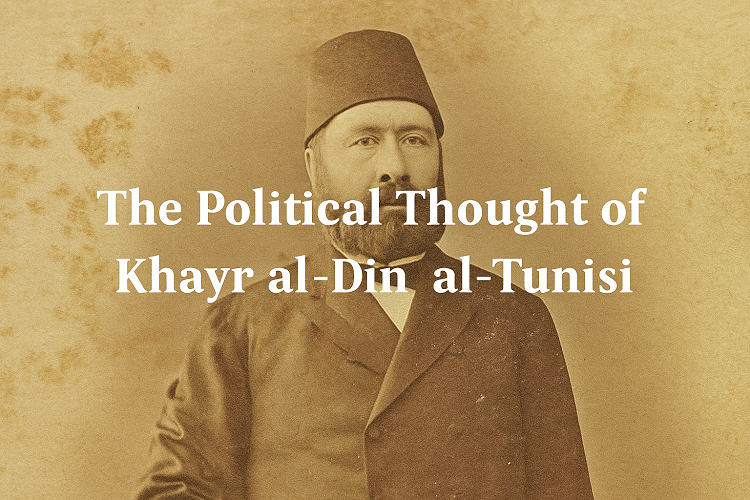
Introduction
In the nineteenth century, at a time when the Islamic world was grappling with deep political, intellectual, and economic crises, a figure emerged from Tunisia who managed to open a new horizon before Muslim thinkers. The Political Thought of Khayr al-Din al-Tunisi was, in essence, a response to a question that still resonates across Muslim societies today: how can one live in a modern world without losing one’s religious and cultural roots?
Khayr al-Din al-Tunisi lived during a period when the Ottoman Empire was in decline, and European colonial powers were rapidly expanding their influence into Muslim lands. Tunisia, his homeland, faced mounting political and economic pressures from France, while its internal governance was riddled with corruption and disorder. In such circumstances, he closely witnessed the weaknesses of the political and administrative structures of Muslim countries and, with a critical and pragmatic mind, sought to analyze the roots of these crises.
According to al-Tunisi, Muslims had fallen behind due to their departure from the rational and ethical principles of Islam, as well as their failure in institution-building and adherence to the rule of law. He believed that Islam, in its essence, is a rational and reformist faith; therefore, Muslim backwardness could not be attributed to the religion itself but to the intellectual and political structures of Muslim societies. Consequently, he sought to find a path for reform and reconstruction from within the Islamic tradition itself—without resorting to blind imitation of the West.
In this context, Khayr al-Din al-Tunisi paid serious attention to the experiences of European countries. Observing institutions such as parliaments, constitutions, and systems of public education, he concluded that the secret of their progress lay in the presence of law and freedom, rather than in any inherent cultural superiority. Hence, one of the fundamental principles of The Political Thought of Khayr al-Din al-Tunisi was that Muslims must learn from the successful experiences of other nations, but such learning should be guided by reason and faith.
In his view, modernity was not necessarily in conflict with Islam; rather, it could acquire meaning and direction through Islamic principles. Thus, in his political thought, al-Tunisi sought to reconcile tradition and modernity—not by rejecting one in favor of the other, but through a wise synthesis of both. He believed that without embracing modern science, order, and law, the Islamic community could not survive in the modern world; yet without maintaining faith and morality, any form of progress would be hollow.
From this perspective, The Political Thought of Khayr al-Din al-Tunisi is not merely a historical theory but a living model for today’s Muslim societies, which continue to seek balance between identity and development.
-
The Life and Historical Context of Khayr al-Din al-Tunisi
To understand The Political Thought of Khayr al-Din al-Tunisi in depth, one must first examine the historical and social context of his life. No intellectual system is born in a vacuum; rather, it arises from a confluence of historical conditions, intellectual transformations, and personal experiences. Khayr al-Din al-Tunisi, born around 1821 in a region of Tunisia, lived during an era when the Islamic world was facing fundamental challenges in power and identity.
At that time, the Ottoman Empire—the largest Islamic polity—was in decline. Its administrative system was deteriorating, its economy dependent, and its political legitimacy weakened. Meanwhile, Europe was undergoing the Industrial Revolution, scientific advancement, and the rise of modern nation-states. Muslim countries, one after another, found themselves retreating before Western military and technological power. Tunisia, though nominally under Ottoman suzerainty, enjoyed relative autonomy but was plagued internally by a feudal and inefficient system of governance.
As a youth, Khayr al-Din entered the court of the Husaynid dynasty, which ruled Tunisia in the nineteenth century. There, he quickly demonstrated his political and administrative talents, becoming an adviser and later a minister in his twenties. His knowledge of Turkish and French, along with his travels to Paris and Istanbul, broadened his intellectual horizons. Unlike many Eastern statesmen who became infatuated with the glitter of Western civilization, al-Tunisi sought to understand the true essence of Western progress.
Upon returning to Tunisia, he realized that his country’s problems stemmed from weak political structures, the absence of the rule of law, and pervasive corruption. Although Tunisia was nominally an Islamic state, in practice it was governed by the arbitrary will of the ruler and his entourage. Heavy taxation, injustice, lack of public education, and the absence of oversight institutions had bred widespread discontent. As a Muslim thinker, al-Tunisi believed that these conditions were not the result of Islamic teachings, but rather of deviation from their spirit and values.
Meanwhile, European powers—especially France and Italy—were steadily increasing their economic and political pressure in North Africa. Faced with this challenge, Khayr al-Din al-Tunisi rejected both isolation and surrender, choosing instead a third way: reform from within. He believed that if Muslim societies could rebuild themselves through rationality and legality, they would not only resist colonialism but also reclaim their former dignity and strength.
The fruit of this intellectual vision was his famous book Aqwam al-Masālik fī Ma‘rifat Aḥwāl al-Mamālik (“The Surest Path to Knowledge of the Conditions of States”), published in 1867. This work is considered one of the earliest reformist political treatises in the Arab and Islamic world. In it, al-Tunisi clearly argued that the secret of Western advancement lies in their commitment to law, justice, and liberty—principles that, he insisted, have deep roots in Islamic teachings. He demonstrated that there is no inherent contradiction between Islamic law (Sharia) and modern legislation, since both aim to uphold public welfare and justice.
In 1873, Khayr al-Din was appointed Grand Vizier (Prime Minister) of Tunisia. Though his tenure was brief, it was highly influential. He implemented a series of administrative and economic reforms: reorganizing taxation, introducing modern education, ensuring financial transparency, and promoting codified law based on justice and Sharia. However, his reforms met resistance from the aristocracy and certain conservative scholars. Court intrigues and foreign pressures eventually forced him to resign, after which he moved to Istanbul, where Sultan Abdülhamid II appointed him Minister of the Navy.
Khayr al-Din al-Tunisi spent his final years in relative seclusion and passed away in 1889. Yet his intellectual legacy endured. He was among the first thinkers to attempt a synthesis between Islamic reformism and rational modernity. The Political Thought of Khayr al-Din al-Tunisi rests upon the conviction that for Muslims to survive and thrive in the modern world, they must draw inspiration from their own values rather than abandon them.
Thus, his life provides a vivid picture of the encounter between tradition and modernity in the Islamic world: a statesman who rose from within the machinery of government but whose intellectual vision transcended day-to-day politics. Instead of adopting anti-Western or submissive slogans, he chose a realistic and balanced path—one that continues to inspire Muslim societies today.
-
The Intellectual and Philosophical Foundations of The Political Thought of Khayr al-Din al-Tunisi
To fully understand The Political Thought of Khayr al-Din al-Tunisi, one must examine the theoretical foundations upon which his intellectual system was built. Unlike many Muslim thinkers of his time, Khayr al-Din developed a coherent and systematic framework. He neither advocated a mere return to the past nor called for unconditional imitation of the West. Rather, he sought a path through which a morally grounded and justice-oriented modernity could emerge from within the Islamic tradition itself.
2.1. Reason and Sharia: The Two Pillars of Reform
One of the central themes of The Political Thought of Khayr al-Din al-Tunisi is the linkage between reason and Sharia. In his writings, he repeatedly emphasized that Islam is a rational religion and that any genuine social reform must be founded upon reason and ijtihad (independent reasoning). For him, reason was not in conflict with religion but rather its complement.
Khayr al-Din believed that if Muslims returned to the rational spirit of Sharia, they would realize that Islam itself calls for reflection, justice, and the rule of law. Therefore, the backwardness of Muslim societies stemmed from their abandonment of reason and neglect of the higher objectives of Sharia. He wrote: “If one reflects upon Islam, one will find that its foundation is built upon knowledge, reform, and order—not upon ignorance and imitation.”
In this view, reason is the means for properly understanding religion and achieving the public good. Political and social reform, therefore, must be accompanied by renewed ijtihad suited to the needs of the time. For this reason, al-Tunisi was among the first thinkers to consider ijtihad essential not only in jurisprudence but also in politics and governance.
2.2. Law and Justice: The Basis of Political Legitimacy
At the heart of The Political Thought of Khayr al-Din al-Tunisi lies the concept of law. He held that no society can progress without law, and no law can endure without justice. In his perspective, law represents order, while justice is its spirit.
In his book Aqwam al-Masālik fī Ma‘rifat Aḥwāl al-Mamālik, Khayr al-Din argued that law must serve the common good, not the interests of rulers. He considered governance a trust, not an ownership. Political legitimacy, he maintained, derives from the observance of justice and accountability to the people—not from heredity or coercion.
For this reason, al-Tunisi emphasized the necessity of institutions such as consultative councils (majlis al-shura), independent courts, and transparent financial systems. Inspired by the experiences of European states, he showed that Islamic law itself stresses consultation, justice, and accountability. Therefore, a political system can be established that is both authentically Islamic and functionally modern.
2.3. Freedom and Responsibility: The Conditions for Social Reform
Khayr al-Din al-Tunisi regarded freedom as one of the essential pillars of reform, but he never separated it from responsibility. In his view, true freedom exists within the boundaries of law and morality. A society in which people enjoy freedom of expression, political participation, and the right to hold rulers accountable is a dynamic and progressive one. However, if freedom degenerates into disorder or lawlessness, the result will be moral decay and social fragmentation.
He emphasized that freedom in Islam means liberation from tyranny and oppression, not license to defy divine law. Therefore, The Political Thought of Khayr al-Din al-Tunisi is rooted in the balance between individual liberty and social order.
2.4. Experience and Comparison: A Realistic Approach
One of the distinguishing features of Khayr al-Din’s thought is his empirical and pragmatic political outlook. He did not confine himself to abstract theorizing but analyzed, through direct observation, the reasons for progress and decline in both European and Muslim societies. For him, blind imitation of the West was fruitless, yet learning from its positive experiences was essential.
In his book, he wrote: “The wise man is he who observes the governance of other lands and benefits from their management, as God has commanded us to contemplate the earth and take lessons from those who came before.”
This statement encapsulates the essence of his reformist vision: not imitation but reflection; not denial of modernity but its prudent localization through reason and faith.
2.5. Morality and Religion: The Inner Dimension of Politics
Ultimately, al-Tunisi considered politics meaningless without morality and religion. He believed that when politics is divorced from faith and ethical values, it becomes an instrument of tyranny and self-interest. In The Political Thought of Khayr al-Din al-Tunisi, politics is a means to achieve justice, nurture human development, and preserve human dignity.
For this reason, he regarded political reform as impossible without moral reform. In his view, leaders and elites must embody ethical virtues, while citizens must participate in governance with a sense of religious conscience and social responsibility.
Accordingly, the foundations of The Political Thought of Khayr al-Din al-Tunisi rest upon five key principles:
- The integration of reason and Sharia,
- Governance based on law and justice,
- Freedom within the framework of responsibility,
- Empiricism and realism,
- Morality as the spirit of politics.
This intellectual framework carries a living message not only for his own time but also for ours: the reconstruction of the Islamic community from within—through reliance on reason, faith, and law.
-
Practical Reforms and the Governing Experience of Khayr al-Din al-Tunisi
One of the distinctive features of The Political Thought of Khayr al-Din al-Tunisi is that he was not only a theoretical thinker but also a pragmatic statesman. Many Muslim intellectuals of the nineteenth century were idealists who confined their reformist visions to the realm of ideas, but Khayr al-Din entered the arena of governance, striving to implement in practice the principles he had articulated in writing.
3.1. The Context of Reform and Political Challenges
When Khayr al-Din assumed the positions of minister and later prime minister of Tunisia (in the 1860s–1870s), the country was in a state of disarray. The state treasury was empty, foreign debts were mounting, and the local rulers and aristocracy were deeply mired in corruption. At the same time, European powers—especially France and Italy—were intensifying their political and economic pressure to expand their influence.
In such circumstances, Khayr al-Din embarked on reform not out of personal ambition but as a vital necessity for the survival of the Islamic state of Tunisia. He believed that without order, law, and transparent accountability, no nation could resist the encroachment of colonialism. Thus, his reforms were essentially salvific—an effort to rebuild the state from within before it collapsed from without.
3.2. Financial and Administrative Reform
One of Khayr al-Din’s first steps was to reform the country’s financial system. He realized that the root of corruption lay in the disorganization of taxation and expenditure. Accordingly, he ordered that all state revenues and expenditures be recorded and audited. For the first time in Tunisian history, a formal governmental accounting office was established, and the public treasury was placed under the direct supervision of the minister of finance.
He also made the tax system more equitable, abolishing the excessive and unjust levies that burdened farmers and the lower classes, and adjusting taxation according to citizens’ capacity to pay. This policy, along with his efforts to combat bribery and embezzlement, earned him popular support among the people—though it provoked the anger of the aristocracy and corrupt bureaucrats.
Administratively, he sought to create a modern bureaucracy. Drawing inspiration from the Ottoman Tanzimat reforms, he reorganized ministerial structures, appointed officials based on merit, and introduced new systems for civil service recruitment and training.
3.3. Educational and Cultural Reform
Khayr al-Din understood well that genuine reform was impossible without education. Therefore, he prioritized the establishment of modern educational institutions. He supported the creation of schools in which religious sciences were taught alongside the natural sciences and foreign languages. His goal was to nurture a generation that would remain faithful to its religion while being conversant with the scientific and intellectual achievements of the wider world.
He believed that public education could cultivate civic responsibility and respect for the law. In his view, ignorance and illiteracy were the greatest enemies of reform. Consequently, Khayr al-Din developed plans to expand primary education and to train competent teachers.
3.4. Rule of Law and Political Transparency
In line with his conviction about governance under the rule of law, Khayr al-Din al-Tunisi emphasized the need for coherent regulations and administrative codes. He advocated the establishment of a consultative council (Majlis al-Shura) to allow citizens or their representatives a voice in state decision-making. He also curbed the arbitrary interference of local governors in judicial and financial matters.
Although gradual and cautious, these reforms represented a major transformation in the autocratic context of his time. Khayr al-Din took care to justify his reforms through Islamic principles to reduce resistance from conservative scholars. In his sermons and writings, he reminded his audience that justice, consultation, and transparency are deeply rooted principles of Sharia.
3.5. Resistance to Corruption and Colonialism
Khayr al-Din’s reforms threatened the interests of powerful groups. The feudal nobility, court officials, and even some conservative clerics—who benefited from the status quo—rose in opposition to him. Moreover, France, which coveted Tunisia, viewed his policies with suspicion, fearing that his reforms might strengthen the country’s independence.
Eventually, a coalition of court intrigues and foreign pressures forced Khayr al-Din to resign. Nevertheless, he never abandoned his reformist mission. After traveling to Istanbul, he continued his efforts as Minister of the Navy in the Ottoman Empire, where he sought to improve administrative and financial affairs.
3.6. The Political Legacy of Tunisian Reform
Although Khayr al-Din al-Tunisi’s reforms did not achieve lasting success in the short term, they left a profound and enduring impact. Later generations of Arab and Tunisian reformers—including ‘Abd al-Rahman al-Kawakibi, Muhammad ‘Abduh, and the Ottoman Khayr al-Din Pashas—drew inspiration from his example. He demonstrated that Islamic reform and political modernization are not contradictory paths but can converge through reason and justice.
Thus, his experience in governance stands as a rare example in the Islamic world: a statesman who put his ideas to the test in the realm of action—and although he faced resistance, he laid the cornerstone for future reforms.
-
The Influence and Place of The Political Thought of Khayr al-Din al-Tunisi in the Contemporary Islamic World
The Political Thought of Khayr al-Din al-Tunisi may be regarded as the first systematic attempt to define a constructive relationship between Islam and modernity—a project founded on reason, law, and justice. He sought to demonstrate that religious values were not incompatible with the principles of the modern state but could, in fact, serve as its moral foundation. This vision, emerging in the nineteenth century when the Muslim world was reeling from its confrontation with Western civilization, opened a new horizon for Muslim intellectuals.
After Khayr al-Din, a wave of Islamic reform movements swept across the Arab and Ottoman worlds. Thinkers such as Muhammad ‘Abduh, Jamal al-Din al-Afghani, ‘Abd al-Rahman al-Kawakibi, and later Rashid Rida each carried forward aspects of his legacy. Like al-Tunisi, they believed that Islam was inherently compatible with reason, science, and justice—and that what required reform were the political and social structures of Muslim societies, not the principles of the faith itself.
In the twentieth century, the idea of reconciling Islam and modernity was reimagined in concepts such as “civil Islam,” “Islamic democracy,” and “rationalized Sharia governance.” Many Arab and Iranian intellectuals drew inspiration from Khayr al-Din’s ideas as they sought to devise models in which Islam could coexist with constitutionalism, parliamentarianism, and political liberty.
4.1. Theoretical Contributions
From a theoretical perspective, Khayr al-Din al-Tunisi made an undeniable contribution to the formation of Islamic reformist thought. He was the first thinker to introduce, in religious language, notions such as “the rule of law,” “social justice,” and “the accountability of rulers” into the Islamic political discourse.
He opened a new intellectual pathway that later inspired reform movements in Egypt, the Ottoman Empire, and North Africa. In this sense, he can be seen as a bridge between the Islamic tradition and modern intellectual revival.
However, as the historical experience of the twentieth century revealed, what was possible in theory often proved deeply challenging in practice.
4.2. A Critical View of Historical Experience: From Ideal to Reality
Khayr al-Din al-Tunisi’s integrative approach—his attempt to reconcile Islam with modernism—was, in its time, a wise and hopeful response to the crisis of backwardness. He sought to save Muslim society from two extremes: traditional stagnation and blind imitation of the West. Yet, the experience of the past century and a half has shown that his optimism remained largely theoretical rather than political.
In practice, efforts to blend religious structures with modern institutions have often resulted in contradiction and crisis. The experience of various countries attempting to establish “modern Islamic states”—including the Islamic Republic of Iran—demonstrates that the integration of religion into political power tends, inevitably, to produce concentration of authority, ideological absolutism, and monopolization of religious interpretation.
Religion, unlike politics, is based on an absolute and transcendent truth, while politics is the realm of conflicting interests, negotiation, and change. When one is imposed upon the other, the outcome is either the politicization of religion or the moralization of politics—and in both cases, spirituality and freedom are the casualties.
In other words, contemporary history reveals that Khayr al-Din’s ideal of merging religious ethics with modern governance, though sincere and well-intentioned, faces an inner philosophical tension: modernity is founded on human reason and autonomy, while religion rests on submission to divine authority. Without clearly defined boundaries and independent institutions, the attempt to combine the two leads in practice to contradiction and crises of legitimacy.
4.3. A Critical Reappraisal of al-Tunisi’s Thought
Nevertheless, Khayr al-Din al-Tunisi should not be portrayed as a failed figure. The value of his thought lies not in its “historical outcome” but in the courage to pose the question itself. He was the first Muslim thinker to ask boldly: How can one remain a Muslim and yet live as a modern individual?
His answer may seem insufficient from today’s standpoint, but it opened the path of inquiry. The Political Thought of Khayr al-Din al-Tunisi invites us not to reject or wholly embrace modernity, but to engage in a sustained philosophical dialogue about the relationship between Islam and the modern world. He was the beginning of that dialogue—not its end.
From this perspective, the critique of religious governments in the modern era is not a negation of al-Tunisi but rather the logical continuation of the very question he initiated: the question of whether faith can coexist with freedom, and morality with power.
Thus, although historical experience has shown that the direct involvement of religion in state power often leads to despotism and corruption, Khayr al-Din’s ideal may still be seen as a call to moralize politics, not to politicize religion.
Perhaps today’s answer to the problem he raised lies in the separation of religious institutions from political authority—so that religion may freely play its role in moral education, social life, and civil society. This, indeed, was the spirit of justice and rationality that animated his vision.
Conclusion
The Political Thought of Khayr al-Din al-Tunisi must be understood as a bold attempt to overcome the historical crisis of the Muslim world—a crisis that intensified in the nineteenth century with the collapse of Muslim political power and the expansion of Western civilization. Unlike many of his contemporaries, Khayr al-Din chose neither wholesale rejection of the West nor blind imitation of it. He proposed a third path: reform from within, grounded in the rational and moral principles of Islam.
In his view, Islam was a religion fundamentally based on reason, justice, and order—the very elements that constitute the foundations of the modern state. Hence, he saw no inherent contradiction between Sharia and modernity. His celebrated treatise, Aqwam al-Masalik fi Ma‘rifat Ahwal al-Mamalik (The Straightest Path to Understanding the Condition of States), embodies this intellectual quest to reconcile faith and progress.
By entering the realm of politics, Khayr al-Din al-Tunisi proved that his ideas were not merely theoretical. His financial, educational, and administrative reforms in Tunisia—though resisted by conservatives—laid a new foundation for state-building in the Islamic world. He was the first Muslim reformer to recognize that without legal institutions, public education, and transparent accountability, Islamic justice could not be realized.
Yet, the historical experience of the modern era has shown that Khayr al-Din’s aspiration to unite Islam and modernity faces a profound challenge. Whenever religion has been absorbed into the machinery of state power, it has tended not to moralize politics but to become itself politicized. Political authority, by nature, seeks control and continuity, while religion carries a moral and spiritual mission. The fusion of these two has often produced what may be called the politicization of faith—the transformation of belief into an instrument of power. In such a condition, neither politics gains true morality, nor religion retains its purity and credibility.
For this reason, many contemporary Muslim thinkers—while respecting Khayr al-Din al-Tunisi—consider his path in need of revision. The greatest lesson of his thought lies not in the full realization of his ideal but in the foundational question he posed about the relationship between religion and politics. He reminded us that the central issue remains unresolved: How can we, while remaining faithful to our religious beliefs, build a society that is free, accountable, and progressive?
If Khayr al-Din al-Tunisi sought to moralize politics, the historical experience that followed directs us toward the necessity of separating religion from political power—so that religion may return to its essential mission: nurturing the moral and social conscience of the community. This was the mission Khayr al-Din dreamed of, though his era did not allow it to be fully realized.
From this standpoint, his thought belongs not to the past but to the living dialogue of the present Islamic world—a dialogue about justice, freedom, and morality in politics. To revisit him is to revisit ourselves along the complex path between faith and reason, between tradition and modernity.


Hello.This article was really interesting, particularly because I was looking for thoughts on this issue last Tuesday.