


Introduction
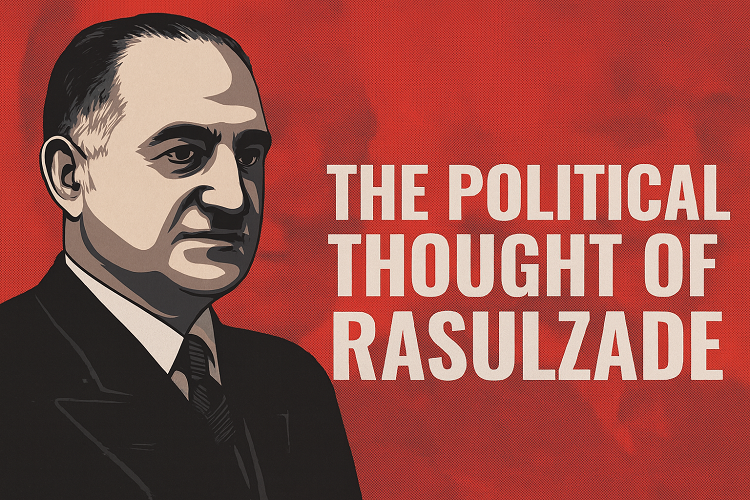
The Political Thought of Rasulzade occupies a prominent place among the intellectual currents of the Caucasus and the Turkic world—a prominence shaped by his uniquely combined political, revolutionary, and cultural experiences. From his youth, when he entered the tense political atmosphere of Russian-ruled Baku through journalism and party activity, his view of politics was never confined to the pursuit of power. On the contrary, it was an effort to redefine the collective identity of a people who, caught between imperial pressures and social crises, needed a common language, a stable political structure, and a clear horizon for the future. Therefore, The Political Thought of Rasulzade must be understood as both the product of lived experience and a coherent intellectual project that gradually took shape and matured through his struggles.
Moreover, he lived in an era when the world around him was undergoing rapid and dramatic changes: the Russian Revolution of 1905, the spread of socialist ideas, the rise of new nationalist movements in the Ottoman Empire, and later the Bolshevik Revolution of 1917—all created an environment that any political intellectual had to confront. Rasulzade, amid these developments—from participation in social-democratic circles to limited collaboration with Pan-Islamist groups—gradually carved out an individual and intellectual path that made him one of the most significant theorists of state-building in Azerbaijan. Thus, the study of The Political Thought of Rasulzade is not merely the study of a political figure, but an examination of the historical transformation of an entire region.
His experience in founding the Azerbaijan Democratic Republic in 1918 demonstrated further that his thought was not merely theoretical. He succeeded in translating a synthesis of modern nationalism, the demand for political liberties, the necessity of a secular state, and the importance of cultural bonds into an actionable political program. Although the republic had a short life, its legacy—much of which stemmed from The Political Thought of Rasulzade—remained in the political memory of Azerbaijan and the broader Turkic world. This has made research on him significant not only historically, but also for understanding state-building, nation-building, and political practice in post-imperial societies.
Beyond this, Rasulzade’s thought continually took shape through dialogue and contestation: dialogue with the West on modernity, with the East on tradition and religion, and with neighboring peoples on identity and independence. For this reason, many contemporary analysts argue that parts of his theories remain applicable today—for instance, the relationship between a secular state and a religious society, the role of language identity in nation-building, or the importance of elected institutions in consolidating statehood. Thus, engaging with his ideas is not merely an exercise in historical scholarship; it is a re-examination of an experience that still offers inspiration.
Ultimately, revisiting The Political Thought of Rasulzade has significance beyond Azerbaijan and the Caucasus. He was part of a broader movement seeking to guide the Turkic and Muslim world—trapped in political backwardness and imperial domination—toward modern models. Understanding him therefore contributes to understanding the intellectual transformations of the Islamic world in the twentieth century. Accordingly, this article aims to present a comprehensive analysis of his political thought, its historical context, and the legacy he left behind.
-
Intellectual Life and Historical Context
To grasp The Political Thought of Rasulzade precisely, one must begin with the historical and intellectual environment that shaped his personality. His ideas emerged not in a vacuum but in one of the most tumultuous periods of political transformation in the Caucasus and the Russian Empire. This context explains many of his choices, concerns, and even key terms, and reveals why his intellectual project followed such a distinctive trajectory.
1-1. Baku and Its Socio-Political Environment
Baku, in the late nineteenth and early twentieth centuries, was an industrial, multilingual, multiethnic city saturated with class tensions. The rapid modernization brought by the oil boom, high economic growth rates, the arrival of foreign investors, and the rise of labor movements made the city one of the main centers of political activism in the Russian Empire. Young people—including Rasulzade—encountered newspapers, political parties, pamphlets, and clandestine meetings in this atmosphere. Thus, the first layers of The Political Thought of Rasulzade were formed here, in a milieu where Social Democrats, Socialist Revolutionaries, Pan-Islamists, Iranian constitutionalists, and Caucasian nationalists operated side by side.
Muslim workers suffered from severe social problems, while young intellectuals sought a path out of cultural backwardness and political repression. In this environment, Rasulzade confronted not only the question of “identity,” but also those of “power,” “freedom,” and “modernity”—themes that later became central in The Political Thought of Rasulzade.
1-2. Early Encounter with Leftist Movements
A key factor in shaping Rasulzade’s political outlook was his close contact with leftist movements. As a teenager, he participated in Social-Democratic circles, worked with revolutionary publications, and gained practical familiarity with concepts such as social justice, party organization, and struggle against autocracy. Although he later distanced himself from social democracy, he retained many of its analytical tools throughout his life.
This early exposure meant that his understanding of “nation” was never merely emotional or cultural; Rasulzade also incorporated class, inequality, and power structures into his analyses. For this reason, his nationalism never resembled the romantic nationalism of Eastern Europe but was instead deeply intertwined with the social realities of the Caucasus.
1-3. The Impact of the 1905 Russian Revolution
The uprisings, strikes, formation of workers’ councils (Soviets), and the expansion of political participation in 1905 created unprecedented opportunities for Caucasian intellectuals. For the first time, a relatively free press allowed Rasulzade to write openly on political matters. It was during this period that he made a name for himself in journalism and entered serious debates about liberty, identity, and modernization.
In this sense, the 1905 revolution not only broadened his intellectual horizons but also convinced him that political change—even temporary—was possible. This belief later proved decisive in his efforts to establish the Azerbaijani republic.
1-4. Engagement with the Ottoman World and Its Importance
At one stage of his life, Rasulzade moved to Istanbul and lived amid the intellectual environment shaped by the Young Turk constitutional revolution. There he encountered the emerging nationalism of the Young Turks and the intense debates on secularism, centralization, linguistic identity, and administrative reform. This experience was crucial: in the Ottoman Empire, unlike in the Caucasus, “nation-building” had become an official priority.
He drew two essential lessons from the Ottoman experience:
- Nation-building is impossible without institutional development and administrative reform;
• Language, education, and the press constitute the foundations of national identity.
These principles later became central pillars of The Political Thought of Rasulzade.
1-5. The Years of Struggle Against Bolshevism
As the Bolsheviks rose to power, Rasulzade witnessed the disappearance of the limited freedoms that had existed before 1917 and the emergence of a monopolistic single-party structure. This experience gradually turned him into a staunch defender of freedom of expression, political pluralism, and a non-ideological state. His opposition to Bolshevism was not simply opposition to a party; it was a rejection of a model of governance in which society became an instrument of party power.
Thus, his confrontation with the Bolsheviks became a significant stage in the evolution of The Political Thought of Rasulzade, pushing him more firmly toward republicanism, free elections, and civil rights.
1-6. The Formation of His Intellectual Project on the Eve of 1918
All these experiences—journalistic activity, involvement in leftist circles, witnessing the 1905 revolution, exposure to the Ottoman reforms, and confrontation with Bolshevism—converged around one “focal point”: the necessity of establishing a national, modern state based on popular participation. His life path therefore, served as the foundation for the development of a political theory that later materialized in the Azerbaijan Democratic Republic.
-
The Fundamental Principles of The Political Thought of Rasulzade
The Political Thought of Rasulzade was built upon a set of principles that deepened throughout his intellectual life. These principles were not merely abstract beliefs; each was tested in various political circumstances and formed part of his effort to build a modern society and a stable national state. To clarify this intellectual system, we examine the fundamental principles of his political thought under four major themes:
2-1. National Identity and the Role of Language (The Core of Nation-Building)
At the center of The Political Thought of Rasulzade lies the question of “nation,” and more importantly, “how a nation is made.” He believed that a nation is not a natural or eternal phenomenon; rather, it is the outcome of historical, cultural, and social processes. Thus, he emphasized three key elements in nation-building: language, education, and historical memory.
Language as the Backbone of Identity
Unlike many Caucasian intellectuals who wrote in Russian or Persian, Rasulzade consciously used Azerbaijani Turkish. In his view, without a shared language, neither modern media nor modern education could take shape, and political participation would also be impossible. Therefore, language was not simply a cultural matter—it was a political tool for shaping the common horizon of the people.
Education and Public Literacy
He believed that Azerbaijani society could only establish a modern state through universal, secular, and widespread education. For this reason, his support for modern schools and local newspapers was part of his nation-building project.
Historical Memory as a Tool of Continuity
Rasulzade sought to reinterpret the past of Turks and Azeris in order to construct a future-oriented identity. His approach to history was neither traditionalist nor romantic; it was a means to build a future that would secure independence and political dignity.
2-2. State-Building and Republicanism (A Practical Blueprint for the Future)
One of the most important elements of The Political Thought of Rasulzade was his deep belief in republicanism and modern institutions. He saw the state not as an instrument for imposing ideology but as an institution for distributing power and guaranteeing citizens’ rights.
The Necessity of a National State
In contrast to some Muslim intellectuals of the Caucasus who were inclined toward Pan-Islamism, Rasulzade argued that the Islamic ummah could not replace the national state. In the modern world, only the national state could organize education, taxation, security, legal institutions, and political participation.
Republicanism as the Preferred Form of Government
He considered hereditary or monarchical rule incompatible with the modern world. In his view:
- The state must be formed by the people’s vote;
• Power must be limited;
• Elected institutions must supervise the government.
These ideas later materialized in the establishment of the Azerbaijan Democratic Republic in 1918, proving that he was not only a theorist but also ready to implement his principles.
Institution-Building Over Leader-Building
Rasulzade believed that political independence could not survive without stable institutions and an efficient bureaucracy. Thus, in his political design, the following held foundational importance:
- The National Assembly,
• The elected government,
• An independent judiciary,
• And a modern educational system.
2-3. Civil Liberties and Citizen Rights (A Free Society for a Stable Future)
From Rasulzade’s perspective, building a “nation” and a “state” without political and social freedoms would be incomplete and unstable. This view distinguished him from certain nationalist movements and also from the Bolsheviks.
Freedom of the Press
He did not regard journalism merely as a tool of propaganda; he believed that the press was the main instrument of political participation and public awareness. For this reason, he consistently defended media freedom—even in the harshest political circumstances.
Freedom of Parties and Pluralism
Rasulzade saw society as a collection of diverse interests, preferences, and social classes. Therefore, he viewed the existence of different parties as the natural outcome of a dynamic and living society. This approach was in sharp contrast to Bolshevik ideology, which viewed the single party as the sole representative of both “class” and “nation.”
Moderate Secularism
Rasulzade was never anti-religious; however, he believed that the state must not become the instrument of a single religion or a specific interpretation. An ideological state, he argued, would eventually suppress freedom. Therefore, he advocated a form of moderate secularism in which:
- Religion plays a cultural and moral role in society,
• But law and governance rest upon modern principles.
2-4. Foreign Policy and Regional Outlook (Realism Combined with Cultural Ties)
Rasulzade’s political thought regarding foreign policy was neither emotional nor purely cultural, contrary to common assumptions. He adopted a realistic outlook—a combination of security considerations, geography, identity, and historical opportunity.
Balancing the Great Powers
The Caucasus during Rasulzade’s lifetime was caught between three major powers: Russia, the Ottoman Empire, and Iran. He believed that Azerbaijan’s survival depended on balancing these powers and then establishing active relations with Europe. Thus, his proposed foreign policy was not only regional but multilayered.
The Role of the Ottoman Empire
Although he referred to the shared cultural heritage of Turks, he did not consider political dependence on the Ottoman Empire a solution. He defined relations with the Ottomans as “strategic but limited.”
The Importance of Europe
Rasulzade believed that democratic institutions and efficient governments had been shaped mostly under European intellectual influences. Therefore, his orientation toward Europe was not imitation but an attempt to draw on successful experiences.
Defending the Independence of the Caucasus
He saw the independence of Azerbaijan within the broader independence of the Caucasus region. In his own words, “every nation that becomes independent paves the way for the freedom of others.”
-
Challenges, Confrontations, and Intellectual Struggles of Rasulzade
The Political Thought of Rasulzade did not emerge in a calm or linear environment; it was shaped through intense encounters, intellectual conflicts, and at times bitter experiences, each adding a new layer to his evolving worldview. To understand his thought deeply, one must recognize the ideological forces he confronted and how these challenges shaped the trajectory of his intellectual development.
This section of the article examines three main arenas of confrontation: clashes with radical leftist currents, disagreements with Pan-Islamists, and tensions with traditionalists and conservatives of the Caucasus region.
3–1. Confrontation with Bolshevism: Freedom or Party Dictatorship?
One of the most significant arenas of Rasulzade’s intellectual struggle was his confrontation with the Bolsheviks—an encounter that was not only political but also deeply theoretical.
- a) From Initial Sympathy to Intellectual Distancing
In his early years, Rasulzade collaborated with some leftist groups and even absorbed part of their justice-oriented discourse from the broader social-democratic environment. Yet, as the Bolsheviks rose to power and established a one-party system, he gradually realized that—contrary to their claims—they did not expand freedom but eradicated it.
- b) A Fundamental Dispute: Defining Freedom
In The Political Thought of Rasulzade, freedom is a foundational value—without it, nation-building is incomplete and state-building impossible. In Bolshevik ideology, however, freedom is defined within the party, and society must operate under a unified ideology. This contradiction led him to sharply criticize the dictatorship of the party in his writings and speeches.
- c) Political Consequences of the Conflict
This theoretical disagreement quickly spilled into the realm of action. After the establishment of the Azerbaijan Democratic Republic, the Bolsheviks countered with military force and propaganda, ultimately ending the young republic’s independence in 1920. This bitter experience is evident in Rasulzade’s later exile writings, where he strongly emphasizes the necessity of independent institutions, constitutionalism, and civil liberties.
3–2. Disagreement with Pan-Islamists: Ummah or Nation?
Another major challenge in The Political Thought of Rasulzade was his confrontation with certain Pan-Islamist groups—currents that emphasized a transnational Islamic identity and dismissed the nation-state as “Western” or “unnecessary.”
- a) The Nation-State Versus the Concept of Ummah
While Pan-Islamists stressed the unity of the Islamic ummah, Rasulzade believed that the Muslim society of the Caucasus needed a modern state in order to survive—one based on defined territory, common language, and stable institutions. He warned that without a nation-state, any community—regardless of its broader religious affiliation—remains vulnerable to great powers.
- b) Distinguishing Religious and National Identities
Rasulzade regarded religion as an important part of people’s culture, yet he argued that national identity holds an independent and essential place. For him, religious identity could guide moral and cultural life, but political organization must rely on national institutions. This distinction became one of the core principles of The Political Thought of Rasulzade.
- c) The Resulting Rift
As a result, some traditional Muslim groups in the Caucasus viewed his ideas as overly “modern” or “Western-oriented.” Yet, over time, it became clear that his nation-building vision—based on language and education—formed the foundations of modern Azerbaijan.
3–3. Confrontation with Internal Traditionalists: The Gap Between Modernity and a Traditional Society
Alongside Bolsheviks and Pan-Islamists, Rasulzade faced another domain of challenge: the resistance of Caucasian traditionalists. This conflict was not only theoretical but deeply social and cultural.
a) The Problem of Tradition in the Multilayered Caucasus
The early-20th-century Caucasus was a multilayered society: cities like Baku had become modern and industrial, while rural areas remained embedded in traditional structures. Thus, Rasulzade’s modernization project met resistance—especially concerning girls’ education, modern language reforms, journalism, and political participation.
b) Modernity as a Necessity, Not Imitation
Rasulzade believed modernity was not a choice but an unavoidable necessity for survival. Yet he rejected “imitative” modernization. Instead, he consistently emphasized that modernization must align with local culture and social needs.
c) His Method for Overcoming Traditionalist Resistance
He relied on three tools to overcome social resistance:
• education,
• media,
• and intellectual dialogue.
For this reason, much of his effort went into cultivating a new generation of readers and writers—a generation capable of carrying forward the path of rationality and transformation.
3–4. Tensions Within the Nationalist Movement: Intra-Movement Disagreements in Caucasian Nationalism
The nationalist movement of the Caucasus was not monolithic. Within it emerged tensions that The Political Thought of Rasulzade inevitably had to navigate.
- a) Dispute Over Relations with the Ottoman Empire
While some Caucasian nationalists believed that the region should follow the Ottoman path entirely, Rasulzade advocated cooperation only under certain conditions. He feared that excessive dependence could endanger Caucasian independence.
- b) Disagreement Over the Pace of Reforms
Some believed reforms should be rapid and sweeping. Rasulzade, drawing on his understanding of social realities, argued for gradual yet sustainable reforms.
- c) Differences in Priorities
For some intellectuals, modernity was more important than independence. But for Rasulzade, political independence was the foremost priority, for without sovereignty, no lasting reform was possible.
All these confrontations—from Bolsheviks to Pan-Islamists, traditionalists, and even certain nationalists—transformed The Political Thought of Rasulzade into a complex, multidimensional system rather than a simple ideological framework. Each challenge clarified a part of his intellectual project and led him down a path that later played a crucial role in the history of Azerbaijan.
-
Rasulzade and His Relationship with Democracy, Nationalism, and Modernity
To analyze The Political Thought of Rasulzade, one must consider three key concepts that form the pillars of his intellectual system: democracy, nationalism, and modernity. Although these domains can be examined separately, within Rasulzade’s framework they are intertwined and organic. He was neither an extreme nationalist nor a purely liberal thinker; rather, he sought to forge a stable synthesis between the needs of a transitioning Muslim society and the values of the modern world. This hybrid approach is precisely why his ideas continue to attract contemporary scholarship.
4.1. Democracy in Rasulzade’s Thought: Transition from Community to Nation
Rasulzade viewed democracy as essential for transitioning from traditional structures to a modern society. He believed that nation-building without democratic institutions was neither sustainable nor legitimate. Thus, in both his writings and political activities, he consistently emphasized the necessity of a parliament, free elections, press freedom, and pluralism.
In other words, he did not regard democracy as a Western luxury; he saw it as a condition for the survival of an emerging nation. For him, only responsive institutions could hold together a society with diverse ethnic and religious groups. Consequently, The Political Thought of Rasulzade approached democracy not merely as a slogan but as a practical structure and historical necessity.
4.2. Civic Nationalism: From Identity Formation to State-Building
Although Rasulzade was among the founders of Turkic-oriented nationalism in the Caucasus, his interpretation of nationalism clearly contained “civic” elements. He believed that national identity should rest on shared political and cultural values, not solely on ethnic lineage. Therefore, the concept of “nation” in his thought was shaped more by language, culture, and political affiliation than by blood or race.
This civic perspective allowed him to envision the young Republic of Azerbaijan as a multiethnic state. He sought to show that the coexistence of Islamic culture, Turkic language, and European modernity was not only possible but necessary. Thus, his nation-building project rested on the fusion of cultural unity and political participation.
4.3. Engagement with Modernity: Institution-Building, Not Slogan-Making
Rasulzade did not understand modernity as mere imitation of the West. He saw it as a project that must be translated from the level of “ideas” to that of “institutions.” Hence, he consistently distinguished between “superficial reforms” and “lasting institution-building.”
More specifically, he believed that three domains must be reformed simultaneously:
- Political structure (parliament, constitutional rights, a responsible government)
- Social structure (public education, women’s rights, reform of traditional institutions)
- Cultural structure (modern journalism, political literature, a standardized language)
Thus, his relationship with modernity was “critical”—neither blind admiration nor dogmatic rejection. He saw modernity as an opportunity to transform the imperial, authoritarian atmosphere of the Caucasus into a society capable of resisting Russian and Ottoman domination.
4.4. Conclusion: A Thought System Based on Balance
Ultimately, the Political Thought of Rasulzade can be described as a “balanced” system grounded in harmony among three key pillars:
- national identity as the engine of historical progress
• democracy as the mechanism of legitimacy
• modernity as the strategy for development
This tripartite synthesis distinguished his thought among Muslim intellectuals of the Caucasus and enabled the first independent Azerbaijani republic to present a more modern political model than many of its neighbors.
-
Rasulzade, Political Islam, and His Relationship with Religious Identity
Any examination of The Political Thought of Rasulzade is incomplete without analyzing his relationship to religion—especially Islam. Rasulzade lived and worked in a society where religious identity was not only a cultural matter but also a determining political factor. Unlike some secularist intellectuals of his time, his approach to religion was not eliminative; rather, it aimed to reinterpret the role of religion in a society undergoing transition and to place it in a position compatible with civic nationalism and modernity.
Therefore, his approach to religion was not confrontational but “managed”—an effort to intellectually mediate between the traditional faith of the people and the requirements of a modern state.
5.1. Distancing Himself from Political Islam and Avoiding the Ideologization of Religion
Despite his respect for Islamic heritage, Rasulzade opposed turning religion into a political ideology. He understood clearly that the politicization of religion transforms it into a tool of conflict and monopoly, potentially deepening social divisions. For this reason, he explicitly emphasized in his writings and party activities that a modern state could be inspired by religious values but must not base itself on Sharia or clerical rule.
In his view, religion was more a “soft cultural force” than a “political program.” Thus, he distanced himself from the type of political Islam seen in parts of the Middle East. This distance allowed the republic he envisioned to protect the region’s ethnic and religious diversity.
5.2. Religion as Social Capital for Nation-Building
Although Rasulzade rejected religious ideology, he did not ignore religion as a form of social capital. In a context where ordinary people identified primarily as Muslims, a wise statesman had to create balance between religious and national identity. Therefore, Rasulzade sought to show that Turkic nationalism and Islamic identity were not inherently contradictory; in some areas, they could even complement each other.
He believed nation-building did not proceed solely through politics; it also had to pass through the cultural and emotional layers of society. Islam—through its mosques, religious schools, clerical networks, and shared traditions—offered a framework that could strengthen social cohesion. Thus, religion for him was not an instrument of political control but a “connector” among different segments of society.
5.3. Critique of Traditional Structures and the Call for Religious Reform
One of the important aspects of The Political Thought of Rasulzade is his approach to religious reform. He believed that part of the inability of Muslim societies to enter the modern world stemmed from the stagnant and rigid structures of religious institutions. Therefore, without disrespecting public faith, he stressed the need to modernize religious education, adopt scientific and rational methods, and distance religious life from superstition and rigidity.
In his newspaper articles, he repeatedly emphasized the need for “religious enlightenment” and urged clerics to play a constructive role in social reform. This approach shows that he did not see religion as part of the problem but as part of the solution—provided it modernized itself and aligned with contemporary institutional frameworks.
5.4. Mild Secularism: A Neutral State Toward People’s Faith
As a theorist of the modern state, Rasulzade advocated a form of mild secularism: a state that neither fights religion nor uses it as a political tool. His model was distant from the strict European forms of secularism, and instead emphasized state neutrality, freedom of belief, and the right of citizens to choose their own faith.
This perspective suited the historical conditions of the Caucasus—a region where Muslims, Christians, and Jews lived side by side. A religious-ideological state would have been dangerous for such a diverse society. Therefore, he supported a “non-religious national state,” not an aggressively secular one.
5.5. Conclusion: The Place of Religion in the Future Political Order
Ultimately, Rasulzade did not seek to remove religion from society; rather, he aimed to shift it from the sphere of political conflict to the realms of “cultural identity” and “social cohesion.” As a result:
- Religion for him was a moral force, not a governmental one
• Religious institutions should be reformed, not abolished
• The state should remain neutral, not anti-religious
• Islamic identity could coexist with civic nationalism
This intermediary approach distinguishes his thought from many radical movements of his time—whether secular or Islamist.
-
Rasulzade and the Question of National Identity, Language, and Culture
The concept of “identity” occupies a central place in The Political Thought of Rasulzade; without understanding his views on language, culture, and nation, one cannot fully grasp his political project. He emerged in a period when the Islamic world was pressured by empires on one side and confronted with European nationalism on the other. In such a context, identity was not a theoretical debate but a vital question concerning the survival of society and the possibility of creating an independent state.
Thus, Rasulzade sought to provide a balanced model of identity-building that linked traditional cultural elements with the needs of a modern state.
6.1. Language: The Backbone of National Identity
For Rasulzade, language was not merely a means of communication but the “core of a nation.” He believed no nation could continue to exist without a common and standardized language. The Azerbaijani Turkic language, in his view, provided the historical, cultural, and even political foundation for uniting the people of the region.
His emphasis on language served several purposes:
- Creating national unity in a multiethnic and dispersed society
- Achieving cultural liberation from forced Russification and Persianization
- Strengthening an independent political identity for the future state
In his writings, he repeatedly highlighted the necessity of public education in Turkic and the production of newspapers and political literature in the same language. He even considered the modernization of language an essential part of the broader project of modernity, supporting efforts to simplify and standardize it.
6.2. Modern Culture: A Bridge Between Past and Future
Unlike some intellectuals of his era who dismissed traditional cultural heritage, Rasulzade did not advocate severing ties with the past. At the same time, he did not want traditional culture to hinder societal transformation. Therefore, he adopted a middle path: culture must be updated without losing its authenticity.
In this framework, he saw two types of cultural reform as essential:
- Internal reform of culture: removing superstition, promoting rationality, expanding public education
• External reform of culture: engaging with global modern achievements and selecting from them consciously
In other words, Rasulzade was neither anti-Western nor blindly Westernized. His attitude was selective: “Take what is constructive; leave what is imposed.”
6.3. The Nation as a Cultural-Political Project
Rasulzade believed that a nation was not a natural or eternal entity but a “historical project”—one that develops through two main pathways:
- Cultural continuity (language, historical memory, traditions, literature)
- Political solidarity (citizenship rights, participation, state structures)
Thus, he viewed nationalism not merely as a political ideology but as a foundation for reconstructing society. According to him, nation-building went beyond state formation; it required creating a shared sense of belonging among people who had lived for centuries under various empires.
Despite emphasizing Turkic identity, Rasulzade sought to define the nation in a way that could include non-Turkic ethnic groups as well, believing that a modern Caucasian state would be sustainable only if it respected cultural diversity.
6.4. The Tie Between Identity and Political Independence
A key point in The Political Thought of Rasulzade is that national identity for him was not merely a cultural concept but a prerequisite for political independence. In his view:
- Without a clear sense of identity
• And without a shared language and culture
• The demand for independence or modern statehood would lack meaning and social force
Accordingly, before thinking about state-building, he focused on “nation-building”—a process that, for him, passed primarily through language and culture.
6.5. Conclusion: Identity as a Tool for Resistance and Development
In conclusion, Rasulzade’s view of national identity was multilayered and pragmatic. For him:
- Language was the binding force of the people
• Culture was a bridge from tradition to modernity
• Nationhood was a construct to be built through institutions
• Identity was the foundation of political independence and development
This multidimensional approach distinguished his intellectual project from that of many of his contemporaries and made identity-building one of the most outstanding aspects of The Political Thought of Rasulzade.
-
Critiques of The Political Thought of Rasulzade
Despite the historical significance and influence of The Political Thought of Rasulzade in shaping the Democratic Republic of Azerbaijan, a closer examination shows that some foundational elements of his theory can be critiqued from the perspective of democracy, pluralism, and the modern nation-state theory. These critiques do not negate his achievements; rather, they are offered to analyze the theoretical and practical limitations of his ideas.
7.1. Fundamental Critique of Language-Centered Identity and Its Anti-Pluralist Implications
One of the main points of critique is Rasulzade’s definition of the nation as a “community of common language.” In his view, the Azerbaijani Turkish language was the backbone of national identity and the foundation of nation-building. While this approach may have seemed necessary at the time for political and cultural cohesion, it presents serious limitations from the viewpoint of democratic and pluralistic principles:
- Conflict with multiculturalism and equal citizenship: Any definition of the nation based on a natural attribute such as language, religion, or ethnicity potentially leads to homogenization or ethnic supremacy and places linguistic or cultural minorities in a position of “otherness.”
- Transnational and regional consequences: Rasulzade’s language-centered approach eventually influenced certain Pan-Turkic movements, especially in Iran. Some anti-nationalist Turkish groups in Iran later found their ideological foundations in this linguistic definition of identity, even if the original legitimacy and purpose differed.
- Theoretical limitations: Defining the nation through language may provide short-term cohesion, but it weakens the possibility of a stable, democratic, and multicultural state because it removes the element of individual choice in national belonging.
Analytically: whenever the nation is defined through a cultural or identity-based marker, politics tends toward ethnic or cultural domination, and the democratic capacity of society becomes restricted.
7.2. Critique from the Perspective of Modern Nation-State Theory
In modern nation-state theory, the nation is not a natural or inherent phenomenon but rather the product of a social contract. Thinkers such as Hobbes, Rousseau, and Benedict Anderson argued that legitimacy of the state and national belonging should emerge from contract, participation, and civil rights—independent of linguistic, religious, or ethnic characteristics.
Within this framework:
- The nation is constitutive, created through institutions and social contract.
- All citizens, regardless of language, religion, or ethnicity, are equal members of the nation.
- Legitimacy and cohesion are based on the social contract, the constitution, and civil rights.
In comparison, it can be said that Rasulzade’s thought is suspended between the cultural-nation model and the civic-nation model:
- He places cultural identity at the center of nation-building while simultaneously advocating democratic and republican principles.
- This theoretical paradox created limitations for fully realizing democracy and pluralism in the newly-formed Azerbaijani republic.
In simple terms: if the nation is constructed only on the basis of language, the social contract—source of equal citizenship and legitimacy—is weakened.
7.3. Practical and Historical Consequences
This identity-and-language-centered view had not only theoretical limitations but also practical consequences:
- Within the Republic of Azerbaijan: It produced short-term national cohesion but limited the capacity to integrate linguistic and ethnic minorities.
- Regionally: The idea of a nation built on the Turkish language inspired segments of Pan-Turkic movements in Iran and the Caucasus, at times legitimizing anti-national or ethnically supremacist tendencies.
- In relation to modernity and citizenship rights: The emphasis on identity meant that certain democratic principles, such as equal participation and cultural rights of minorities, were constrained in practice.
Thus, the core critique is that Rasulzade’s cultural-nation theory—while historically understandable and locally contextualized—shows weaknesses when assessed against democratic and pluralistic standards.
7.4. Summary of Theoretical Critique
- Language- and culture-centered nationhood: It creates cohesion in the short term but threatens pluralism and minority rights.
- Cultural nation vs. contractual nation: Political independence and legitimacy must be supported by a social contract and equal participation.
- Regional implications: The language-centered approach can have cross-border effects and fuel pan-national or Pan-Turkic movements.
This analytical foundation prepares the ground for comparing Rasulzade with other contemporary thinkers and also provides a critical lens for examining the practical experience of the Democratic Republic of Azerbaijan.
-
Comparing Rasulzade’s Thought with His Contemporaries
The Political Thought of Rasulzade, alongside his efforts in nation-building and institution-building, formed part of the broader intellectual movement of early twentieth-century Muslim reformers and nationalists. Comparing him with contemporary thinkers highlights both the strengths and weaknesses of his theory and clarifies how he positioned himself among three major political currents—Islamism, nationalism, and communism.
8.1. Comparison with Reformist Islamists
Some Muslim intellectuals of the period—especially in the Ottoman Empire and Iran—sought a balance between religion and modernity. Among them:
- Jamal al-Din al-Afghani: Emphasized unity of the Islamic ummah and viewed ethnic or linguistic nationalism as limiting. Unlike Rasulzade, he did not consider the independent nation-state as central; instead, he focused on unity of the Muslim world.
- Muhammad Abduh: A religious reformer who advocated a rational reinterpretation of Islam for modernity. For him, religion could be a tool for social change, but the legitimacy of the state needed to align with Islamic principles.
- Namık Kemal: In the Ottoman Empire, he combined Turkish nationalism with state modernization. He and Rasulzade shared a strong emphasis on language and cultural nationhood, but Rasulzade highlighted mild secularism more clearly than the religious reformists.
Result of comparison:
Rasulzade adopted a relatively secular approach, viewing religion primarily as a source of cultural unity, whereas Islamic reformers emphasized the ummah and religious legitimacy of governance.
8.2. Comparison with Regional Nationalist Intellectuals
- Yusuf Akçura: A major theorist of Pan-Turkism who defined nationalism almost exclusively through language and ethnicity, with little attention to democratic elements.
- Ziya Gökalp: Combined nationalism and modernity, with emphasis on social reform and education. He shared many similarities with Rasulzade, but Rasulzade pursued the practical project of establishing an independent republic.
- Ali bey Hüseynzade: Emphasized cultural nationhood and language as the basis of identity but had fewer concrete proposals for state-building and institutions.
Result of comparison:
Rasulzade represented a synthesis of cultural nationalism and the practical project of building a modern state, whereas some contemporaries focused only on theoretical aspects of nationhood or linguistic identity.
8.3. Comparison with Socialist and Communist Thinkers
- Nariman Narimanov: A Muslim communist who prioritized class issues and social justice and viewed national identity as subordinate to class identity.
- Lenin and Stalin: Theorists of the national question who grounded the right to self-determination in class politics and the political structure of the Soviet Union.
- Difference from Rasulzade: He defined the nation based on language and culture rather than class. Unlike the communists, he valued genuine national independence and an autonomous state.
Result of comparison:
Rasulzade occupied a distinct position among communist movements, linking national independence and limited democracy to cultural identity rather than class struggle or party dictatorship.
8.4. Comparative Summary
Based on the comparisons above:
- Rasulzade was a moderate and synthesizing thinker:
- Between Islamism and secularism
- Between cultural nationalism and democratic legitimacy
- Between ethnic-linguistic identity and the needs of modern state institutions
- Compared with his contemporaries:
- He was more independent and secular than Islamic reformers
- More pragmatic and state-focused than purely linguistic Pan-Turkists
- More committed to national independence than communists
- His weakness remained the emphasis on cultural nationhood and linguistic identity, which could conflict with pluralism and the logic of the social contract.
This section prepares us to examine the practical experience of the Democratic Republic of Azerbaijan and explore how this theoretical synthesis was implemented in real politics and what challenges it encountered.
-
The Experience of the Azerbaijan Democratic Republic (1918–1920) and the Practical Test of The Political Thought of Rasulzade
The experience of the Azerbaijan Democratic Republic—the first modern independent state in the Caucasus—was the arena in which Rasulzade’s theoretical ideas, such as cultural nation-building, limited democracy, and mild secularism, were implemented in practice. This short period, despite all its difficulties and time constraints, created an opportunity to reveal both the impact and the limitations of his theory in the political sphere.
9.1. Founding and Early Challenges
With the collapse of the Russian Empire, Azerbaijanis found an opportunity to establish an independent state. Rasulzade, as the leading intellectual and symbol of nationalism, played a central role in the founding of the republic. His main goals included:
- Creating a unified nation based on the Azerbaijani Turkic language and culture
- Establishing democratic institutions and a constitution
- Limited secularization and protection of religious freedoms
However, time constraints, external pressures, and ethnic divisions prevented the full realization of these plans.
9.2. Cultural Nation-Building in Practice
Rasulzade’s ideas on cultural nation-building were implemented in tangible ways:
- Education and the press in the Turkic language were promoted.
- Azerbaijani Turkic identity was consolidated as the official cultural and political core.
- Efforts were made to integrate other ethnic minorities, but theoretical limitations and language-centered policies led some groups to feel marginalized.
This experience showed that although focusing on language and culture creates short-term cohesion, it limits genuine pluralism.
9.3. Democracy and Secularism in the Republic
Regarding democratic and secular elements of the republic:
- A national parliament was established, and relatively free proportional elections were held.
- There was relative freedom of the press, and various political parties were allowed to operate.
- Mild secularism was practiced: the state was separate from religion, while religion continued to be recognized as a cultural and social factor.
Nevertheless, operational limitations and external threats prevented full democratic development.
9.4. External Pressures and the Fall of the Republic
The main challenge facing the republic was the threat posed by neighboring empires and the Bolsheviks. Soviet Russia:
- Overthrew the republic in 1920 through military invasion.
- Internal constraints and weak military and economic capacity prevented independent defense.
Due to these external factors, parts of Rasulzade’s ideas—such as full democratic legitimacy and multiethnic cohesion—could not be implemented.
9.5. Historical Lessons and Intellectual Outcomes
The short-lived republic showed that:
- The idea of a cultural nation has limitations in practice: it fostered short-term cohesion, but a multiethnic society required a social contract and equal rights.
- Democracy remained limited: institutions were created, but internal and external pressures prevented their full realization.
- Secularism was implemented flexibly: religion functioned as a social tool rather than an ideological force.
- Rasulzade’s thought inspired later generations, both in the Republic of Azerbaijan and in Pan-Turkist movements in Iran and the Caucasus.
9.6. Summary of the Practical Experience
The experience of the Azerbaijan Democratic Republic can be considered the real-world test of The Political Thought of Rasulzade. It demonstrated:
- Strengths of his theory: efforts toward nation-building, institutional formation, and moderate secularism
- Limitations: language-centered policies, cultural essentialism, and challenges to pluralism
- Practical outcome: a short-lived and fragile republic, yet a modern model in the region
-
The Legacy and Contemporary Significance of The Political Thought of Rasulzade
The Political Thought of Rasulzade has influenced not only the history of the Azerbaijan Democratic Republic but also the political and intellectual developments of the Caucasus and parts of Iran. His legacy combines cultural nation-building, mild secularism, and limited democracy—an inheritance that carries both significant achievements and theoretical as well as practical limitations.
10.1. Impact on Politics and Nation-Building in Azerbaijan
- Rasulzade’s cultural and language-centered nation-building project shaped Azerbaijan’s modern national identity.
- His efforts in institutional building and creating democratic structures served as a model for post-Soviet states.
- Despite the fall of the early republic, the idea of independence and a modern state remained alive in the historical memory of the Azerbaijani people.
10.2. Intellectual Influence in the Region and Iran
- His language-centered and cultural-nation perspective inspired parts of the Pan-Turkist movements in Iran, especially after the 1920s.
- Although these movements aimed to defend the rights and identity of Turkic populations, they sometimes adopted anti-national or exclusionary attitudes toward other minorities.
- Conversely, critiques based on the social-contract model and the concept of the civic nation show that his approach could have been more effective and democratic had it given stronger weight to citizenship rights and cultural pluralism.
10.3. Theoretical Legacy: Mild Secularism and Limited Democracy
- Rasulzade’s model of moderate secularism and limited democracy influenced regional states seeking a balance between religion and modernity.
- The practical experience of the Azerbaijan Democratic Republic highlighted the importance of political flexibility and attention to multiethnic and multilingual realities.
- It also demonstrated that combining cultural identity with democracy requires precise theoretical and practical considerations to maintain cohesion without suppressing minorities.
10.4. Historical and Contemporary Standing
- Rasulzade holds a unique place among Muslim and nationalist intellectuals of the region, as he succeeded in creating a relative balance between cultural identity, secularism, and practical nation-building.
- He served as a model for later leaders and intellectuals seeking to reconcile national independence and modernity with tradition and religion.
- However, critiques of his language-centered approach and limited pluralism remain an essential part of his historical evaluation.
10.5. Final Summary
In general, The Political Thought of Rasulzade:
- Shaped the foundations of Azerbaijan’s modern national identity
- Introduced secularism and limited democracy into political practice
- Inspired Pan-Turkist and nationalist movements in the region
- Faced theoretical critiques regarding cultural nationalism and pluralism
Overall, his legacy is a combination of historical achievements and theoretical limitations, and understanding it is essential for studying politics, nation-building, and identity in the Caucasus and the broader region.

