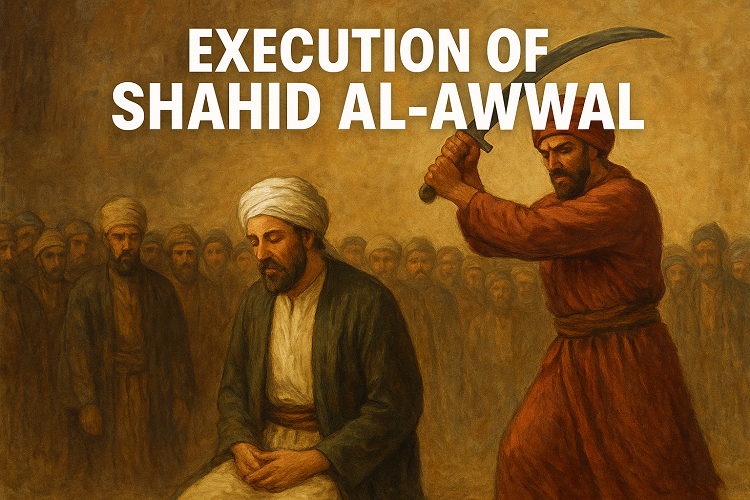
The political thought of Shahid al-Awwal represents one of the most significant milestones in the history of Islamic political theory, especially within the Shi‘i intellectual tradition. Living in the eighth century AH (14th century CE), Shahid al-Awwal combined jurisprudence, theology, and rational analysis to articulate a theory of governance, legitimacy, the role of jurists, and the connection between religion and politics. His approach not only influenced later scholars such as Shahid al-Thani, al-Muhaqqiq al-Karki, and Safavid-era jurists but also laid the groundwork for the development of Shi‘i theories of governance in the modern era.
In this article, we will first introduce his biography and historical context; then, analyze his political principles, the role of jurisprudence in politics, his conception of legitimate authority, and the relation between religion and the state. Finally, we will assess the impact of the political thought of Shahid al-Awwal on subsequent generations of Shi‘i scholars.
Biography and Intellectual Context of Shahid al-Awwal
To understand the political thought of Shahid al-Awwal, one must begin with his life and historical background. Shams al-Din Muhammad ibn Maki al-‘Amili al-Jizzini (734–786 AH / 1334–1385 CE) was born in Jabal ‘Amil, a region in southern Lebanon renowned for producing prominent Shi‘i scholars. At a young age, he traveled to Hilla, Damascus, and Baghdad to study jurisprudence, theology, and philosophy.
From the outset, Shahid al-Awwal was recognized as a distinguished jurist who engaged in scholarly exchange with both Shi‘i and Sunni scholars. Moreover, the turbulent political environment of the 14th century—marked by persecution of Shi‘is under Sunni rule, the lingering influence of Mongol invasions, and regional rivalries—sharpened his awareness of political issues.
His most famous work, al-Lum‘a al-Dimashqiyya, is not only a cornerstone of Shi‘i jurisprudence but also contains implicit insights into his political thought. The later commentary by Shahid al-Thani transformed it into a fundamental textbook in Shi‘i seminaries.
The Foundations of the Political Thought of Shahid al-Awwal
1. The inseparability of Sharia and politics
At the heart of the political thought of Shahid al-Awwal lies the conviction that Sharia and politics are inseparable. He argued that the implementation of divine law requires a political framework; conversely, politics without Sharia lacks legitimacy. Therefore, governance must serve as the mechanism for the application of divine justice.
2. Legitimacy of government
Like most Shi‘i jurists, Shahid al-Awwal considered ultimate legitimacy to rest with the infallible Imams (Ahl al-Bayt). Yet, recognizing the reality of the occultation (ghayba) of the Twelfth Imam, he held that qualified jurists (fuqaha’ with comprehensive knowledge and moral integrity) possess delegated authority to perform certain governmental functions. This position provided the intellectual foundation for later theories of wilayat al-faqih (the guardianship of the jurist).
3. Justice as the axis of politics
In addition, Shahid al-Awwal placed justice at the very core of political legitimacy. For him, justice was not merely an ethical virtue but the defining criterion of a legitimate government. Thus, even a ruler who claims Islamic authority would lose legitimacy if his governance were to violate justice.
The Role of the Jurist in the Political Thought of Shahid al-Awwal
Jurists occupy a central place in his theory of governance during the period of occultation. According to the political thought of Shahid al-Awwal, the jurist is entrusted with key responsibilities:
- Acting as a judge and arbitrator among people;
- Implementing Islamic legal punishments (hudud) when feasible;
- Supervising the proper application of Sharia in society;
- Guiding the community in political and social matters.
Consequently, his conception amounted to a doctrine of general deputation of jurists (al-niyaba al-‘amma), which later evolved into a cornerstone of Shi‘i political jurisprudence.
Religion and State in the Political Thought of Shahid al-Awwal
On the other hand, Shahid al-Awwal rejected any sharp separation between religion and state. He regarded religion as the guiding principle of politics, while the state was merely an instrument for enforcing divine law. Hence, governments that divorced themselves from religion automatically forfeited legitimacy.
Nevertheless, he was also a realist. Recognizing that in the era of occultation not all governments would be fully religious, he admitted the necessity of a policy of precaution (taqiyya) and pragmatic accommodation in certain situations to ensure the survival of the Shi‘i community.
Imamate and Governance in His Political Thought
Imamate occupies a pivotal place in Shi‘i political theory, and the political thought of Shahid al-Awwal reflects this centrality. He maintained that legitimate authority belongs exclusively to the infallible Imams. However, to address the practical needs of the Shi‘i community in the absence of the Imam, he introduced a twofold conception:
- Specific Imamate (al-imama al-khassa): authority restricted to the infallible Imams.
- General Imamate (al-imama al-‘amma): provisional authority exercised by qualified jurists during the occultation.
This conceptual division demonstrates his political pragmatism, as he sought to preserve the Shi‘i doctrine of Imamate while also providing a realistic framework for governance in his time.
Comparison with Other Jurists
To appreciate the uniqueness of the political thought of Shahid al-Awwal, it is helpful to compare his ideas with those of other scholars:
- Al-Muhaqqiq al-Hilli: emphasized the jurisprudential foundation of juristic authority but focused less on practical politics, whereas Shahid al-Awwal highlighted both.
- Shahid al-Thani: expanded upon and systematized Shahid al-Awwal’s ideas, transmitting them to later generations.
- Safavid scholars: drew heavily on his legacy to provide religious legitimacy for the Safavid state.
The Place of Shahid al-Awwal in the History of Islamic Political Thought
Therefore, it may be said that the political thought of Shahid al-Awwal formed a bridge between classical Shi‘i theories of Imamate and later elaborations of juristic authority under the Safavids and beyond. He was among the first to articulate a coherent vision of the jurist’s role in political life and the inseparability of religion and politics.
Impact on Safavid Political Theory
One of the most notable consequences of Shahid al-Awwal’s political thought was its influence on Safavid-era jurisprudence. The Safavids, seeking religious legitimacy for their state, relied on the theoretical foundations developed by Shahid al-Awwal and his successors. Consequently, the model of a jurist-state partnership became institutionalized in early modern Iran.
Critique and Challenges
Despite its importance, the political thought of Shahid al-Awwal is not without limitations:
- He did not fully delineate the boundaries of power between the jurist and the temporal ruler.
- His theory remained largely jurisprudential and less concerned with institutional political structures.
- A certain tension persisted between his idealism (rule of the infallible Imam) and pragmatism (juristic authority in occultation).
Yet, these challenges should be viewed as the natural outcome of pioneering efforts. Far from diminishing his contribution, they highlight his role as a forerunner in the development of Shi‘i political thought.
Conclusion
The political thought of Shahid al-Awwal constitutes a crucial turning point in the history of Shi‘i political theory. By grounding his vision in jurisprudence and reason, he proposed a system that remained faithful to the doctrine of Imamate while offering practical solutions for governance during the Imam’s occultation.
Therefore, Shahid al-Awwal can rightly be considered both a founder of the doctrine of juristic authority and a key figure in linking Shi‘i tradition with evolving political realities. His works continue to be taught in seminaries, and his ideas retain profound influence on contemporary Islamic political thought.