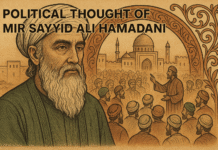
The political thought of Sayyid Haydar Amuli represents a unique synthesis of Islamic mysticism, Shi‘ite theology, and political philosophy. Living in the turbulent 14th century, Amuli developed a comprehensive vision of political authority rooted in divine guidance, metaphysical wisdom, and the esoteric dimensions of Islam. His thought reflects a deep critique of worldly power devoid of spiritual legitimacy, offering instead a model of governance grounded in wilayah (divine authority) and esoteric truth.
In this article, we explore the essential elements of the political thought of Sayyid Haydar Amuli, examining how he combined Sufism, Shi‘ite doctrine, and philosophical principles to construct a vision of just and sacred rule.
Biography and Intellectual Background of Sayyid Haydar Amuli
To properly understand the political thought of Sayyid Haydar Amuli, we must begin with his life and intellectual background. Born in Amul, a city in northern Iran, Amuli initially served in the court of the Ilkhanid rulers. However, he soon abandoned worldly affairs in favor of spiritual pursuits, turning toward the path of Sufism and metaphysical inquiry.
Amuli was profoundly influenced by Ibn Arabi, Suhrawardi, and other leading figures of Islamic mysticism. Nevertheless, he remained firmly committed to Shi‘ite theological doctrines, particularly the concept of Imamate. His major works—Jami‘ al-Asrar, Nass al-Nusus, Sharh Fusus al-Hikam, and al-Miftah fi Sharh al-Misbah—are testimonies to his attempt to harmonize the inner realities of mysticism with the outward structures of religious and political authority.
The Relationship Between Mysticism and Politics in Amuli’s Thought
One of the most distinctive aspects of the political thought of Sayyid Haydar Amuli is the intrinsic link he draws between mysticism and politics. Unlike thinkers who treat politics as a mundane realm and mysticism as a purely individual pursuit, Amuli insists that true politics must manifest divine will through the institution of wilayah.
From his perspective, society and government must be led by those who embody divine wisdom. When governance is separated from wilayah, it inevitably degenerates into tyranny and corruption. For Amuli, wilayah is not a symbolic or abstract idea; rather, it is the metaphysical foundation upon which legitimate political order must be built.
The Central Role of Wilayah in Sayyid Haydar Amuli’s Political Vision
At the core of the political thought of Sayyid Haydar Amuli lies the concept of wilayah (divine authority). He, drawing upon Ibn Arabi’s metaphysics, makes a sharp distinction between nubuwah (prophethood), risalah (messengership), and wilayah. Importantly, Amuli sees wilayah as superior and continuous, unlike prophethood which he sees as temporally bounded.
In Amuli’s view, the Imam is not merely a religious figure but a manifestation of divine authority in the world. Any political system that lacks connection to the Wali (the spiritual guide appointed by God) is ultimately illegitimate and lacks both wisdom and justice. Therefore, political legitimacy must flow directly from divine designation, not from popular consent or historical convention.
The Distinction Between Imamate and Caliphate
Another significant theme in the political thought of Sayyid Haydar Amuli is the distinction between Imamate and Caliphate. According to Amuli, the caliphate is only legitimate when it is a manifestation of the Imamate. In the absence of divine appointment and spiritual qualification, the caliphate becomes a worldly usurpation.
Consequently, Amuli implicitly criticizes the first three caliphs, viewing their authority as lacking wilayah. However, due to the political sensitivities of his time, he often employs symbolic and esoteric language to express these views. Nonetheless, the message is clear: true governance is possible only under the light of Imamate, which reflects divine will and esoteric truth.
Implicit Critique of Political Authorities of His Time
Sayyid Haydar Amuli lived in a post-Abbasid world dominated by regional dynasties and military rulers. While he does not engage in overt political polemic, his writings contain a clear critique of temporal rulers who govern without spiritual legitimacy.
In his view, most of these rulers were disconnected from the light of wilayah and instead pursued power for its own sake. Rather than validating existing regimes, Amuli calls for a return to the guidance of the Hidden Imam and the sacred order rooted in divine truth. In this way, his political mysticism serves as a form of subtle but radical resistance to illegitimate power.
The Fusion of Philosophy, Mysticism, and Politics
One of the hallmarks of Sayyid Haydar Amuli’s political thought is the integration of metaphysical philosophy, mystical insight, and political theory. Drawing upon the concepts of wahdat al-wujud (unity of being), the hierarchy of existence, and the doctrine of divine names, Amuli constructs a cosmic-political order.
In this view, the true ruler is not just an administrator, but a theophanic figure—one who reflects the attributes of God. Politics, therefore, becomes a branch of divine wisdom (hikmah), and governance becomes a sacred duty rather than a pragmatic arrangement.
The Role of Justice and the People
Critics of mystical political theory often claim that it neglects the role of the people. However, in the political thought of Sayyid Haydar Amuli, while political legitimacy does not derive from popular sovereignty, justice and compassion remain essential.
Amuli argues that the Wali must manifest both the majesty (jalal) and beauty (jamal) of God. Therefore, he must govern with mercy, equity, and concern for the spiritual and material well-being of the people. Injustice and oppression are seen as signs of a deviation from true wilayah and result in the collapse of political legitimacy.
The Occultation of the Imam and the Question of Legitimate Authority
A major issue in Shi‘ite political theology is the occultation (ghaybah) of the Twelfth Imam. In response, Sayyid Haydar Amuli’s political thought presents a mystical and symbolic approach. He maintains that although the Imam is physically hidden, he is spiritually present and continues to guide through the hearts of the awliya’ (friends of God).
In this framework, the gnostic or arif may serve as the spiritual deputy of the Hidden Imam—not in the juridical sense, but as a source of esoteric knowledge and inner guidance. This interpretation laid the groundwork for later Shi‘ite theories of religious authority during the Imam’s absence.
Legacy and Influence of Amuli’s Political Thought
The political thought of Sayyid Haydar Amuli exerted a lasting influence on later Shi‘ite thinkers. Philosophers such as Mulla Sadra, Qadi Sa‘id Qummi, and even some Safavid-era scholars adopted and expanded upon his ideas. His articulation of wilayah as the spiritual axis of legitimate rule contributed to the development of Shi‘ite political identity and theology.
Furthermore, his synthesis of mysticism and politics has inspired strands of contemporary Islamic thought that seek to root governance in metaphysical and ethical principles, rather than mere pragmatism or majoritarian rule.
Conclusion: Toward a Sacred Politics of Unity and Truth
In conclusion, Sayyid Haydar Amuli’s political thought presents a profound and richly layered vision of political life, rooted in the sacred. By combining the metaphysics of Ibn Arabi with the Shi‘ite doctrine of Imamate, Amuli constructs a vision of politics that transcends worldly ambition and seeks alignment with divine reality.
In an age marked by the fragmentation of authority and moral confusion, revisiting Amuli’s thought opens the possibility of a renewed understanding of politics—not merely as management of power, but as the expression of sacred truth and spiritual guidance. His vision challenges us to imagine a political order founded not on coercion, but on hikmah, wilayah, and justice.