


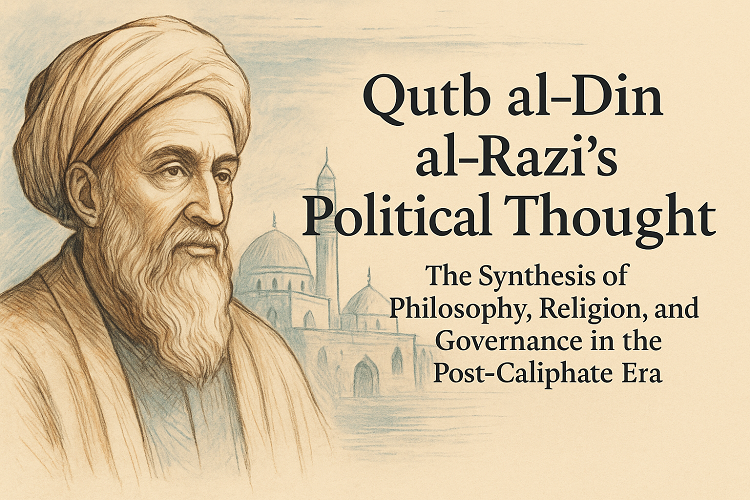
Qutb al-Din al-Razi’s political thought represents a distinguished example of the efforts made by medieval Iranian scholars to merge philosophical rationalism with Islamic principles in response to the shifting political realities of the Mongol era. Living during the 13th and early 14th centuries CE, Razi was not only a prominent philosopher and theologian but also a sharp observer of political power, the legitimacy of the caliphate, and the intricate relationship between religion and governance. In this article, we explore his political philosophy in historical, theological, and philosophical contexts, shedding light on how his views reflect both the crisis of legitimacy after the fall of the Abbasid Caliphate and the search for a new Islamic order.
Life and Times of Qutb al-Din al-Razi
Education and Intellectual Influences
Qutb al-Din Mahmoud al-Razi, also known as Qutb al-Din al-Katib, was born in Rayy or its surrounding regions in the late 13th century. Though not a direct student of Fakhr al-Din al-Razi, he was deeply influenced by his works and engaged thoroughly with the Ashʿarite and philosophical traditions. His writings reflect a fusion of ideas from Avicenna, Fakhr al-Din al-Razi, and Nasir al-Din al-Tusi. He taught and wrote in major intellectual centers such as Hamadan, Baghdad, and Tabriz, and even served in the courts of some Ilkhanid rulers.
Historical Context and the Crisis of the Caliphate
Razi lived through the transformative period following the Mongol invasions and the collapse of the Abbasid Caliphate in Baghdad in 1258 CE. This epoch was marked by significant political upheaval, spiritual disorientation, and questions surrounding religious authority and governance. Unsurprisingly, Qutb al-Din al-Razi’s political thought emerged as a philosophical and theological response to this crisis.
Philosophical Foundations of Qutb al-Din al-Razi’s Political Thought
The Role of Reason in Politics
For Razi, as with many Islamic philosophers, reason is the foundation of political organization and social order. He believed that political structures should mirror the rational design of the universe. Just as the cosmos is governed by divine wisdom, society should be guided by human reason and philosophical principles.
Utopian Concepts and the Platonic Ideal
Razi frequently invoked the concept of the “virtuous city” (madīna fāḍila) reminiscent of Plato and al-Farabi. However, he reformulated this idea within the Islamic tradition. In his view, the ideal polity is not realized through the caliphate or the Mongol sultanate per se, but through the establishment of justice, reason, and wisdom within political institutions. He advocated a form of rational legitimacy rather than lineage or brute force.
The Role of Sharia in Razi’s Political Philosophy
Sharia and Reason: Conflict or Complement?
A central question in Qutb al-Din al-Razi’s political thought concerns the relationship between Sharia and reason. Contrary to simplistic dichotomies, he saw these two forces as complementary. While reason is the human capacity to discern moral principles, Sharia is the divine framework for guiding human collectivity. Thus, he argued that governance must integrate both rational and divine elements in pursuit of justice.
The Dual Roles of the Jurist and Philosopher
Within this framework, Razi envisioned a division of intellectual labor. The jurist (faqih) interprets and implements Sharia, while the philosopher (ḥakīm) provides the rational architecture for governance. This conceptual division enables a balanced system wherein theology and philosophy collaborate in shaping the political order.
Caliphal Legitimacy and Political Authority in Razi’s Writings
Critique of the Abbasid Caliphate
Razi did not refrain from criticizing the Abbasid Caliphate. He believed that the institution had devolved into a vehicle for political domination rather than a guardian of moral and rational governance. Using both veiled critique and overt philosophical argument, he questioned the theological legitimacy of the caliphs.
Rational Principles as the Basis of Political Legitimacy
According to Razi, a government is only legitimate if it is founded upon rationality, justice, and public interest (maṣlaḥa). He indirectly critiqued Mongol rule as well, noting that a non-Muslim ruler who governs justly and rationally could still be more acceptable than a corrupt Muslim sovereign. This pragmatism in Qutb al-Din al-Razi’s political thought marked a significant departure from conventional dogmas.
The Interplay of Philosophy, Mysticism, and Politics
Rational Mysticism and Ethical Governance
Although Razi was a rationalist philosopher, he did not reject mystical insights. However, he favored a form of rational mysticism akin to Suhrawardi or al-Ghazali rather than Ibn Arabi‘s more esoteric models. His vision of the ideal ruler—wise, virtuous, and spiritually upright—embodies this synthesis.
Politics as a Vehicle for Ethical Perfection
Razi viewed politics not simply as the exercise of power but as a moral enterprise. The ruler, in his eyes, is a moral educator and not just a political manager. In this regard, Razi follows the tradition of al-Farabi and Avicenna in seeing governance as an extension of ethical philosophy.
Social Order and Political Justice
The Structure of the Islamic Society
Drawing on Greek-Islamic classifications, Razi proposed a structured society composed of philosophers, jurists, warriors, artisans, and farmers. Rather than promoting elitism, this stratification aims to ensure functional specialization and societal balance.
Justice as the Cornerstone of Governance
In Qutb al-Din al-Razi’s political thought, justice is the supreme value in any political system. Without justice, no government—however religious—can claim legitimacy. He asserted that justice is both a product of reason and a primary goal of divine law.
Religion and Politics in Razi’s Ideal State
Religion as the Guide of Political Power
Razi held that religion must guide politics, but this guidance should come from learned sages rather than demagogues or literalists. He emphasized the rational interpretation of religious texts to prevent authoritarianism or ignorance from dominating governance.
Politics as a Means to Human Fulfillment
Ultimately, for Razi, politics is a means to promote human flourishing and spiritual elevation. It is not merely about law and order but about achieving intellectual and moral excellence in society.
Legacy and Influence of Qutb al-Din al-Razi’s Political Thought
Bridging Traditions of Islamic Political Philosophy
Qutb al-Din al-Razi occupies a transitional role between Fakhr al-Din al-Razi, Nasir al-Din al-Tusi, and later figures such as Mulla Sadra. His thought represents a unique blend of Ashʿarite theology, Avicennian rationalism, and Farabian political theory. As such, he contributed meaningfully to the continuity and development of Islamic political philosophy.
Relevance for Contemporary Political Discourse
In today’s world, marked by extremism, autocracy, and ideological fragmentation, revisiting Qutb al-Din al-Razi’s political thought offers insights into building a rational, just, and morally anchored political order. His vision can inspire new conversations about reconciling faith and reason in modern governance.
Conclusion: Why Qutb al-Din al-Razi’s Political Philosophy Still Matters
In conclusion, Qutb al-Din al-Razi’s political thought offers a sophisticated synthesis of reason, Sharia, and ethical governance. He challenged the ossified structures of the Abbasid Caliphate, criticized unprincipled rule, and proposed a model of rational, just, and spiritually conscious leadership. At a time when Islamic political thought is often pulled between authoritarianism and populism, Razi’s vision of balanced, enlightened governance provides a compelling alternative rooted in both tradition and critical reflection.


