


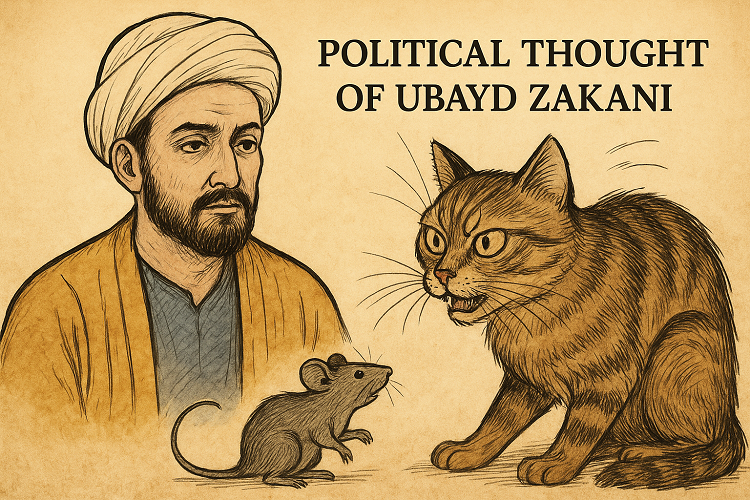
The political thought of Ubayd Zakani can be seen as one of the most striking examples of social and political criticism in the form of satire and parody in Iranian history. Living in the 14th century CE (8th century AH), Ubayd used sharp and incisive language to criticize the structures of power, corruption, hypocrisy, and official religion. While many of his contemporaries addressed politics through philosophical and religious frameworks, Ubayd employed satire and allegory to narrate politics from the perspective of the common people and unveil the mask of power. This article aims to examine in detail the historical background, key concepts, rhetorical tools, and critical content in the political thought of Ubayd Zakani.
Historical and Social Context of Ubayd Zakani’s Time
To better understand Ubayd Zakani’s political thought, one must consider the historical and social conditions of his era. Ubayd lived during the collapse of the Ilkhanid rule in Iran. After the death of Abu Sa’id Bahadur Khan in 1335 CE, Iran’s centralized political structure disintegrated, and a series of local governments, warlords, and short-lived rulers emerged. This instability brought about widespread insecurity, economic disorder, and a breakdown of public morality.
In such a climate, the people were exhausted by the tyranny of rulers, the corruption of elites, and the incompetence of officials. Ubayd, who had briefly worked within bureaucratic systems, witnessed the decay of administrative and intellectual institutions firsthand. He chose satire as his medium to expose this decay.
Personal Experiences and Political Insight
Born in Qazvin, Ubayd spent much of his life in cities such as Tabriz, Shiraz, Baghdad, and Isfahan—centers of political and cultural activity at the time. His presence at courts like the Muzaffarid court in Shiraz gave him direct access to political and intellectual elites, allowing him to observe the stark contrast between their public speech and private behavior. These experiences fueled his sharp and merciless critique of power.
Satire as a Political Tool in Ubayd Zakani’s Works
One of the most prominent features of Ubayd Zakani’s political thought is his use of satire as an effective instrument for criticizing power. Satire, typically marginalized in classical Persian literature, was rarely employed as a tool of political analysis. However, Ubayd elevated it to a primary mode of expression for exposing corruption and deceit.
Functions of Satire in Power Discourse
In Ubayd’s works, satire is not merely for entertainment—it functions as a communicative strategy. By inverting moral and religious values, he uses satire to highlight social contradictions. In Akhlaq al-Ashraf (“Ethics of the Nobles”), qualities like lying, flattery, hypocrisy, and ruthlessness are ironically praised as virtues. This reversal forces the audience to reflect on the absurdity of the prevailing social order.
Akhlaq al-Ashraf: Portrait of a Degenerate Class
In Akhlaq al-Ashraf, Ubayd presents a seemingly humorous but deeply bitter portrayal of the elite. Instead of offering ethical guidance to the nobility, he presents a list of vices as superior traits. From the perspective of political philosophy, this work serves as a critique of the legitimacy of power, showing how a ruling class redefines values to serve its interests.
Mouse and Cat: Allegory of Despotic Rule
The poem Mouse and Cat is one of Ubayd’s most famous allegorical works. In this narrative, mice represent the common people, while the cat symbolizes the oppressive ruler. The story depicts the constant struggle between the people and authority, with the people always ending up defeated. In the end, the mice are once again tricked and destroyed by the cat, reflecting a bleak and hopeless view of the state-society relationship.
The Concept of Politics in Ubayd Zakani’s Thought
Ubayd Zakani presents a stark picture of politics as a domain of deception, violence, and self-interest. In his view, politics is not a space for justice or public welfare, but rather a field of performance where cunning and hypocrisy are used to maintain power.
Politician as Actor
In Ubayd’s writings, the politician resembles an actor who wears a mask of piety, honesty, or compassion, but whose true concern is the preservation of power. This image is both modern and tragic, revealing that politics, far from being altruistic, is designed for domination and survival.
Critique of Religion and Clergy in Ubayd Zakani’s Political Thought
Ubayd is among the few traditional Persian writers who openly and fearlessly criticized the institution of religion and the clergy. He not only pointed to the moral and financial corruption of religious figures but also raised the fundamental question of whether religion served the people or served power.
Definitions: Satire Against Religious Deceit
In his treatise Ta’rifat (“Definitions”), Ubayd skillfully redefines religious, ethical, and social terms. For instance, he defines a “pious man” as someone “who grabs the world with one hand and the afterlife with the other.” These definitions reveal the collapse of the boundary between the sacred and the profane in his society and expose the decay of religious institutions, much like political ones.
Religion as a Tool for Justifying Injustice
In Ubayd’s view, the clergy, by aligning with the court, not only abandoned their reformist role but also became apologists for tyranny. In many of his poems and stories, preachers, jurists, and religious scholars are portrayed as allies of liars and oppressors.
Social, Ethical, and Cultural Critique in Ubayd Zakani’s Works
Beyond political and religious critique, Ubayd’s works are rich with layers of social and ethical criticism. He vividly portrays a society in which values have collapsed, public trust has eroded, and people are exhausted and disoriented.
General Corruption and the Crisis of Trust
Ubayd’s poems depict betrayal, greed, deceit, and ignorance as widespread societal traits. He does not spare even the masses from his criticism. The society he describes is deeply entrenched in corruption, to the point where hope for reform seems lost.
Distrust as a Central Theme
In Ubayd Zakani’s political thought, distrust emerges as a dominant principle. No one is trustworthy—not the ruler, the scholar, the judge, nor even the friend. This view reflects the real social conditions of his time, when power and wealth had replaced virtue and honesty.
Ubayd Zakani’s Place in the Tradition of Persian Political Thought
Although Ubayd may not be categorized alongside traditional political philosophers, he undoubtedly played a significant role in shaping a critical form of political thought within the Persian tradition. While thinkers like Farabi, Nasir al-Din Tusi, and Mulla Sadra focused on ideal political systems, Ubayd confronted the grim reality.
Ubayd as a Link Between Tradition and Modernity
A fascinating aspect of Ubayd’s work is its resemblance to modern thinkers. His critique of power and religion echoes Michel Foucault’s ideas on power and Karl Marx’s thoughts on ideology. Whether intentionally or not, Ubayd laid the groundwork for a genealogical approach to politics in Persian literature.
Ubayd Versus Traditional Philosophers
While classical philosophers were preoccupied with the ideal order and the just ruler, Ubayd spoke of the absence of truth, of hypocrisy, injustice, and corruption. For him, truth lay not in utopian ideals but in revealing the harsh reality.
Conclusion: Ubayd Zakani, the Laughing Conscience of a Mourning Society
The political thought of Ubayd Zakani is a blend of bitterness and satire, despair and insight, criticism and irony. He not only attacks corrupt rulers and clergy but also holds a mirror to society. His works remain a valuable source for understanding the relationship between power, discourse, and resistance in Persian political thought. Ubayd’s laughter was not a laughter of joy—it was the laughter of awakening, resistance, and unmasking. In an age where justice and truth were in retreat, his pen stood as the last refuge of the conscience. He mocked to awaken, ridiculed to resist, and wrote to ensure that history would not forget the tragedy veiled behind the comedy of power.


