The old position of The Stripped Women and Punishment
It’s the 19th century: Bushehr port, southern Iran. Around sunset, a woman’s body is pulled from the sea. No one speaks; silence fills the length of the shore. There are no questions. The gathered crowd knows the woman well. Their familiarity with her dates back just one day prior, when she and two other women were stripped naked in the town square. One of these women was later seen leaving town with her family before dawn. Of the other woman, there is no sign—neither of her nor her family.
The matter is not complex: three families have been destroyed, and several lives shattered over the past two days. The husbands of these women were servants of the Bushehr officials, evading customs duties. The decision was made to ruin their lives. No one was executed, no one jailed, and no one whipped. Only the wives of these men were stripped in the town square.
The above account shows that exposing a woman’s body was the highest form of punishment in the Middle East. It could be argued that this punishment was even harsher than execution. In an execution, a person dies, but by stripping women in public, their families—and potentially larger communities—are torn apart. The cultural framework that led to this kind of devastating punishment was rooted in a historical structure that saw a woman’s body as a mythical entity imbued with magic.
This mythological being remained alive only as long as it was unseen. As soon as this being was revealed to others, the magic would bring an end to its life. In the Middle East, a woman was believed to be part of a man’s property. Ownership of this “asset” was confirmed through the exclusive right to view her body, a right reserved for the husband. If a woman’s body was displayed to others, it was considered a profound violation of honor, a breach of privacy, and a forfeiture of ownership.
This rigid historical structure has shaped social relations in the Middle East for centuries. It was perhaps one of the few mental constructs capable of regulating social relationships without the need for a tyrant’s presence. In other words, the presence of this structure in the minds of individuals was so powerful that there was no need for an external authority from the public realm to enforce social order.
People regulated their behavior and adhered to the underlying logic of this powerful historical structure out of belief and compliance. Yet, this same rigid structure, which ensured social order, also led to the harshest of punishments—a punishment that could bring ruin to families.
The new situation of The Stripped Women and Punishment
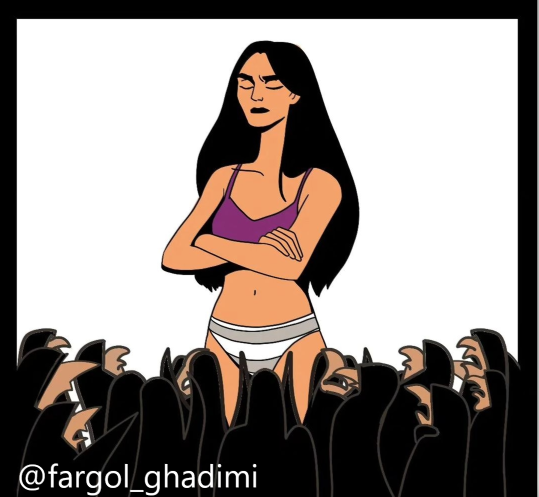
The hashtag stripped_protest_girl has flooded the digital space. Political and social analysts across various media are openly and radically criticizing Iran’s religious government. Remarkably, there is a unanimous condemning the Islamic government and its policy of mandatory hijab. What has sparked worldwide opposition against this policy was the bold act of Ahoo Daryayi stripping in protest at the entrance to the Azad University, Science and Research branch.
Ahoo, a student in Tehran, was attempting to enter the university when she was confronted by a security guard. The guard deemed her hijab unacceptable and barred her from entry, apparently damaging her clothing in the process. In response, Ahoo publicly removed her clothes to protest the compulsory hijab policy and the guard’s behavior.
When an act of protest resonates with public sentiment, it becomes more than just an objection—it becomes a powerful indictment of those who make daily life increasingly restrictive for the people of Iran. Contrary to the past, public opinion supports human individuality, and sanctity of material life, and human agency in daily affairs. They hate subjugation and assimilation and enable the possibility of pluralism.
The Stripped Women and Punishment in Two Situations
In the two events described, “stripping” and “Punishment” serve as central themes, each shaped by a different logic in distinct contexts.
In the first scenario, due to the deep-rooted cultural structure in the Middle East, the public stripping of a woman is the ultimate form of punishment for both her and her family, likely leading to social rejection and disgrace. The power of this structure allows society to use this form of punishment as a means of retribution against those who have fallen out of favor.
In the second scenario, however, a fundamental shift is evident. Ahoo Daryayi’s stripping, supported by public opinion, has become a form of protest aimed at punishing the political system, which derives its legitimacy from upholding the same historical-cultural structure. The ruling religious regime in Iran, believing in the strength and authority of this structure, assumed that as long as it protected and preserved this framework, it would enjoy the support of a large segment of the Iranian and Middle Eastern population.
This shift indicates the emergence of Iranian individuality. The historical cultural structure that suppressed individual autonomy is fading, drawing its final breaths. The most significant outcome of this transformation is the collapse of this traditional cultural structure in Iran’s public sphere.
At one time, it was assumed that governance in this land relied on the preservation and protection of this structure, and even foreign political and economic actors believed that successful interaction with the people of this region required respecting and adhering to it.
However, Ahoo Daryayi’s act marks a historical moment that demonstrates how Iran is undergoing profound change. Individuality, along with human rights and values, now commands far greater respect in society and public opinion than the outdated cultural structure. This transformation may extend beyond Iran’s borders into the broader Middle East, but for now, Ahoo Daryayi has brought it to light within Iran.
While Ahoo Daryayi’s action presents an opportunity for the Iranian people to interact anew with each other around modern values and to critique the outdated religious government, it also carries a clear message for foreign political and economic powers.
Those who believe they can achieve substantial influence in Iran by feigning respect for the dying cultural structure are gravely mistaken. Iranian society has changed. Even though the political system still clings to this decaying structure, the people of Iran speak of a new world with modern values. Don’t believe it? Just ask Ahoo Daryayi.