


Introduction
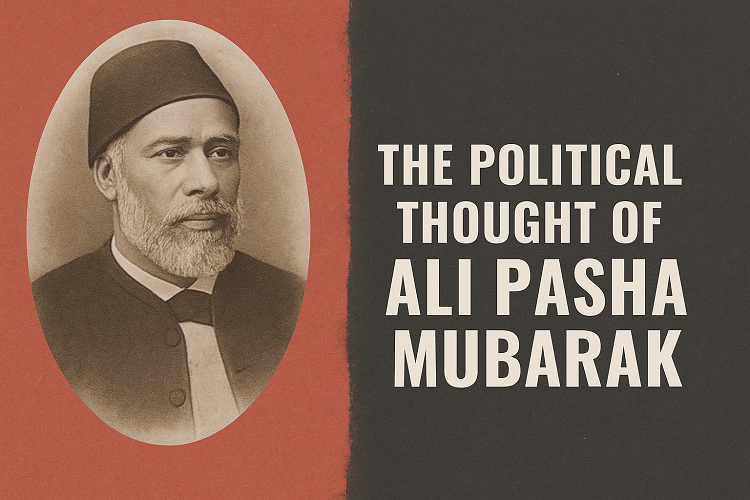
The political thought of Ali Pasha Mubarak represents one of the milestones in the intellectual and political history of nineteenth-century Egypt. Living between 1823 and 1893, Mubarak was not a political fighter in the conventional sense of leading armed resistance against colonialism or ruling elites. Rather, he was a reformist thinker, administrator, and educator whose contributions to modern education, administration, and urban development shaped Egypt’s path toward modernity. This article examines his life, works, reforms, and, most importantly, the political ideas that made Ali Pasha Mubarak a pioneer of rationalist reform in Arab modern history.
Biography and Historical Context
Ali Pasha Mubarak was born in 1823 in a small Egyptian village. Unlike many of his contemporaries who pursued traditional religious education, Mubarak was educated in new institutions established during the reformist era of Muhammad Ali Pasha and his successors. His studies exposed him to mathematics, engineering, natural sciences, and foreign languages, which later shaped his reformist vision.
Mubarak’s lifetime coincided with a period of profound transformation in Egypt. On one side, the reforms of Muhammad Ali Pasha aimed to modernize the army, bureaucracy, and economy. On the other, European colonial pressures—particularly from Britain and France—were tightening their grip on Egyptian affairs. Against this backdrop, Ali Pasha Mubarak rose as one of Egypt’s most influential administrators and intellectuals, serving in various ministerial roles while also producing significant writings that combined history, geography, and political thought.
Works and Writings of Ali Pasha Mubarak
Mubarak’s most celebrated work is the encyclopedic “al-Khitat al-Tawfiqiyya”, a detailed historical and geographical description of Egypt’s cities, towns, monuments, and social transformations. Yet, beyond being a reference book, this work reveals his political vision. It reflects his belief that governance must be based on order, knowledge, and rational administration.
In addition, Mubarak wrote extensively on education and administration. His writings, together with those of contemporaries such as Rifa’a al-Tahtawi, laid the intellectual foundations for linking modern knowledge, social reform, and political order in Egypt.
Educational Reforms and Their Political Implications
Education was at the core of Ali Pasha Mubarak’s reformist project. He believed that no political or social progress could be achieved without a modern educational system. During his tenure as Minister of Education, he worked tirelessly to establish schools that taught modern sciences such as mathematics, physics, chemistry, engineering, and geography alongside the humanities.
Unlike the traditional focus of al-Azhar, which centered on religious jurisprudence and classical grammar, Mubarak sought to create a new generation of civil servants, teachers, and engineers who could serve the needs of a modern state. For him, education was not only a social necessity but also the very foundation of an efficient political order.
Ali Pasha Mubarak’s Opposition to al-Azhar and Traditional Religious Education
A central element of the political thought of Ali Pasha Mubarak was his criticism of traditional education at al-Azhar University. He argued that the Azharite system, with its heavy reliance on memorization of religious texts and scholastic debates, was inadequate for the challenges of the nineteenth century.
Mubarak did not reject religion per se. Rather, he believed religion should serve an ethical and spiritual role, while education needed to address practical sciences and the requirements of state governance. He criticized the methods of al-Azhar as detached from the realities of modern administration and incapable of preparing Egypt for colonial challenges and internal reforms.
This opposition placed Mubarak at the heart of the broader intellectual struggle between tradition and modernity in nineteenth-century Egypt. His reforms, which promoted rational and scientific curricula, provoked resistance from traditional scholars but eventually set the course for the modernization of Egyptian education.
Administrative and Urban Reforms
Beyond education, Mubarak made substantial contributions as a statesman and administrator. He served in several ministerial positions and played a key role in reorganizing Egypt’s bureaucratic apparatus. His reforms included restructuring ministries, improving financial systems, and streamlining administrative procedures.
Equally significant were his urban development projects. Mubarak oversaw the expansion of roads, the construction of bridges, and improvements in Cairo and Alexandria’s urban infrastructure. For him, efficient governance was inseparable from organized urban planning and public services. These reforms highlighted his vision of politics as the rational management of society through functional institutions and visible public works.
The Political Thought of Ali Pasha Mubarak
The political thought of Ali Pasha Mubarak can be summarized in several core principles:
- Politics as Social Organization: Mubarak saw politics not as ideological confrontation but as a means to organize society and improve collective welfare.
- Rationality and Knowledge: He emphasized that governance should rely on reason, science, and empirical knowledge rather than mere tradition.
- Religion and Politics: Mubarak valued religion as a moral foundation but prioritized reason and modern expertise in political and administrative affairs.
- Critique of Corruption and Inefficiency: Much of his writings denounced corruption and inefficiency within the bureaucracy, advocating reform and accountability.
- Selective Borrowing from the West: Mubarak admired European methods of administration and education but sought to adapt them to Egypt’s cultural and social context.
Comparison with Contemporary Figures
To better situate Ali Pasha Mubarak’s role, comparisons with his contemporaries are essential:
- Ahmed Urabi (Arabi): Unlike Urabi, who led an armed revolt against foreign domination and the ruling elite, Mubarak avoided direct confrontation and focused on structural reforms from within.
- Rifa’a al-Tahtawi: Both shared an emphasis on education and rationality, but Mubarak leaned more toward administrative and infrastructural reforms, while Tahtawi emphasized cultural renewal.
- The Arab Nahda (Renaissance): Mubarak’s ideas and reforms were central to the Nahda movement, providing practical and institutional dimensions to the broader intellectual awakening of the Arab world.
Influence of Ali Pasha Mubarak’s Political Thought on Egypt and the Arab World
The influence of Ali Pasha Mubarak’s political thought on Egypt’s modern history is undeniable. His reforms created a new class of educated Egyptians capable of running state institutions, thereby laying the groundwork for a modern bureaucratic state.
Moreover, his writings shaped the intellectual framework for subsequent generations of Egyptian reformers and politicians. Figures of the twentieth century who engaged with the challenges of modernization often traced their intellectual lineage back to the reforms initiated by Mubarak.
Beyond Egypt, his ideas resonated in the Arab world, influencing reformist movements in Syria, Lebanon, and Tunisia. Mubarak embodied the model of combining modern rationality with indigenous cultural roots, a model that later reformers sought to emulate.
Criticism and Evaluation of His Political Thought
The political thought of Ali Pasha Mubarak is not without its limitations.
- Strengths:
- Pioneering focus on modern education and rational administration.
- Structural reforms in bureaucracy and urban planning.
- Balanced attempt to integrate modernity with local traditions.
- Weaknesses:
- Lack of direct confrontation with British colonialism, which limited the scope of his reforms.
- Dependence on working within the framework of existing power structures.
- Narrow focus on state institutions, with less attention to grassroots political participation.
Nevertheless, his contributions remain a cornerstone of Arab political thought, especially in the context of Egypt’s modernization.
Conclusion
The political thought of Ali Pasha Mubarak is best understood as a project of rationalist reform rather than militant activism. His legacy rests in the transformation of Egypt’s education system, his criticism of traditional institutions like al-Azhar, his administrative and urban reforms, and his vision of politics as rational social organization.
By prioritizing knowledge, reason, and effective governance, Mubarak laid the intellectual and institutional foundations for Egypt’s modern state. While his reluctance to directly challenge colonial power may be seen as a limitation, his impact on education, administration, and intellectual life ensured that he remained a central figure in the Arab Nahda.
Ali Pasha Mubarak was not a political fighter but a political thinker and reformer, whose legacy continues to shape discussions of tradition, modernity, and governance in the Arab-Islamic world.


Definitely, what a splendid website and instructive posts, I definitely will bookmark your blog.Have an awsome day!