


Introduction
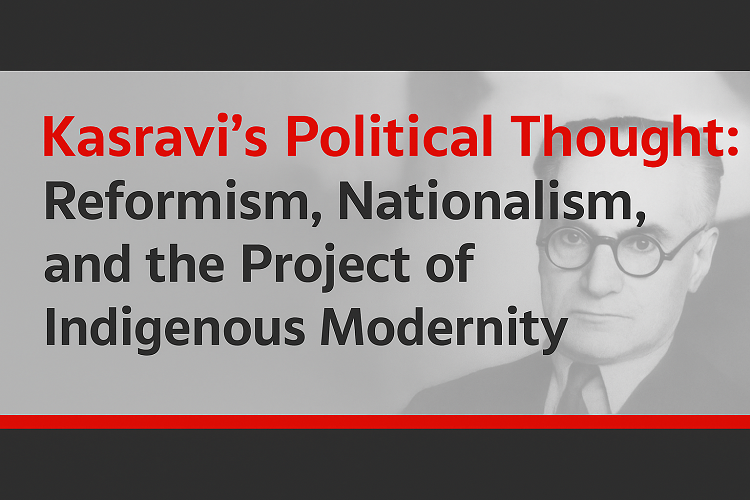
Kasravi’s political thought is one of the most unique and significant intellectual phenomena in modern Iranian history. Ahmad Kasravi (1890–1946), a jurist, historian, and outspoken intellectual, emerged from within the religious tradition but turned toward reformism and national reconstruction. More than being “anti-religious,” he sought to purify religion, critique superstitions, rebuild rational nationalism, and lay the foundation for a modern state.
In other words, Kasravi’s political thought was his attempt to address the profound crises of twentieth-century Iran: identity fragmentation, the failure of the Constitutional Revolution, the weakness of state institutions, and the tension between tradition and modernity. In this context, Kasravi sought a “third way” — neither a wholesale return to tradition nor blind imitation of the West.
Biography and Historical Context of Kasravi’s Political Thought
Understanding Kasravi’s political thought requires situating him in his historical context. Born in Tabriz, Kasravi was initially trained in Islamic seminaries. As a young man, he pursued religious studies but soon distanced himself from the narrow confines of the clergy, instead turning toward law, history, and social reform.
His life coincided with three major transformations:
- The Constitutional Revolution and its failures, which raised the question: “Why did freedom fail in Iran?”
- World War I and the occupation of Iran, which exposed the vulnerability of national sovereignty.
- The rise of the Pahlavi state, which pursued authoritarian modernization while creating a duality between progress and repression.
Thus, Kasravi’s political thought emerged from these crises: the need for religious reform, the reconstruction of national identity, and the creation of a rational and disciplined society.
Kasravi’s Political Thought and Religious Reform
Pure Religion: Purification, Not Denial
In works such as Dar Piramun-e Eslam (On Islam) and Pakdini (Pure Religion), Kasravi emphasized that his goal was not to deny religion but to purify it. He believed that authentic Islam could guide people toward ethics, truthfulness, and service to society. Yet over centuries, it had been corrupted by rituals, sectarianism, and superstition.
Thus, “Pure Religion” was his project to return to the moral and social essence of faith: religion as a guide to justice and honesty, not as a source of discord or a tool of power.
Critique of the Clergy and Sectarianism
A central pillar of Kasravi’s political thought was his critique of the clerical establishment and sectarian divisions. In Shi‘igari (Shi‘ism), he did not reject Shi‘ism as a whole but criticized excessive rituals, sectarian dogmatism, and the clerical class’s political influence.
In other words, he sought to transform religion into an ethical and communal practice, free from the dominance of clerics and factional strife.
Kasravi’s Political Thought and Nationalism
Persian Language as the Core of National Identity
Kasravi saw the Persian language as the foundation of Iranian identity. In writings such as Zaban-e Pak (The Pure Language), he called for purifying Persian from excessive Arabic words. For him, language was not merely a means of communication but the backbone of national consciousness and a precondition for cultural independence.
Thus, Kasravi’s political thought intertwined “linguistic reform” with “political reform.” Without a strong national language, he argued, no independent and rational nation could be built.
History and the Nation
Through The History of the Iranian Constitutional Revolution and Eighteen-Year History of Azerbaijan, Kasravi offered a critical reading of Iran’s modern history. He showed why the Constitutional Revolution failed and how Iranians should learn from those mistakes.
Therefore, Kasravi’s political thought was essentially a nation-building project: to create a collective identity rooted in language, historical consciousness, and social order.
Kasravi and the Constitutional Movement
The Failures of Constitutionalism
Kasravi argued that the Constitutional Revolution failed because of public ignorance, weak institutions, and clerical interference. He believed that political freedom without cultural and intellectual reform was doomed to collapse.
From this perspective, Kasravi’s political thought continued the goals of constitutionalism but insisted on a deeper foundation: before drafting constitutions, minds and languages had to be reformed.
The Necessity of Law and Order
A firm believer in discipline and law, Kasravi maintained that freedom only made sense within the framework of law. Social disorder, in his view, was the greatest obstacle to progress. Hence, he emphasized universal education and the role of a strong state to ensure order and justice.
Kasravi and the Project of Indigenous Modernity
Critique of Westoxication and Eastoxication
Kasravi was neither a Westernizer nor an Easternizer. He considered both tendencies as forms of dependency. Instead, his political thought sought an indigenous modernity: a modernity rooted in Iranian culture and history yet open to rationality and scientific progress.
The Third Way in Politics
Kasravi rejected liberalism as unsuitable for Iran’s conditions and condemned communism as dangerous and inhumane. He envisioned a middle path — a national, rational, law-abiding, and just society that avoided both religious traditionalism and blind imitation of the West.
Kasravi’s Political Thought and the Question of Women
Women’s Liberation as a Condition of National Freedom
Kasravi was among the few intellectuals of his time who consistently addressed women’s rights. He argued that a society that kept half of its population in ignorance and exclusion could never progress. Thus, women’s education, right to work, and participation in public life were essential to social reform.
Critique of Restrictive Traditions
Kasravi criticized prevailing traditions concerning veiling, marriage, and the exclusion of women. He regarded them as major obstacles to national development. In this respect, Kasravi was a pioneering advocate of women’s emancipation within Iranian intellectual circles.
Language and Culture in Kasravi’s Political Thought
Pure Language and Intellectual Independence
Kasravi believed that a healthy language produces healthy thought. His project of “language purification” aimed to make Persian simpler, stronger, and free of unnecessary foreign borrowings. For him, linguistic independence was inseparable from political and cultural independence.
Toward a Rational Culture
Kasravi argued that culture must rest on reason and ethics. He viewed excessive poetry, mysticism, and superstition as obstacles to rational culture. Instead, he advocated a civic culture based on truthfulness, hard work, honesty, and patriotism.
Kasravi and Political Violence
Enemies and Assassination
Kasravi’s political thought provoked fierce opposition from traditionalist groups. He was repeatedly threatened and eventually assassinated in 1946 by members of Fada’iyan-e Islam. His death revealed how radical and threatening his reformist ideas appeared to entrenched powers.
The Question of Tolerance
Kasravi’s assassination raised a fundamental question: why are divergent ideas in Iran often met with violence instead of debate? His fate underscored the persistent lack of tolerance in Iranian political culture — an issue still relevant today.
Strengths of Kasravi’s Political Thought
- Religious reformism: emphasis on ethics and spirituality rather than sectarian dogma.
- Rational nationalism: linking language, history, and identity to nation-building.
- Attention to women and education: a progressive stance on women’s rights.
- Indigenous modernity: seeking independence from both traditionalism and Western imitation.
- Law and order: recognition of the necessity of discipline and state authority.
Weaknesses and Criticisms
- Radical language: his harsh tone sometimes undermined dialogue.
- Lack of a coherent political system: his vision was more cultural and social than institutional.
- Insufficient attention to popular religiosity: he failed to balance reform with people’s deep-rooted religious sentiments.
The Place of Kasravi’s Political Thought in Modern Iranian History
A Bridge Between Tradition and Modernity
Kasravi can be seen as one of the earliest thinkers to articulate a project of indigenous modernity in Iran. He sought to combine rationality and ethics with nationalism while avoiding dependence on either the East or the West.
Inspiration for Later Intellectuals
Kasravi’s political thought inspired subsequent generations of Iranian intellectuals. Some followed his path of religious critique, while others pursued his project of nation-building. Even his staunch critics had to confront his questions about religion, nationalism, and progress.
Comparing Kasravi’s Political Thought with His Contemporaries
Kasravi’s political thought can be better understood when placed alongside that of his contemporaries. Each intellectual in early twentieth-century Iran grappled with similar questions — national identity, the relation between religion and politics, and the path to modernity — but they provided very different answers.
Kasravi and Foroughi: National Ethics versus Liberal Pragmatism
Mohammad Ali Foroughi (Zokāʾ al-Molūk) was a key figure in state-building and in introducing Western philosophy and political concepts into Iran. As a statesman, he linked philosophy to politics and emphasized the necessity of adopting modern institutions and legal structures for governing the country. By contrast, Kasravi, while valuing order and law, rejected mere imitation of the West. Instead, he focused on reconstructing national ethics and purifying religion and culture. If Foroughi represented a form of liberal pragmatism in Iran, Kasravi embodied indigenous reformism.
Kasravi and Dehkhoda: Language as a Political Instrument
Ali Akbar Dehkhoda is best known for his Dictionary and his satirical writings in the newspaper Sur-e Esrafil. For Dehkhoda, language was a weapon of political critique and resistance against tyranny. Kasravi likewise placed language at the center of his political thought, but differently: he sought to simplify and “purify” Persian to create national unity. Thus, while Dehkhoda saw language as an instrument of critique, Kasravi regarded it as the foundation of nation-building and cultural independence.
Kasravi and Arani: Scientism versus Ethical Reformism
Taqi Arani, founder of modern leftist thought in Iran, promoted scientism and Marxist ideology through the journal Donya. He stressed historical materialism and the critique of capitalism. Kasravi, although strongly opposed to superstition and irrationalism, rejected Marxism and other imported ideologies. His emphasis remained on rationality, ethics, and purified religion. In this sense, the contrast between Arani and Kasravi reflects a broader intellectual tension: science and ideology versus ethics and reformed religion.
Kasravi and Nazem al-Eslam Kermani: Critical History versus Awakening History
In the field of historiography, comparing Kasravi with Nazem al-Eslam Kermani, the author of The History of the Awakening of Iranians, is particularly illuminating. Nazem al-Eslam wrote as an “awakener,” aiming to cultivate national identity and inspire collective action. His narrative style was often motivational, moralizing, and designed to stir the sentiments of ordinary readers for political engagement.
Kasravi, however, adopted an analytical and critical approach in works such as The History of the Iranian Constitutional Revolution. He sought to uncover the structural causes of political failures and to extract practical lessons for reform, rather than merely inspiring patriotic fervor. In other words, if Nazem al-Eslam used history as a tool of awakening, Kasravi used it as a tool of critical analysis. Taken together, their approaches illustrate the dual needs of modern Iran: inspiring narratives for mass mobilization and critical analysis for effective reform.
Kasravi and Taqizadeh: Indigenous Modernity versus Total Westernization
A comparison between Kasravi and Sayyed Hasan Taqizadeh further highlights the diversity of intellectual projects in early twentieth-century Iran. In his youth, particularly through the journal Kaveh, Taqizadeh openly called for “becoming Westernized from head to toe.” For him, Iran’s salvation lay in the complete adoption of Western civilization — in politics, economy, culture, and even morals. He argued that no indigenous basis for progress existed within Iran’s traditions.
Kasravi, in contrast, though he valued rationality, science, and law, never accepted wholesale Westernization. He believed Iran had to construct its own path to modernity, grounded in its history, language, ethics, and a purified religion. For him, absolute imitation of the West meant rootlessness and dependency.
In short, Taqizadeh embodied total Westernism, while Kasravi advocated for indigenous modernity. Their comparison illustrates the central divide within Iranian intellectual life: between those who sought salvation in complete Western imitation and those who sought to build a homegrown, independent modernity.
These comparisons show that Kasravi occupied a distinctive position among his contemporaries: unlike Foroughi, he refused straightforward Western importation; unlike Dehkhoda, he viewed language not just as critique but as the basis of national unity; unlike Arani, he rejected ideological materialism in favor of ethical reform; unlike Nazem al-Eslam, he prioritized analytical history over motivational narrative; and unlike Taqizadeh, he rejected total Westernization in favor of an indigenous modernity. In sum, Kasravi’s political thought was a unique attempt at reform rooted in Iran’s own identity and cultural resources.
Conclusion
Kasravi’s political thought was a bold attempt to answer Iran’s most pressing questions in the twentieth century: Why have we lagged behind, and how can we progress? By advocating Pure Religion, rational nationalism, the centrality of language and culture, women’s rights, and the rule of law, he tried to open a new path.
Although his project ended in violent opposition and ultimately in his assassination, Kasravi’s questions remain alive. For this reason, studying Kasravi’s political thought is not merely a historical exercise but a vital means of understanding Iran’s ongoing struggles with identity, modernity, and reform.

