IRNA news agency released a video of a man in New York. This man was one of Ebrahim Raisi’s companions on his trip to New York. By attending gatherings in front of the United Nations and showing photos of Iranian patients, he sought to show the results of international sanctions for the Iranian government and condemn them.
On behalf of the Islamic regime, he claimed that the sanctions of the United States and its allies have caused Iranian patients to lack access to the necessary medicines and that a humanitarian disaster has occurred.
On the other hand, the US and other powers of the international system have always emphasized that medicine and humanitarian aid have never been included in sanctions. Which one is telling the truth?
In this note, I want to illustrate a phenomenon about sanctions for the Iranian people that has the most disastrous results for the people of the country.
This phenomenon emerged by the combination of two separate processes. On the one hand, it is the result of the decision-making mechanism of a religious government. On the other hand, it is the result of the policies of the United States from the time of Barack Obama’s presidency until today.
I try to follow each of these factors separately. Finally, by combining these two influential processes, I will illustrate the formation of this phenomenon.

1- Decision-making in the religious government
A good way to know a religious government and how to make decisions in it is to answer these two questions: First, how many people rule in it: one person a few people, or the majority of people? Second, is the decision-making in this government aimed at the benefit of everyone or is it only the interests of the rulers? [1]
If we want to define a religious government according to the idea of Islamic thinkers in the modern era, it is a government that seeks to establish a political system that makes possible divine sovereignty on earth. Divine sovereignty means that the decision-making mechanism is based on God’s will and the laws and norms are by divine decrees and Sharia [2].
The political system that is accorded to the will of God and the divine decrees are all based on the holy texts and the experience of the religious government at the beginning of Islam. The establishment of such a government in the modern era faces many challenges. The issues and conditions that have arisen in the present era are fundamentally different from what was going on at the beginning of Islam.
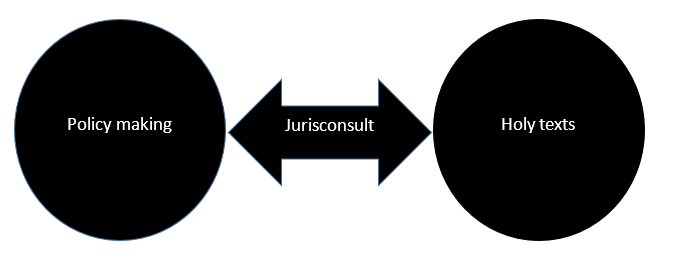
On the other hand, the comparison and examination of matters with the holy texts and the Qur’an are also facing the same problem. How can you measure the human condition today with sources that are 1400 years old? It is precisely at this point that the necessity of the presence of commentators and jurisconsult on religious affairs in the field of governance appears. Therefore, the answer to the first question is found. how many people govern the religious government? The religious government is implemented by a few religious commentators and jurisconsults.
To answer the second question is necessary to refer to the conditions of the formation of the Islamism movement in the modern era and the necessity of religious government among Islamic thinkers. Islamism was a reaction to modernization that has affected all aspects of human life [3]. Modernization has shown itself variously in different regions of Muslim lands. Somewhere it has entered through colonialism and in some areas, it has shown itself in the form of reforms and planning of modern civilizations by local rulers.
In any case, it has been hard and sometimes impossible to bear it by traditional and especially religious forces. Islamism was the reaction of these people to modernization so that they could preserve and spread their identity and power in the modern era.
obviously, if this movement succeeds in establishing a government, the basis of its decision is to fight against the components of modernism and to expand and increase the power of the religious government. In a situation where the ruler is a few religious commentators and jurisconsult and the government aims to fight against modernism, the decision-making must be made in the direction of providing the interests of the rulers who consider the continuation of the government and the increase of their power necessary to fight against modernism.
Therefore, the answer to the second question is also clear. The religious government is aimed at providing for the interests of rulers. And providing for the interests of the majority of people has no place in the decision-making process.
2-The US foreign policy from Obama’s presidency until now
The US foreign policy after September 11, 2001, was severely criticized because it could not achieve the desired result in a short period, and on the other hand, it was paralleled with the economic recession. This platform provided a suitable opportunity for Barack Obama to win the 2008 presidential election with the slogan of “change”.
Obama was trying to show that he was looking for alternatives to the foreign policy of George W. Bush. Multilateralism instead of Unilateralism, diplomacy instead of war, regional security instead of global hegemon, new partners, soft power, and other such kinds of stuff were the components of this “change”.
Obviously, in some cases, this “change” of approach is not possible simply, and cannot be expected significant achievements from it. The issue of Iran was one of these cases.
How could the US simply ignore the enmity between the governments of the two countries after the Islamic revolution and want to open the door to diplomacy with the Islamic Republic? Although Iran did not have diplomatic and economic relations with the United States after the Islamic Revolution, it had significant relations with other world powers such as China, Russia, and Europe.
With these words, how could the US adopt a tough position on Iran but follow multilateralism? Multilateralism requires the presence of other world powers in confrontation with Iran, while these powers had beneficial relations with Iran.
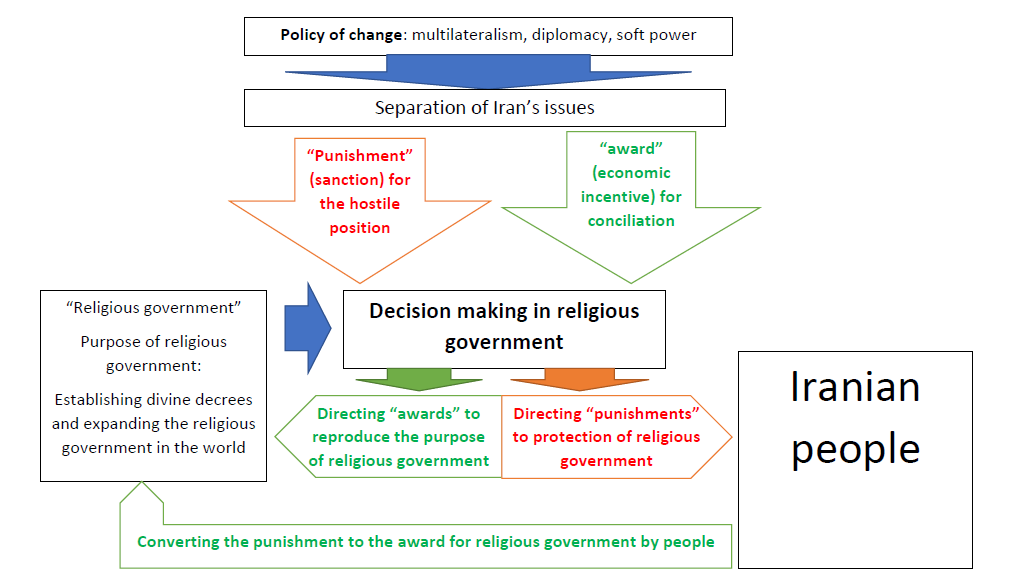
The Obama administration’s solution was to “separation of spheres”. In the sense that the US separated different spheres, instead of defining Iran with a single Islamic government, it tried to the definition Iran with diverse spheres. Iran’s nuclear field, Iran and human rights, Iran in Afghanistan and Iraq, Iran and ISIS, Iran and the social movement, and so on. This approach made it possible for diplomacy to be opened on an issue, while the same hostile position would always remain in the rest of the spheres.
On the other hand, the participation of other powerful governments in Iran’s nuclear issue would be possible without disrupting the relations of these countries in other fields.
This approach led to providing commercial and political opportunities for the religious government through agreement and cooperation in some areas. But in some other fields, it was applied by heavy sanctions. In the United States’ opinion, the separation of different areas in the confrontation with Iran not only made it possible to open diplomacy and multilateralism but also left a message to the religious government that Cooperation and companionship with the US will lead to profit, and choice hostile positions will be sanctioned.
But what has been formed is that a religious government regardless of different fields has been faced with awards and benefits on the one hand and punishment and sanctions on the other hand. This government considers itself free to do the authoritative distribution of benefits and values. From exactly this point, we return to the first part of this article: what is the religious government, and whose interests does it serve?
3-The poverty and misery caused by the sanctions for the Iranian people are the result of the combination of the above two processes.
“Change” policy; The multilateralism and diplomatic approach of the US has caused a flow of rewards and punishments for separate fields to Iran. According to its nature, the religious government tries to direct both (reward and punishment) in any case for the benefit of survival, continuity, and expansion of its intellectual foundations. It is not difficult to understand the direct channeling of rewards to secure the interests of the ruling group.
The pressure of punishments, which are often in the form of economic sanctions, is directly transmitted to the people through financial policies. Raising the exchange rate, creating massive inflation, making facilities double-rated, and creating rent for insider forces and such kinds of stuff are the policies of the religious government to convert sanctions into convenient opportunities for themselves.
After the election of Obama as president, the US foreign policy always has claimed to respect human rights and human freedom, but the policy of “change” accompanied by religious rule has led to the formation of a completely anti-human phenomenon. This process (Sanctions for the Iranian people) has continued during Trump’s presidency.
Although Donald Trump showed himself to be a critic of Obama’s foreign policy, he believed that the religious government should deal with him. Probably, by changing a few dates or a few grams of the weight of enriched uranium in the JCPOA agreement, Trump’s consent would be obtained. Unfortunately, this process continues in the current US government and there is no prospect of its change. and Sanctions for the Iranian people are still going on.
PS:
1- With these two questions, Aristotle divided governments into 6 categories, which, despite being simple, still answer many questions.
2- For more information, you can refer to these books:
Enayat, Hamid. (2001). Modern Islamic Political Thought. Publisher: Islamic Book Trust.
Enayat, Hamid. (1977). A Survey of Arab Political Thought. Publisher: Amir Kabir. Tehran. [in Persian].
3- For more information, you can refer to this book:
Nolte. Ernst. (2020). The Third Radical Resistance Movement: Islamism. Translator: Tadayoni, Mahdi. Publisher: Sales. Tehran. [in Persian].