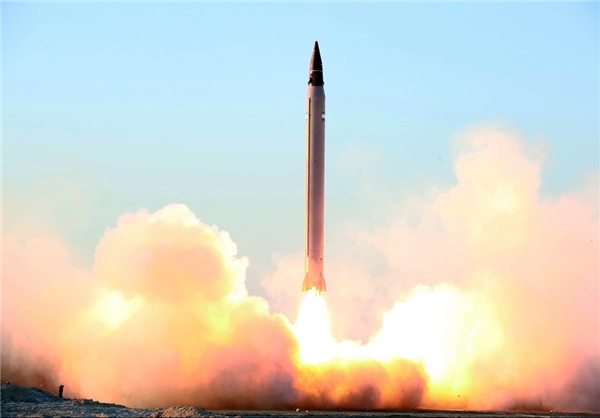
The US Secretary of State confirmed that Iran had delivered ballistic missiles to Russia Following that, a new package of economic sanctions was applied against organizations and individuals affiliated with the Islamic Republic. Unfortunately, the analysts of the Western countries don’t accept what determines the behavior of the religious government is not related to the economic interests, the well-being of the people, and even the security of the country of Iran.
The religious government pursues only one purpose: promoting and developing Islamism and fighting against human rationality and modern knowledge. This misunderstanding of the essence of the Islamic regime causes on the one hand deterrence policies ineffectively on the behavior of the Islamic regime and on the other hand, it has destroyed the lives of millions of people living in this country.
So, punishments and incentives of the economy do not affect the behavior of the Islamic regime. If the Islamic government is standing by Russia in the war against Ukraine, it is not based on economic interests, security, energy supply, or even the balance of regional forces.
It is not difficult to find out the main factor determining the behavior of the Islamic government if we spend our time on various issues of the Islamic regime. In this article, an attempt is made to show the most important factor affecting the behavior of the Islamic regime through the relations between Iran and Russia. It is expected that a similar result will be obtained if an investigation is carried out on other subjects.
1. A brief history of relations between Iran and Russia
The historical experience of Iran-Russia relations shows that the most losses of material, human, national, and security for Iran were caused by Russia. Therefore, it seems unlikely that Iran’s decision to get closer to Russia in the war with Ukraine is aimed at the material interests, security, and well-being of the Iranian people. The following contents are part of Russia’s performance towards Iran during the last few centuries.
• Parallel to the consolidation of the foundations of the national governments of Iran and Russia in the late 15th century and the beginning of the 16th century, the political and economic relations between the two governments began.
During the time of Shah Abbas I (1629-1578) in Iran and Boris Godunov in Russia, their relations were increased. The most important note of the Russian government’s deals with the central government of Iran is that, At the same time as sending an ambassador to the court of the Safavid kings, which is considered the central and national government of Iran, the Russians also sent ambassadors to different regions and local governments, including to Ahmad Khan, the ruler of Gilan.
Communication with regions and local governments in Iran has been one of the special features of Russian diplomacy during the past centuries. Whenever the central government became weak, the Russians’ relationship with the local governors increased, and whenever the central government of Iran gained power, the regional governors lost their political role.
Peter the Great died in 1725 and left behind a will that is highly doubtful whether it is fake or authentic. However, history has shown that the main lines of regional and global goals and the historical task of the Russians were under this will.
Despite such a policy on the part of the Russians, it is completely naive to think that sending weapons to Russia is aimed at providing material benefits, security, and regional power balance. Paragraph 9 of this will include recommendations as follows:”
By getting closer to Constantinople and India, the one who controls this area will own the whole world. So, to achieve this purpose, constant wars must be fueled not only in Turkey (Ottoman) but also in Iran. For the implementation of our plans is necessary the establishment of shipbuilding workshops around the Black Sea, the gradual occupation of this sea, which, like the Baltic Sea, and penetration to the Persian Gulf by weakening Iran and, if possible, re-establishing former trade relations with the East and advance to India, which is the storehouse of the world’s treasures. Once we get there, we won’t need British gold anymore”.
The series of wars between Iran and Russia in the 19th century, which led to the imposition of the treaties of Golestan (October 12, 1813) and Turkmenchai (February 22, 1828) on Iran was the biggest destruction of military, economy, and policy on Iran in the 19th century. In the historical memory of the Iranian people, the bitterest national event is the imposition of these two treaties, which led to the separation of a large part of the land of Iran.
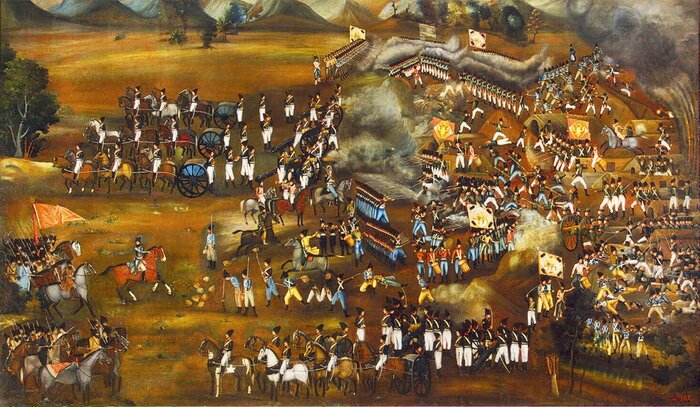
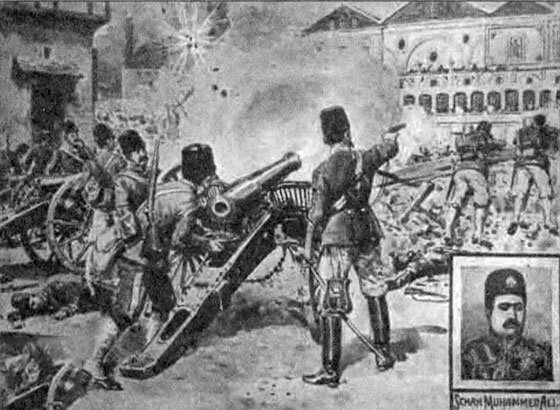
On Tuesday, June 23, 1908, the newly established National Assembly of Iran, which was the achievement of the constitutional revolution (the first popular revolution in the Middle East and Asia), was destroyed with artillery by the Russian officer Liakhov.
This action was in line with the agreement of the Russian government with the new king Muhammad Ali Shah Qajar, who sought the return of tyranny and the destruction of the constitutional system. It seems that Russia has always considered the establishment of democracy and the threat of tyranny in the region against its interests. Russians always thought that democracy meant the influence of Western power in the zone, so they considered fighting against it as part of their duties.
In St. Petersburg on August 31, 1907, a treaty was concluded by the Russian Empire and the British Empire about Iran. This treaty was the last step towards creating a triangular understanding that solved the problems between Britain and Russia, it united these two countries with France. According to this treaty, Iran was divided between the Russians and the British.
The northern region was awarded to the Russian Empire and the southern region to the British Empire. The middle zone was supposed to act as a neutral zone. Northern Iran was occupied by the Russians and after World War I, the British advanced towards Shiraz by occupying the southern regions of Iran. In Iran, the newly established constitutional system was the first experience of its kind in this region of the world.
So, the pillars of the shaky government and many necessary institutions had not yet been established. In such a situation, the occupation of Iran’s territory from the north by Russia and from the south by England destroyed the foundations of the new political system.

World War II Iran had declared itself neutral. Can you guess what force violated this neutrality? During the Second World War, the Russians created the right opportunity for the ethnic groups to call themselves a nation claim the establishment of an independent republic, and desire to join the Soviet Union.
In the Iran-Iraq war, more than 85% of the war equipment in Iraq was supplied by the Russians. Here you can see some of the Russian weapons delivered to Saddam Hussein.
The sovereignty of the three islands of Big Tunb, Small Tunb, and Abu Musa is one of the territorial disputes between Iran and the United Arab Emirates. Despite the historical and legal documents based on the belonging of these three islands to Iran, the Russian government now considers these three islands a part of the United Arab Emirates.
This issue is not about the governments of Russia and the government in Iran in previous times. Currently, Vladimir Putin’s government does not consider these three islands to be part of Iran, and the Islamic Republic (the religious government that rules Iran) has never officially complained about Putin’s position.
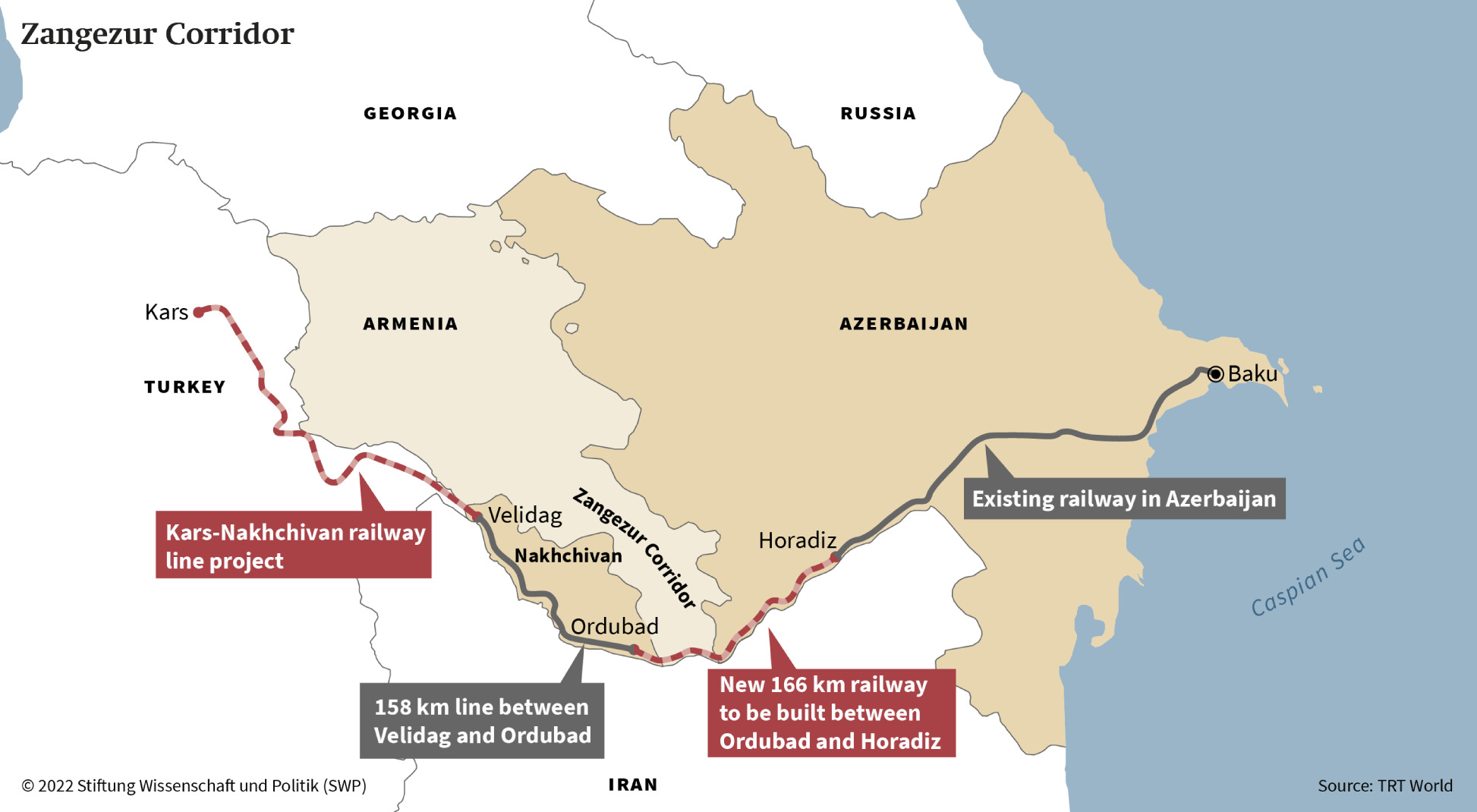
The Zangzur corridor is a transportation route that, if implemented, will give the Republic of Azerbaijan unhindered access to the Nakhchivan region through the Sivnik province of Armenia without Armenian checkpoints.
This will permanently cut the borders of Iran and Armenia. In a broad sense, it is a geopolitical corridor that excludes Iran from the transit route of Türkiye to Baku. It is interesting to know that Russia is the most important power that seeks to establish this crossing and cut off the land access of Iran and Armenia to each other.
Despite such a history of relations between the two countries of Iran and Russia, any observer is sure that sending missiles or any other military weapon from Iran to Russia is not to achieve economic benefits and national security. How is it possible that the government in Iran sends weapons to this country after all these violations of security, territorial integrity, and economic strikes by Russia? To better understand the answer to this question, it is necessary to consider the next section.
2. -the pattern of distance and closeness between Russia and the religious regime
The distance or closeness between the Islamic regime and Russia has not been permanent. In the era of the communist regime, due to the fundamental distances of the epistemic standards, the two regimes cannot be related to each other. However, the Islamic regime wished that the Islamic ideological foundations would somehow be attention by the communists. However, after the fall of communism, the relations between Iran and Russia had ups and downs due to the different characteristics of Russia.
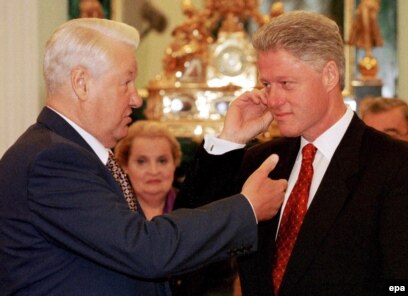
During the first years of Boris Yeltsin’s presidency, the dominant discourse on Russia’s foreign policy was Atlanticism. In these years (1991-1996), the Atlanticists led by Andrei Kozyrev defined Russia’s national interests and identity in terms of European and Western identity. They sought Russia’s interests only in developing relations with the West. During this period, the relations between Moscow and Tehran dropped to their lowest level.
When Putin came to power, the policy of pragmatism became the headline of the Russian government. This means that during the years of Putin’s rule, by combining the approaches of looking to the East and looking to the West to present an independent face from the West, it was enough for the Islamic Republic to have a desire to be close to Russia.
Putin’s relative distancing from liberal democracy caused improved relations between the religious government and Russia. We should not exaggerate the warmth of these relations, as much as Russia cooperated with the West and specifically with liberal democracy (in the case of Afghanistan, Iran’s nuclear issue, and relations with Israel), the religious government distanced itself from Russia.
When Russia confronted the policies of the West and especially the United States, the Religious government showed a greater desire for relations. The strategic impact of the pragmatic policies of the first period of Putin’s government on Iran-Russia relations can be seen at the beginning of the third millennium. In 2000, Russia announced its withdrawal from the 1995 agreement between Al Gore (then US Vice President) and Chernomerdin (then Russian Prime Minister), which prohibited Moscow-Tehran arms relations, and in practice started a new round of relations and cooperation with Iran.
However, the religious regime’s honeymoon with Russia did not last long. At the same time as the September 11 incident, and Russia’s cooperation with the United States, we are again witnessing the distancing of the Islamic State from Russia.
Although during the war and crisis in Georgia, which was accompanied by cold relations between Russia and the West, the Islamic Republic again considered itself close to Russia, but with the turn to the West in 2008 with the presidency of Dmitry Medvedev, the relations between the religious government and Russia got cold. Medvedev believed Russia needed better relations with the rich world, especially the United States and the European Union, for modernization and economic development.
It was at this time that Medvedev signed the decree imposing restrictions on cooperation with Iran and refusing to deliver the S-300 system to Iran. In the continuation of this distance, we see frequent delays in launching the Bushehr nuclear power plant by Russia.
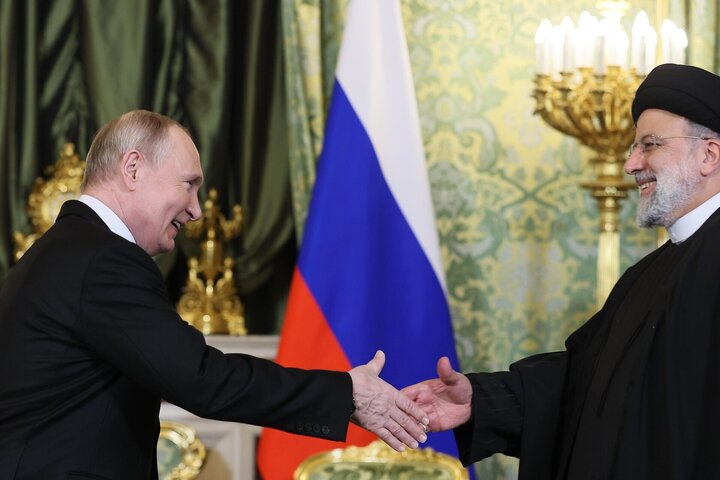
With Putin’s return to office and his anti-Western positions, the Islamic regime has again thrown itself into the arms of Russia and we are witnessing the close relations between the two countries. In a way, today, with the export of weapons from Iran to Russia, which I think is the first time, we are witnessing an exceptional situation in the history of relations between the two countries.
The above two sections show two specific issues. First: The history of Russia’s relations with Iran has never been based on providing economic benefits, national security, and convergence. Second; in the era of the Islamic Republic, what is effective in these relations is the measure of closely related and distance of Russia from the West. In other words, the more Russia distances from the West, the more inclined the Islamic Republic is to interact with Russia. Given that, this interaction has never been based on providing economic benefits and national security, it should be concluded that the most effective factor in the relations between these two countries is the Islamic government’s hatred of the West.
The ideology of Islamism was the reaction of persons who organized their social life based on religious teachings. Until entering modernism and new sciences, they did not know the consequences of traditional life. With the arrival of the elements of the new world, a serious challenge arose for the heralds of religious norms. Islamism was an intellectual and practical resolution to this challenge.
Obviously, according to Islamism, everything that causes this challenge should be rejected. In international relations, the West, especially the United States, is a main manifestation of modern human rationality. It is not strange that Islamists hate this rationality.
Despite such rationality, religious heralds like; Mullahs cannot introduce themselves as the only source of truth and distinguish between right and wrong. In the above, it can be seen how the Islamist government of Iran defines its relations with Russia by fighting against Western rationality.
Despite Russia considering the three islands of the Persian Gulf as belonging to the United Arab Emirates and also insisting on the creation of the Zangzur corridor – both of which are a clear violation of Iran’s national security and territorial integrity – however, the Islamic regime is ready to provide weapons for Russia to participate in the struggle with the rationality of liberal democracy.
The long article above shows that any international policy to change the behavior of the Islamic regime, which is based on economic interests and investment opportunities will not affect it. The history of relations between the Islamic government and Russia shows that the economy and welfare of the people are not important for the Islamic government.
What determines government behaviors is the fight against human rationality that has undermined the legitimacy of religious preachers as the only source of truth. According to this situation, the idea that it is possible to influence the decisions of this government by providing economic incentives is far from reality. The misconception became clear to everyone after the JCPOA. The reason that caused Donald Trump to tear up the JCPOA.