


Abstract
Yaqub Sanu’s political thought—expressed through journalism, satire, and oppositional theater—represents one of the earliest and most influential currents in shaping nationalist public opinion in nineteenth-century Egypt. This article first situates Sanu’s life within its historical context, then analyzes the key components of Yaqub Sanu’s political thought. Subsequently, it explores the impact and functions of his ideas on domestic politics and resistance to colonial encroachment. Finally, it highlights the challenges he faced, his intellectual legacy, and the contemporary relevance of his vision for political activism in the Arab world.
Introduction
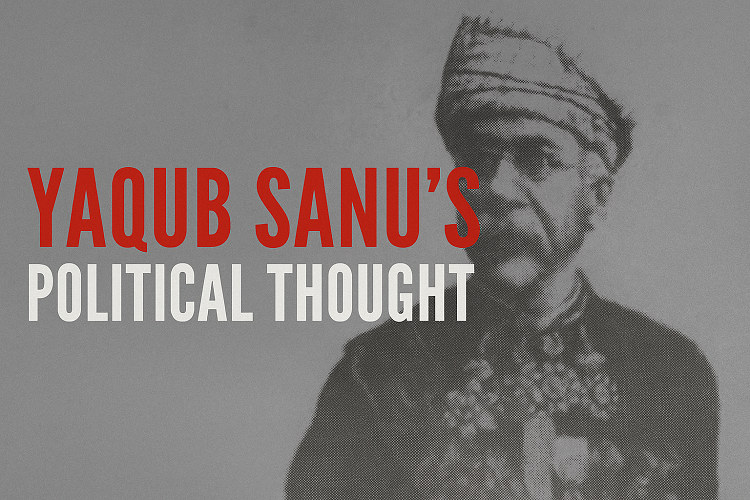
Yaqub Sanu (also known as James Sanua or Abu Naddara) stands as one of Egypt’s most remarkable intellectuals, journalists, and playwrights of the nineteenth century. Through the satirical magazine Abu Naddara Zarqa and his popular plays, he challenged autocracy, corruption, foreign domination, and social injustice. Yaqub Sanu’s political thought was not confined to abstract theorizing; rather, it was deeply rooted in lived experience, expressed through humor, caricature, and colloquial Egyptian Arabic. By targeting both domestic tyranny and foreign intervention, his political thought offered Egyptians a powerful cultural weapon to imagine justice and national independence.
This article seeks to provide a comprehensive analysis of Yaqub Sanu’s political thought by exploring its historical foundations, thematic components, political functions, challenges, and enduring influence.
Part I: Biography and Historical Context
Life and Education of Yaqub Sanu
- Born in Cairo in 1839 to a Jewish Egyptian family of Italian heritage, Sanu grew up in a cosmopolitan environment.
- He studied in Livorno, Italy, where he received training in languages, arts, political economy, and international relations.
- Upon returning to Egypt, he taught languages, founded theater companies, and introduced plays in colloquial Egyptian Arabic—breaking away from classical Arabic conventions.
The Political Climate of 19th-Century Egypt
- Under Khedive Ismail, Egypt embarked on ambitious modernization projects, financed through heavy borrowing, which ultimately entrenched corruption and foreign financial control.
- Rising foreign influence (especially from Britain and France) and increasing censorship created fertile ground for oppositional discourse.
- Intellectuals, journalists, and emerging middle-class groups demanded accountability, political participation, and freedom of expression.
This environment provided the backdrop for Yaqub Sanu’s political interventions through satire, theater, and journalism.
Part II: Core Components of Yaqub Sanu’s Political Thought
Resistance through Satire and Caricature
- Sanu pioneered political caricature in Egypt with his journal Abu Naddara, making satire a vehicle for mass political critique.
- He employed colloquial Egyptian Arabic rather than formal literary Arabic, ensuring accessibility for the wider public.
- His satirical voice exposed state abuses and gave ordinary Egyptians a cultural vocabulary of dissent.
Nationalism and Independence
- A central theme of Yaqub Sanu’s political thought was nationalism—“Egypt for the Egyptians.”
- He fiercely criticized foreign interference, financial domination, and the Khedive’s submissiveness to European powers.
- His writings articulated popular aspirations for sovereignty and self-rule.
Social Justice and Anti-Corruption
- Sanu denounced government extravagance, mismanagement, and the oppressive tax system that burdened peasants.
- His satire linked corruption at the top with suffering among the poor, making his critique resonate widely.
- He envisioned reforms in administration, justice, and education as prerequisites for a fairer society.
Freedom of Expression and Public Enlightenment
- Despite censorship and eventual exile, Sanu championed the freedom of the press.
- His illustrated satire allowed even semi-literate audiences to grasp complex political messages.
- He emphasized education and public awareness as essential tools of empowerment.
Part III: Functions and Impact of Yaqub Sanu’s Political Thought
Shaping Public Opinion in Egypt
- Through his satirical plays and the Abu Naddara press, Sanu mobilized Egyptians around the ideals of accountability, justice, and independence.
- He created a new cultural space where humor and criticism converged to challenge authoritarian power.
Resistance to Colonial Domination
- After his exile to Paris in 1878, Sanu continued publishing Abu Naddara, smuggling issues back into Egypt.
- His bilingual editions (Arabic and French) allowed him to address both Egyptian and European audiences, exposing colonial abuses internationally.
Cultural Legacy
- Sanu is widely considered the “father of modern Arabic theater” and a pioneer of satirical journalism.
- His fusion of theater, caricature, and journalism shaped later traditions of political satire in Egypt and beyond .
Part IV: Challenges and Limitations
Censorship and Exile
- Sanu’s plays were banned in 1872, his journal was shut down, and he was forced into exile in Paris by 1878.
- While exile allowed him intellectual freedom, it limited his ability to directly influence Egyptian politics.
Tension Between Colloquial and Classical Language
- His use of colloquial Arabic democratized political critique but invited criticism from conservative intellectuals who considered it “low culture.”
Lack of Systematic Political Theory
- Sanu was primarily a satirist and activist, not a systematic theorist.
- While he offered sharp insights into justice, corruption, and independence, he did not articulate a comprehensive model of governance.
Part V: Contemporary Relevance of Yaqub Sanu’s Political Thought
Inspiration for Arab Political Satire
- Modern Arab satirists—whether in print, television, or social media—inherit Sanu’s legacy of resistance through humor.
- His methods remain strikingly relevant in societies where censorship persists and humor becomes a safe yet subversive weapon.
Application in the Digital Era
- Social media memes, caricatures, and satirical sketches echo Sanu’s approach, democratizing political critique for broad audiences.
- His emphasis on public education and mass communication aligns with today’s calls for digital literacy and civic awareness.
Directions for Further Research
- Comparative studies of Sanu and contemporary Arab satirists.
- Exploration of his bilingual strategy as an early form of transnational political communication.
- Archival research using the Abou Naddara Collection for in-depth textual and visual analysis.
Conclusion
Yaqub Sanu’s political thought represents a powerful synthesis of satire, nationalism, and advocacy for social justice. By blending humor with biting political critique, he challenged tyranny, corruption, and colonial domination, empowering Egyptians to envision independence and accountability. Although he lacked a fully systematized political theory and faced exile, his cultural innovations—political caricature, colloquial theater, and oppositional journalism—endure as a lasting legacy.
In the twenty-first century, with authoritarianism and censorship still present across parts of the Arab world, Sanu’s model of political resistance through satire remains not only historically significant but also profoundly relevant.


You really make it seem so easy with your presentation but I find this matter to be actually something that I think I would never understand. It seems too complex and very broad for me. I am looking forward for your next post, I’ll try to get the hang of it!