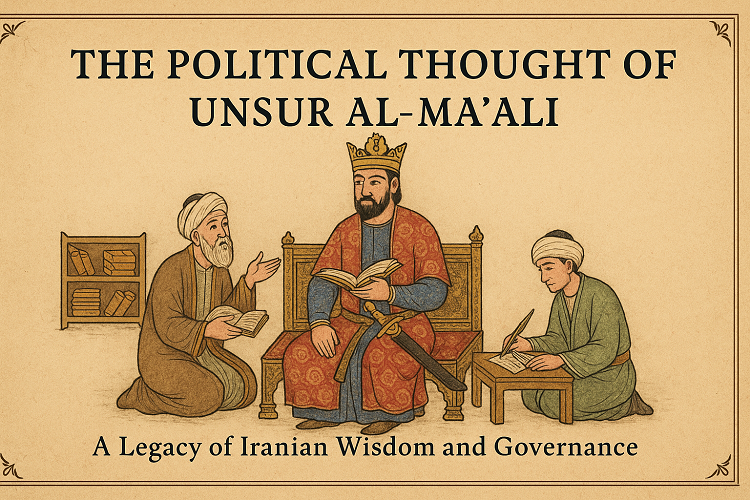
The political thought of Unsur al-Ma‘ali, the celebrated author of Qabus-Nama, represents a compelling synthesis of ethics, governance, and practical wisdom in the Persian intellectual tradition. Unsur al-Ma‘ali Kaykavus ibn Iskandar ibn Qabus Ziyar (d. 1083 CE) was a prince of the Ziyarid dynasty. By composing the Qabus-Nama for his son Gilanshah, he left behind a monumental guide not only for personal conduct but also for political leadership. This article explores the structure, key concepts, and enduring values of his political philosophy, offering a comprehensive account of his contributions to Islamic and Iranian political thought.
Historical and Political Context of Unsur al-Ma‘ali
To fully understand the political thought of Unsur al-Ma‘ali, one must first consider the socio-political environment in which he lived. As a descendant of Qabus ibn Vushmgir—a culturally inclined ruler who had connections with intellectuals like Avicenna—Unsur al-Ma‘ali belonged to a period of shifting political structures. The weakening of the Abbasid Caliphate gave rise to regional dynasties in Iran. During this time, questions of political legitimacy, royal ethics, and the education of rulers became paramount.
Qabus-Nama: More than a Book of Ethics
While Qabus-Nama is often categorized as an ethical and didactic work, it is also a deeply political and strategic text. Through its forty-four chapters, Unsur al-Ma‘ali sets forth a model of ideal kingship, effective administration, and social harmony. Consequently, the political thought of Unsur al-Ma‘ali extends beyond courtly etiquette and addresses the moral foundations of statecraft and leadership.
Political Virtue in Unsur al-Ma‘ali’s Thought
A central tenet in Unsur al-Ma‘ali’s political philosophy is the concept of political virtue. Unlike those who view politics merely as a tool for power maintenance, he believed that virtue is the cornerstone of legitimate rule. He repeatedly urges his son to avoid injustice, dishonesty, and cruelty, famously stating that “a kingdom may survive disbelief, but it cannot survive injustice.” Thus, he positions justice as both a moral imperative and a political necessity.
Teaching Politics through Experience
Another defining feature of the political thought of Unsur al-Ma‘ali is his reliance on personal experience. Throughout Qabus-Nama, he shares insights from his own life—mistakes, diplomatic encounters, and governance challenges. This experiential method highlights his view that political wisdom is gained not only through study but also through practice. In effect, his politics is grounded in observation, trial, and reflection.
Ethics, Religion, and Politics: An Integrated Vision
Unsur al-Ma‘ali envisions politics as part of a triad involving ethics and religion. The ruler, in his view, is not only a political leader but also a moral exemplar and guardian of divine law. He intertwines Islamic values with Persian notions of divine kingship (farr-e izadi), advocating a balanced model where justice, piety, and rational governance coexist.
Justice as a Foundational Principle
Justice is perhaps the most critical theme in the political thought of Unsur al-Ma‘ali. He asserts that without justice, no kingdom can endure. Importantly, he does not limit justice to the political sphere; rather, it should also guide personal, economic, and social interactions. Justice, therefore, becomes a comprehensive framework for sustaining human dignity and social order.
Bureaucracy and the Role of State Institutions
The administrative apparatus is another vital element in Unsur al-Ma‘ali’s conception of governance. He repeatedly advises the ruler to consult knowledgeable secretaries, viziers, and judges. For him, a functioning bureaucracy is not merely a technical necessity but a guarantor of justice and effectiveness. He outlines the qualifications for good scribes and loyal ministers, reflecting a nuanced understanding of institutional governance.
Royal Education: Politics Begins at Home
Given that Qabus-Nama is a paternal guidebook addressed to a prince, Unsur al-Ma‘ali emphasizes the early political training of future rulers. He encourages learning in languages, logic, swordsmanship, and the study of historical political texts. This approach underscores his belief that politics is a multidimensional skill that requires both moral character and practical acumen, which are cultivated from youth within the royal household.
Comparing Unsur al-Ma‘ali with Other Persian Mirror-for-Princes Writers
Unsur al-Ma‘ali belongs to the broader tradition of Persian mirrors for princes, alongside figures like Ibn al-Muqaffaʿ and Nizam al-Mulk. Yet, he differs in one crucial aspect: he was not merely an advisor but a practicing prince. Thus, the political thought of Unsur al-Ma‘ali is rooted in realpolitik rather than abstract theory, making it pragmatic, candid, and occasionally cautionary.
The Ruler-Subject Relationship: Mutual Respect and Proto-Social Contract
Interestingly, Unsur al-Ma‘ali hints at a form of social contract. He insists that while subjects must respect their ruler, this respect must be earned through justice and kindness. Tyranny is not only immoral but also strategically foolish, as it alienates the populace and weakens the state. The relationship between the ruler and the ruled, therefore, must be reciprocal and grounded in trust.
The Legacy of Unsur al-Ma‘ali’s Political Thought
The political thought of Unsur al-Ma‘ali had a long-lasting impact on Persian political culture. Qabus-Nama served as a manual for training princes and administrators well into the Timurid and Safavid periods. Its influence extended beyond politics into literature, inspiring writers such as Saʿdi. The integration of ethics, governance, and practicality in his work ensured its relevance across centuries.
Conclusion: Politics as the Art of Living
In conclusion, the political thought of Unsur al-Ma‘ali elevates politics beyond mere power dynamics. For him, politics is an art of living—one that requires virtue, reflection, and a commitment to the public good. He challenges us to envision governance not as domination but as a form of ethical stewardship.
In an era increasingly disillusioned with politics, revisiting the insights of Unsur al-Ma‘ali offers a refreshing and timeless perspective on leadership, justice, and human dignity.