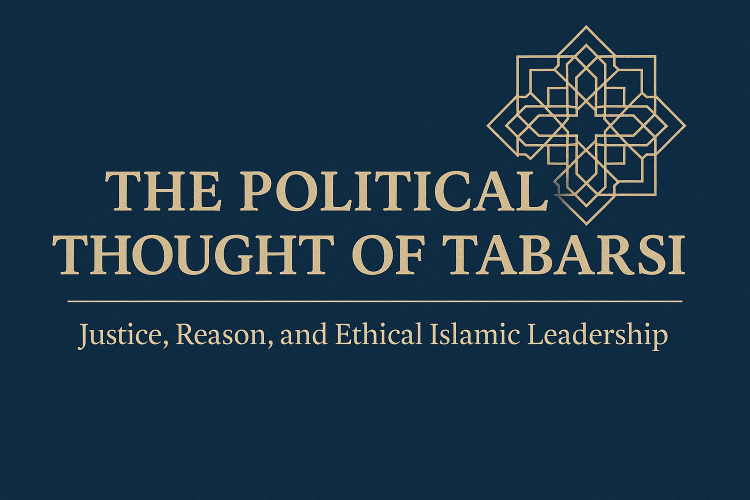
The political thought of Tabarsi represents one of the most coherent and sophisticated Shiite perspectives on the relationship between religion and politics in the Islamic Middle Ages. Fazl ibn Hasan Tabarsi, a distinguished Shiite scholar and the author of Majma’ al-Bayan fi Tafsir al-Qur’an, is not merely a Qur’anic commentator. Rather, in his exegetical introductions, ethical writings, and theological treatises, he provides a theoretical foundation for governance, leadership, justice, and social order. This article explores the major components of his political philosophy.
The Life and Times of Fazl ibn Hasan Tabarsi
Tabarsi’s Position in the Shiite Intellectual Tradition
Tabarsi (d. 548 AH / 1154 CE) lived during the 12th century in Khorasan, a period marked by sectarian tensions, the rise of Shiite states, and growing interaction with Mu’tazilite rationalism. As a major figure in the Imami tradition, his works—especially Majma’ al-Bayan—played a vital role in shaping the rationalist and juristic character of Shiism.
Affinity with Rationalist Moderation
Although rooted in Shiite theology, Tabarsi was strongly influenced by Mu’tazilite logic and rationalism. He harmonized transmitted religious texts with reasoned interpretation, offering a comprehensive understanding of religion’s political function. Therefore, the political thought of Tabarsi exemplifies a rationalist-religious synthesis.
Theological Foundations of the Political Thought of Tabarsi
Divine Sovereignty as the Basis of Governance
At the heart of Tabarsi’s political theology lies the doctrine of divine sovereignty. Political authority, in his view, ultimately belongs to God. Human governance must conform to divine will, thus directly linking political legitimacy to Shiite notions of Imamate.
The Role of Reason in Political Legitimacy
Significantly, Tabarsi affirms the independent capacity of human reason to discern moral truths. This premise underpins his belief that rational evaluation plays a key role in identifying just rulers. Hence, authority derived from coercion or lineage alone lacks legitimacy.
Justice in the Political Thought of Tabarsi
Justice as a Criterion of Legitimate Rule
Justice is a central concept in the political thought of Tabarsi. A legitimate ruler must be just—not only personally but in the structure and policies of governance. Tabarsi emphasizes that any ruler failing to uphold justice forfeits his religious legitimacy.
Social Justice and the Responsibility of Government
Unlike certain Sunni perspectives, Tabarsi insists that rulers are duty-bound to uphold social equity. He references Qur’anic verses on fairness and interprets them as mandates for public welfare. Thus, his thought ventures into the realm of public law and social justice.
The Link Between Imamate and Politics in Tabarsi’s View
The Imam as Religious and Political Leader
For Tabarsi, as for all Shiite thinkers, the Imam is both a religious guide and a political leader. In his writings, including the preface to Majma’ al-Bayan, he outlines the Imam’s duty to govern and guide the Muslim community in accordance with divine justice.
The Occultation and the Role of Scholars
One of the key questions in Shiite political theory is leadership during the Imam’s occultation. While Tabarsi does not explicitly endorse clerical authority, his theological framework provides the groundwork for later theories of juristic governance, including Wilayat al-Faqih.
The Political Thought of Tabarsi on the Religion–Politics Relationship
Religion as a Comprehensive Guide to Life
For Tabarsi, Islam is not a purely private or ritual faith. Rather, it encompasses governance, law, ethics, and public life. Therefore, a political system divorced from religious guidance is inherently flawed and incomplete.
An Early Critique of Proto-Secularism
Although unfamiliar with modern secularism, Tabarsi’s criticism of rulers who ignore divine law implies a strong rejection of political secularism. The political thought of Tabarsi thus draws a clear line between religious governance and irreligious statecraft.
Ethics, Governance, and Leadership
Politics as a Moral Responsibility
In works like Makarem al-Akhlaq, Tabarsi advocates for a vision of governance grounded in service, consultation, and moral integrity. Leaders, he argues, should view politics as a trust rather than a tool for domination.
Piety and Asceticism in Governance
Tabarsi repeatedly underscores the importance of piety and self-restraint for those in power. He believes that only an ethical state, led by morally upright individuals, can maintain justice and legitimacy—thus, rejecting any form of Machiavellian pragmatism.
Critique of Contemporary Political Powers
Implicit Criticism of Sunni Caliphs
While not overtly polemical, Tabarsi’s emphasis on the qualities of a just Imam serves as an indirect critique of Sunni rulers who lacked these attributes. His ideal of leadership implicitly challenges the legitimacy of dynastic or coercive rule.
Reform over Rebellion
Importantly, Tabarsi does not advocate violent revolt. Instead, he calls for moral reform, public education, and gradual social change. In this respect, he resembles a religious reformer more than a revolutionary.
The Legacy of the Political Thought of Tabarsi in Shiite Jurisprudence
Influence on Later Shiite Thinkers
The political thought of Tabarsi, especially his fusion of justice, reason, and scriptural fidelity, deeply influenced later scholars such as Muhaqqiq al-Hilli, Nasir al-Din al-Tusi, and Allama al-Hilli. His writings helped shape the rational-juristic Shiite political tradition.
Foundations for the Theory of Jurist Guardianship
Though Tabarsi does not articulate a theory of Wilayat al-Faqih, his intellectual framework—emphasizing rational governance and divine justice—provided the conceptual groundwork for its later development in the Safavid and post-Safavid periods.
Conclusion: The Contemporary Relevance of the Political Thought of Tabarsi
Ultimately, the political thought of Tabarsi offers a balanced, ethical, and intellectually grounded approach to Islamic politics. His integration of reason, scripture, and moral duty continues to resonate in contemporary debates on Islamic governance. In an age marked by authoritarianism and ideological extremism, Tabarsi’s vision stands as a testament to moderation and moral leadership.