Introduction: The Role of Shaykh al-Tusi in Shiite Political Thought
The political thought of Shaykh al-Tusi constitutes a cornerstone in the formation of Shiite jurisprudential and political theory. Shaykh Muhammad ibn Hasan al-Tusi, known as Shaykh al-Ta’ifah, was not only a prominent jurist but also a key architect of Shiite religious institutions and socio-political frameworks during the classical Islamic era. His works, such as al-Mabsut, al-Khilaf, al-‘Uddah, and Talkhis al-Shaykh, played a fundamental role in shaping the Shiite perspective on governance, the occultation of the Imam, and the role of jurists.
He lived in a turbulent period marked by political and theological upheaval. The Abbasid Caliphate was in decline, and the Buyid dynasty, with its Shiite leanings, provided a fertile ground for Twelver Shiism to flourish. This context both shaped and was shaped by al-Tusi’s political theory.
Historical and Social Context of Shaykh al-Tusi’s Era
To understand the political thought of Shaykh al-Tusi, it is essential to examine the historical context of his time. Born in 385 AH (995 CE) in Tus, he later migrated to Baghdad and studied under Shaykh al-Mufid and Sayyid al-Murtada. Baghdad at the time was a major center of Shiite scholarship and a hotbed of political and sectarian tensions.
Buyid Rule and the Rise of Religious Institutions
The Buyid dominance over the Abbasid Caliphate enabled Shiites to establish religious institutions and take part in social organization. Al-Tusi emerged as a key figure in both scholarly and political-religious life. However, after the fall of the Buyids and the Seljuk invasion, his house and library were destroyed. He subsequently moved to Najaf, where he laid the foundation for what would become the Najaf seminary (hawza).
Foundations of Shaykh al-Tusi’s Political Thought
Differentiating Between the Era of the Imam and the Occultation
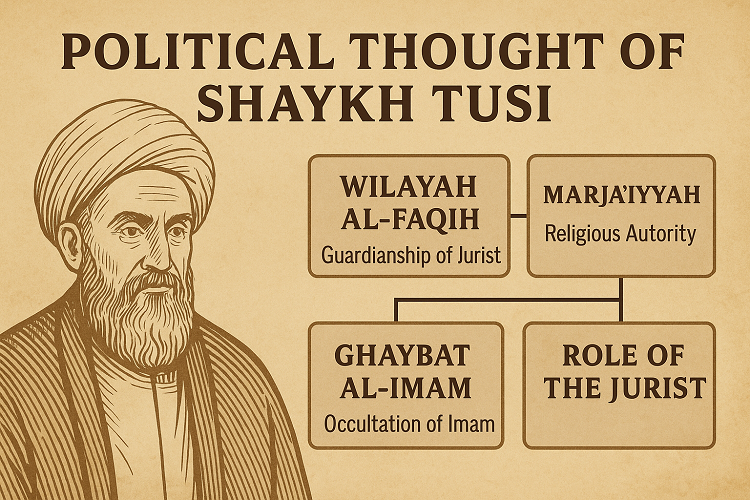
A central component of the political thought of Shaykh al-Tusi is his clear distinction between the era of the present Imam and the era of the Occultation (ghayba). During the Imam’s presence, he holds exclusive political and religious authority. However, in the era of Occultation, jurists act as the Imam’s general representatives and assume responsibility for maintaining social and religious order.
In other words, al-Tusi sought a legitimate solution to the power vacuum without undermining the principle of Imamate. This theoretical approach would later evolve into the full doctrine of Wilayat al-Faqih (Guardianship of the Jurist).
The Role of Jurists During Occultation
Using hadiths and legal reasoning, al-Tusi granted jurists the authority to judge, collect religious taxes, and manage public affairs in the Imam’s absence. He wrote:
“The just jurist who meets the criteria of ijtihad is entitled to perform the functions of the Imam when the Imam is in occultation.”
This indicates his belief in the jurist’s legitimate role—not as a political ruler per se, but as a religious and social guardian.
Politics in the Service of Sharia
In al-Tusi’s worldview, politics is subordinate to Sharia, not independent from it. Unlike some Sunni thinkers who see the Caliphate as a rational necessity, al-Tusi sees political legitimacy as dependent upon the approval of the Imam or his juristic representatives.
Political Aspects in the Works of Shaykh al-Tusi
1. Al-Mabsut fi Fiqh al-Imamiyyah
This expansive legal work contains not only rulings on worship and transactions but also discussions on jihad, Imamate, governance, and judiciary. Al-Tusi authorizes jurists to judge and administer public religious funds, revealing his belief in their pivotal societal role.
2. Al-Khilaf
A comparative jurisprudential work, al-Khilaf contrasts Shiite and Sunni legal opinions. Politically, al-Tusi challenges the legitimacy of Abu Bakr’s caliphate and emphasizes the divinely appointed leadership of Imam Ali.
3. Al-Iqtisad fi Ma Yata‘allaq bil-I‘tiqad
This theological text addresses the Imamate as a core tenet of faith. Al-Tusi stresses that without an Imam, guidance—both religious and political—remains incomplete.
Comparison with Other Shiite Thinkers
With Shaykh al-Mufid
Al-Tusi’s teacher, Shaykh al-Mufid, was the first to outline the idea of Wilayat al-Faqih. However, al-Tusi advanced the theory by systematizing it within fiqh and broadening the practical role of jurists.
With ‘Allamah al-Hilli
Two centuries later, ‘Allamah al-Hilli expanded on al-Tusi’s framework by integrating it with theological and philosophical reasoning. Thus, al-Tusi serves as the pivotal link between early theoretical formulations and later systematic political doctrines.
Institutionalization of Religious Authority
One of Shaykh al-Tusi’s great innovations was the establishment of the Najaf Seminary and the institutionalization of religious authority. By relocating to Najaf and teaching near the shrine of Imam Ali, al-Tusi established a center for religious learning independent of political regimes.
This marked the transformation of Shiite jurisprudence into an autonomous socio-political institution—an essential development in the long-term evolution of Shiite political identity.
The Relationship Between Religion and Government
For Shaykh al-Tusi, religion and government are not separate domains. Rather, the state exists as a means to implement Sharia. Nonetheless, during the Occultation, he does not advocate for the establishment of a Shiite state; instead, he focuses on expanding juristic and ethical influence over society. This reflects a type of conservative pragmatism in his political thought.
Conclusion: The Enduring Legacy of Shaykh al-Tusi’s Political Thought
The political thought of Shaykh al-Tusi represents a watershed in the history of Shiite political jurisprudence. By articulating the theory of juristic representation during the Occultation and establishing Najaf as an independent religious center, he laid the groundwork for centuries of Shiite political and legal development.
Rather than seeking direct control of power, al-Tusi emphasized the religious, ethical, and communal leadership of jurists. His legacy continues to shape modern Shiite political structures, most notably the theory of Wilayat al-Faqih as realized in the contemporary Islamic Republic of Iran.
Ultimately, Shaykh al-Tusi brought Shiite jurisprudence from the margins to the heart of sociopolitical life, achieving a lasting synthesis of theology, law, and authority.