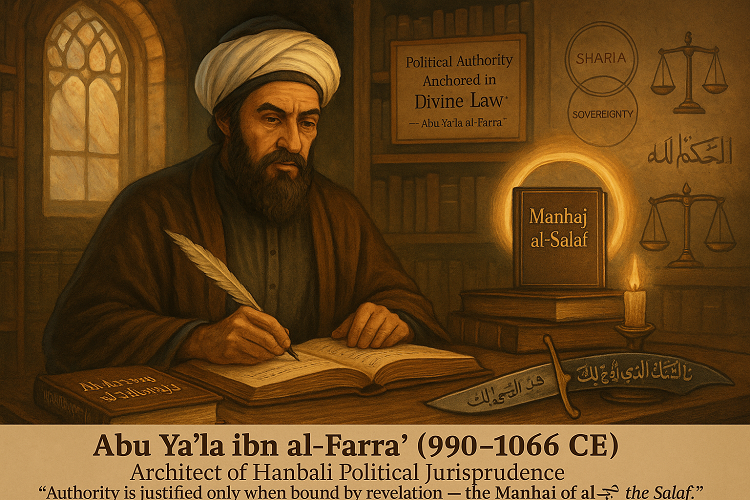
The political thought of Qadi Abu Ya’la Ibn al-Farra stands as one of the foundational contributions to the theory of caliphate within the Hanbali school of jurisprudence. Living in the 5th century AH (11th century CE), Ibn al-Farra developed a systematic approach to legitimize the caliphate and define the responsibilities of the ruler, based on Hanbali traditionalism and strict adherence to religious texts. This article examines the various aspects of his political ideas and evaluates their contribution to the development of Sunni political jurisprudence.
Intellectual Biography of Qadi Abu Ya’la
Qadi Abu Ya’la Muhammad ibn al-Husayn ibn Muhammad ibn Khalaf Ibn al-Farra was born in 451 AH (1059 CE) in Baghdad. He studied under prominent scholars such as Abu Bakr Abd al-Rahman ibn Muhammad ibn Musa and quickly rose to prominence within Hanbali scholarly circles. Renowned not only for his expertise in jurisprudence but also in legal theory, theology, and judicial practice, he authored significant works in political jurisprudence.
Among his most influential writings is al-Ahkam al-Sultaniyya, considered one of the earliest codified texts of Hanbali political theory. The book was composed in response to the weakening authority of the Abbasid caliphate and the rising influence of military rulers.
Theoretical Foundations
The Integration of Law and Politics
For Qadi Abu Ya’la, politics is inseparable from Sharia. He viewed the caliphate as a continuation of the Prophet’s political leadership—not in the capacity of prophethood but in the responsibility of preserving religion and administering worldly affairs. Therefore, he sought to define the caliphate through legal reasoning, grounding political authority in religious legitimacy.
The Role of Consensus and Reason
Although the Hanbali school is traditionally characterized by a strong emphasis on textual sources, Ibn al-Farra occasionally incorporates consensus (ijmaʿ) and reason (ʿaql) in specific areas, such as the qualifications of the imam. He asserts that the legitimacy of the ruler must be recognized by the consensus of the knowledgeable elite, albeit within a strictly defined religious framework. His use of reason is pragmatic, aimed at resolving contemporary political dilemmas rather than theorizing abstractly.
Core Features of the Caliphate in the Political Thought of Qadi Abu Ya’la Ibn al-Farra
Qualifications of the Imam and the Legitimacy of Rule
A central element of Ibn al-Farra’s political theory is his discussion on the qualifications (shurut) of the imam. He lists justice, knowledge of Sharia, administrative capability, and descent from the Quraysh tribe as necessary traits. Importantly, he asserts that rulership lacking these conditions is not legally valid. However, in exceptional circumstances—such as political crises—he admits the possibility of de facto leadership based on necessity.
This notion introduces the concept of taghallub (usurpation of power) into his theory, albeit implicitly. Unlike rationalist thinkers such as al-Mawardi, Ibn al-Farra opens the door to recognizing governments that come to power through force, provided they uphold Islamic rituals and maintain public order.
Duties of the Caliph
According to Ibn al-Farra, the caliph has multiple obligations: to lead prayers, enforce legal punishments (hudud), defend borders, collect zakat, judge between people, and uphold justice. He stresses that neglecting these responsibilities undermines the ruler’s legitimacy. The caliph is not merely a political figure but also the guardian of both religion and public morality.
The Political Thought of Qadi Abu Ya’la Ibn al-Farra with Contemporary Thinkers
Comparison with Al-Mawardi
Both Qadi Abu Ya’la and Abu al-Hasan al-Mawardi were pioneers of Sunni political thought, yet they differ in approach. While al-Mawardi, a Shafi‘i scholar, emphasizes administrative structures and balance of power, Ibn al-Farra, rooted in Hanbali traditionalism, focuses on religious legitimacy and textual authority. He shows less concern for statecraft and more for ensuring the ruler’s compliance with divine law.
The Role of the Community in the Political Thought of Qadi Abu Ya’la Ibn al-Farra
In Ibn al-Farra’s theory, the general public plays a minimal role. The selection of the imam is entrusted to a select group known as ahl al-hall wa al-ʿaqd, consisting of scholars and upright individuals. Thus, popular participation in governance is absent. This reflects a hierarchical vision of society in which religious elites mediate political legitimacy.
Legitimizing Rule in Times of Crisis
Acceptance of the Taghallub Rule
A significant challenge for classical Islamic political theory was how to address the reality of rulers who seized power by force. Ibn al-Farra, like al-Mawardi, was among the first to offer a legal accommodation of such regimes. He conditions the legitimacy of a taghallub ruler on certain criteria: protection of Islam, preservation of security, and commitment to Sharia. In this light, legitimacy is not based on democratic consent but on functional performance within a legal framework.
Distinction Between Legitimacy and Acceptance
In contemporary political theory, a clear distinction is often made between legitimacy (based on principles) and acceptance (based on popular support). Ibn al-Farra does not articulate such a dichotomy. For him, legitimacy is conditional on the ruler’s ability to uphold Islamic law, regardless of public approval. Thus, a pragmatic rather than participatory conception of authority emerges.
Contextual Relevance
The Political Thought of Qadi Abu Ya’la Ibn al-Farra Responding to Abbasid Decline
Ibn al-Farra lived in an era of deep political fragmentation. The Abbasid caliphs had become figureheads, while real power was exercised by military commanders. His political theory attempts to preserve the structure of the caliphate while acknowledging the reality of emergent military regimes. In this sense, his work reflects a form of legal realism.
Conservative Orientation
Despite his realism, Ibn al-Farra remains a conservative thinker. He resists political innovation and prefers to maintain the traditional legal categories. His work does not seek to redefine power or sovereignty but rather to stabilize and legitimize existing institutions through religious law.
Conclusion
The political thought of Qadi Abu Ya’la Ibn al-Farra exemplifies the Hanbali effort to reconcile religious orthodoxy with political necessity. By emphasizing the legal basis of the caliphate, specifying the qualifications and duties of the ruler, and conditionally accepting de facto regimes, Ibn al-Farra offers a model of political jurisprudence that is both principled and pragmatic.
In the contemporary context, revisiting his theories is essential not only for historical understanding but also for exploring the origins of Islamic legal and political concepts. Although his ideas diverge sharply from modern democratic norms, they offer valuable insights into the evolution of Muslim political thought and the challenges of legitimizing authority within a religious framework.