


Introduction
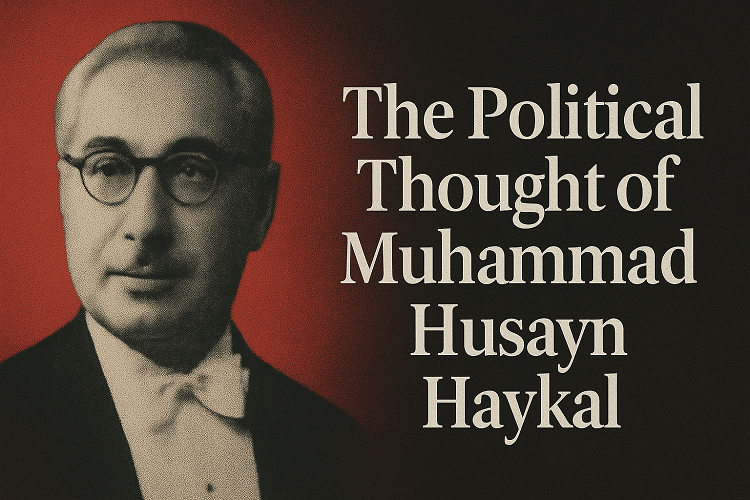
The political thought of Muhammad Husayn Haykal represents a crucial stage in the intellectual transformation of the Arab world, particularly in Egypt during the early twentieth century. Haykal was a journalist, writer, and statesman who sought to reconcile Islamic faith with the values of modernity. At a time when Muslim societies faced the dual pressure of Western colonialism and internal traditionalism, Haykal proposed a balanced path: neither blind imitation of the West nor rigid adherence to outdated traditions.
In his celebrated book The Life of Muhammad, Haykal presented a modern, rational, and humanistic portrayal of the Prophet of Islam. This work symbolized a new intellectual effort to harmonize religion with reason, science, and the idea of progress. In this sense, the political thought of Muhammad Husayn Haykal was not merely a theological exercise but a project of social and political reform grounded in Islamic principles. His writings sought to redefine the relationship between Islam, modernity, and the nation-state — an issue that remains vital in contemporary debates about Islamic reformism.
Islam and Modernity in the Political Thought of Muhammad Husayn Haykal
To understand the political thought of Muhammad Husayn Haykal, one must situate it within the historical and intellectual context of modern Egypt. During his lifetime, Egyptian society was torn between two forces: the cultural dominance of Western colonial powers and the rigidity of traditional religious authorities. Haykal, like his contemporaries Taha Hussein and Ali Abd al-Raziq, attempted to bridge this gap by reinterpreting Islamic thought in light of modern rationality.
Haykal firmly believed that Islam is inherently compatible with reason and civilization. He argued that Muslim decline did not stem from religion itself but from the loss of its rational and moral essence. Using modern methods of historical and textual analysis, he sought to show that Islam encourages scientific inquiry, social progress, and individual freedom.
His book The Life of Muhammad marked a turning point in this intellectual journey. Unlike classical biographies filled with miraculous narratives, Haykal’s work approached the Prophet’s life through the lens of human experience and moral example. He interpreted miracles as symbolic expressions of ethical truths and presented the Prophet as a reformer who sought to establish justice, equality, and rational governance.
Gradually, Haykal’s reflection expanded from theology to political philosophy. He maintained that the Islamic civilization could renew itself not through confrontation with the West, but by reviving its own rational foundations. In his view, modernity should not be imported wholesale but reinterpreted within the framework of Islamic moral and cultural heritage.
Thus, the political thought of Muhammad Husayn Haykal represents a model of “indigenous modernity” — a reformist approach that seeks progress from within the tradition rather than outside it.
Religion, Politics, and the Modern Nation-State
A central element of Haykal’s political thought is his vision of the relationship between religion and politics. While he rejected both theocratic rule and complete secularism, he advocated a moral and balanced connection between the two. For Haykal, religion should inspire politics ethically, not dominate it institutionally.
In the aftermath of the Ottoman Empire’s fall, when many debated the revival of the Islamic Caliphate, Haykal offered a distinctly nationalistic interpretation. He argued that Islam does not require a single political authority over all Muslims; instead, it provides ethical principles that can guide national governance. The modern state, in his opinion, should rest on law, rational administration, and civic participation rather than on dynastic or religious privilege.
Through his editorials in newspapers such as Al-Siyasa, Haykal called for constitutional government, freedom of the press, and equality of citizenship — all of which he viewed as compatible with Islamic notions of justice (‘adl) and consultation (shura). His vision can thus be described as an Islamic form of liberalism, rooted in morality rather than in material individualism.
Haykal was also a strong proponent of Egyptian nationalism (Masriyya). He believed that each Muslim society should pursue reform according to its own cultural and historical circumstances. In this respect, he distanced himself from pan-Islamic movements that prioritized religious unity over national identity. For Haykal, Islam provided the moral fabric of society, while the state represented the collective political will of its citizens.
Ultimately, the political thought of Muhammad Husayn Haykal sought to harmonize ethical religion with the principles of the modern nation-state. He envisioned a polity guided by moral values but grounded in law, reason, and civic responsibility — a synthesis that continues to inspire reformist thinkers today.
The Role of Intellectuals in Arab Reform
Haykal’s political philosophy extended beyond abstract theory. As a journalist and editor, he viewed the press as a vital instrument of enlightenment and reform. He argued that intellectuals must mediate between tradition and progress, between the people and the governing elite.
For Haykal, the decline of Muslim societies was due less to external domination than to internal stagnation — particularly the fear of change and the misuse of religion by political authorities. He believed that reform would only be possible through education, freedom of thought, and the spread of rational discourse. Hence, his political thought can also be understood as a theory of intellectual responsibility and social awakening.
Moreover, Haykal insisted that Islamic reformism should be communicated in accessible language. Unlike scholars who wrote only for clerical audiences, he addressed the emerging middle class and educated youth. His style combined journalistic clarity with philosophical depth, making reformist ideas understandable to the broader public.
He also linked intellectual reform with institutional reform. According to Haykal, true modernization required changes in education, administration, and the media. Without modern institutions, he argued, cultural revival would remain superficial. This comprehensive approach gave his reformism a practical and structural dimension that many of his contemporaries lacked.
Comparison with Muhammad Abduh and Other Egyptian Reformers
The intellectual genealogy of the political thought of Muhammad Husayn Haykal cannot be fully grasped without reference to Muhammad Abduh, the seminal reformer of late nineteenth-century Egypt. Abduh sought to revive Islam by returning to its rational foundations and by showing its compatibility with science, reason, and moral progress. Haykal, a generation later, expanded this vision into the social and political sphere of the modern nation-state.
While Abduh’s project focused primarily on internal religious reform and reinterpretation of the shari‘a, Haykal transformed these principles into a political discourse on state-building and citizenship. In other words, Abduh reformulated theology, while Haykal translated it into political philosophy.
Both thinkers shared a belief in Islam’s inherent rationality and in the necessity of moral renewal. However, their methods differed. Abduh used the language of religious scholarship, appealing mainly to ulama and reform-minded clerics, whereas Haykal deliberately adopted the language of modern journalism and social science to reach a wider audience. This shift of discourse marked a decisive move from the fiqh tradition toward a civic, public-oriented reformism.
Thus, Haykal can be seen as a bridge between Abduh’s theological reform and the later secular reform movements of the Arab world. He preserved Abduh’s moral concerns while embedding them within the framework of modern political institutions such as constitutional government, education, and the media.
When compared with Taha Hussein and Ali Abd al-Raziq, Haykal’s position appears more moderate. Whereas Hussein leaned toward Western historicism and Abd al-Raziq advocated the separation of religion and state, Haykal sought a middle path that retained the ethical essence of Islam within a modern political order. This synthesis made his thought both distinctive and enduring.
Conclusion
The political thought of Muhammad Husayn Haykal stands at the crossroads of Islam and modernity. His writings reveal a deep commitment to reconciling faith, reason, and freedom within the emerging structure of the modern state. Haykal’s Islam is not a closed system of dogma but a dynamic source of moral and intellectual vitality capable of inspiring renewal.
He envisioned a modern state guided by ethics rather than by religious authority, one that upholds law and civic participation as reflections of divine justice. In doing so, Haykal offered a uniquely Islamic answer to the challenges of modern governance — an answer that avoided both secular extremism and religious rigidity.
By extending the reformist vision of Muhammad Abduh into the political realm, Haykal played a pivotal role in shaping Arab modernist thought. His legacy reminds us that the dialogue between tradition and modernity, far from being exhausted, remains one of the central issues facing Muslim societies today.

