


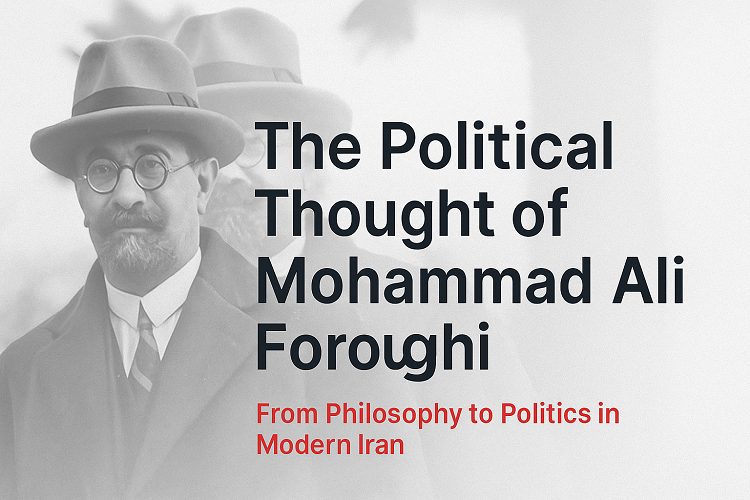
The political thought of Mohammad Ali Foroughi is one of the most significant intellectual legacies in modern Iranian history. He was not only a prominent statesman but also a philosopher, translator, and influential intellectual who played a key role during the turbulent periods of the Constitutional Revolution, the reign of Reza Shah, and the early years of Mohammad Reza Shah’s monarchy. Foroughi managed to create a unique bridge between tradition and modernity, and through a rational and pragmatic approach, he left a lasting impact on Iran’s political and intellectual development. This article explores the dimensions of Foroughi’s political thought, his practical activities in politics, and the long-term influence of his ideas and actions on Iran.
Life and Social Context of Mohammad Ali Foroughi
To understand the political thought of Mohammad Ali Foroughi, one must first consider the historical and social context in which he lived. Foroughi was born in Tehran in 1877 into a family deeply rooted in scholarship and culture. This background naturally oriented him toward philosophy, law, and politics. His youth coincided with the Constitutional Revolution, a period marked by social unrest, foreign intervention, and the struggle to establish a modern political order in Iran.
Iran at the time was grappling with multiple crises: weak state institutions, foreign interference, scientific and industrial backwardness, and the absence of a coherent modern political system. Foroughi, with his philosophical mindset and pragmatic outlook, sought ways to reconstruct Iran’s political and social order.
Foroughi’s Political Thought: Bridging Philosophy and Politics
One of the most distinctive aspects of Mohammad Ali Foroughi’s political thought was the link he established between philosophy and politics. As a translator and interpreter of Western philosophy—especially the works of Descartes, Kant, Bacon, and other modern thinkers—Foroughi played an unparalleled role in introducing concepts of rationalism, the scientific method, and modern political thought to Iran.
Importantly, Foroughi was selective in what he emphasized. From Descartes, he emphasized the concept of “self-grounded reason” and methodological doubt, which he employed to challenge uncritical traditions and superstitions in Iranian society, suggesting that politics, too, should be grounded in reason. From Bacon, he highlighted empiricism and inductive reasoning, linking them to the need for scientific and educational reforms in Iran. From Kant, he introduced the notions of “moral autonomy” and “rational legality,” which he connected directly to constitutionalism and the necessity of the rule of law.
The transmission of these concepts was not confined to books. Foroughi employed multiple avenues: teaching at Dar al-Fonoon, serving at the Ministry of Education, authoring school textbooks, and publishing essays accessible to a broader audience. By simplifying complex philosophical concepts, he ensured their integration into Iran’s intellectual and political discourse. This effort helped institutionalize rationality, scientific thinking, legalism, and critiques of authoritarianism in Iranian culture.
Foroughi and the Constitutional Revolution: Institutionalizing Law
The political thought of Mohammad Ali Foroughi became increasingly visible during the Constitutional Revolution. He was a strong advocate of constitutionalism and the rule of law, believing that only through legal institutions could political power be limited and individual freedoms guaranteed.
As a writer and journalist, he published numerous articles on the importance of modern legislation and legal reform. Unlike some radical intellectuals of his time, Foroughi believed in gradual reform. He argued that reforms must be based on rational calculation and social capacity, rather than on utopian ideals that could destabilize society.
Foroughi and the Encounter with the West: Tradition Meets Modernity
In his works, Foroughi dealt with both Greek and modern Western philosophy while simultaneously emphasizing the Iranian-Islamic intellectual heritage. This dual approach made his political thought a unique model of combining tradition and modernity.
Crucially, Foroughi’s synthesis was not superficial. He pursued it in two practical ways. First, in education, he helped design curricula that included both Islamic philosophical classics—such as Avicenna and Farabi—and modern Western philosophy, ranging from Plato and Aristotle to Descartes and Kant. This integration allowed students to study both traditions side by side. Second, in politics and law, he contributed to drafting Iran’s civil code, which balanced Islamic jurisprudence with European legal models, especially those of France and Belgium.
For Foroughi, combining tradition and modernity meant that modern institutions—parliament, constitution, judiciary—had to be built in Iran, but not at the expense of cultural identity. He insisted that Iranians would only accept modern reforms if they were embedded within their cultural and historical framework. The practical outcome of this vision was the establishment of political and legal institutions that were both recognizable to Iranians and adaptable to modern governance. Unlike other attempts at “synthesis,” which often resulted in authoritarian religious populism, like Islamism, Foroughi’s approach produced a functional model of modernization that maintained cultural continuity.
Foroughi and Iranian Philosophy: Defending Cultural Heritage
Another dimension of Mohammad Ali Foroughi’s political thought was his defense of Iranian identity and philosophical heritage. In his monumental work The History of Philosophy in Europe, he not only introduced Western philosophy but also highlighted comparisons with Islamic philosophy, showing that Iran had made significant contributions to world thought.
This intellectual stance translated into politics. Foroughi consistently stressed the importance of national unity and cultural identity as the foundation of the modern state. For him, a durable modern Iran required strong ties to its historical and philosophical roots.
Foroughi and the Modern State
The political thought of Mohammad Ali Foroughi was not confined to theory but found direct expression in practice. During Reza Shah’s reign, he served as prime minister and played a key role in constructing the modern Iranian state.
Foroughi was one of the architects of new administrative, legal, and educational institutions. He contributed to drafting the civil code and reforming the judiciary. Despite his closeness to power, he consistently advocated for the logic of legalism and rational policymaking in government.
Foroughi and the Transfer of Monarchy: Political Pragmatism
One of Foroughi’s most important political acts was overseeing the transfer of power from Reza Shah to Mohammad Reza Shah in 1941. At a time when Iran was occupied by Allied forces, Foroughi’s political prudence ensured that the transition took place without serious instability.
This moment underscored his pragmatism. Foroughi understood that the survival of the state and the preservation of social order were more vital than any ideological stance. By using legal legitimacy and maintaining calm, he managed a potentially explosive political transition.
The Impact of Foroughi’s Political Thought on Iranian Intellectuals
The political thought of Mohammad Ali Foroughi profoundly shaped Iranian intellectual life. He modeled a new type of intellectual—one who was simultaneously a thinker and a statesman.
Foroughi’s influence was visible on individuals like Mehdi Bazargan and Ehsan Naraghi, who stressed the necessity of combining rational modernity with Iranian identity. His emphasis on national heritage also inspired the “cultural nationalism” movement that spread in the 1940s and 1950s, encouraging Iranian intellectuals to balance modern reforms with cultural pride.
At the institutional level, Foroughi’s legacy of legalism and rational politics reverberated in the National Movement of Oil in the early 1950s. Leaders like Mohammad Mossadegh emphasized the rule of law and national sovereignty—principles that Foroughi had been among the first to articulate in Iran.
Thus, Foroughi influenced Iranian intellectual life in three concrete ways: individually, by shaping thinkers like Bazargan and Naraghi; ideologically, by fueling cultural nationalism; and institutionally, by embedding legalist discourse into Iranian political culture.
Ethics and Politics in Foroughi’s Thought
Another key aspect of Mohammad Ali Foroughi’s political thought was the relationship between ethics and politics. Unlike power-centered perspectives, he argued that politics without ethics inevitably leads to tyranny and corruption.
Throughout his writings and during his premiership, he emphasized the responsibility of statesmen to uphold moral principles. His reforms aimed to move Iran away from personal or tribal politics toward rational and accountable governance.
Legacy and Place in Iranian Political History
The political thought of Mohammad Ali Foroughi left a lasting mark on modern Iran. On one hand, by introducing Western philosophy and science, he transformed the Iranian intellectual landscape. On the other hand, through his direct political engagement, he helped build the foundations of modern Iranian institutions.
Critics have sometimes accused him of being too close to power or of compromising with the monarchy. Yet, in reality, Foroughi sought to institutionalize rationality, legalism, and moderation within the constraints of his time. His legacy lies in showing how philosophy, ethics, and pragmatic politics could be combined in the service of national progress.
Conclusion
The political thought of Mohammad Ali Foroughi represented a synthesis of philosophy, ethics, and pragmatism. While deeply versed in Western philosophy, he remained committed to Iran’s cultural roots. In practice, he shaped Iran’s constitutional reforms, civil code, educational system, and managed critical political transitions.
His influence extended beyond state institutions into the intellectual life of Iran, inspiring cultural nationalism, rational legalism, and a generation of thinkers who sought to reconcile modernity with identity.
Even today, revisiting the political thought of Mohammad Ali Foroughi provides valuable lessons on how rationality, law, and cultural continuity can be combined to face the challenges of modern politics.

