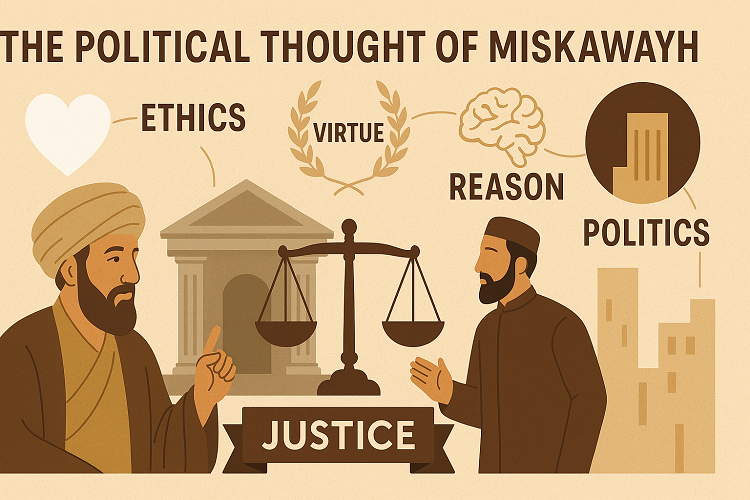
The political thought of Miskawayh represents a unique fusion of ethics, reason, and politics within the broader framework of Islamic philosophy. Living in the 10th century (4th century AH), Miskawayh was an influential Persian philosopher whose ideas bridged the gap between classical Greek philosophy and Islamic thought. While he is most renowned for his contributions to ethics, particularly through his seminal work Tahdhib al-Akhlaq wa Tathir al-A’raq (Refinement of Morals and Purification of Traits), his approach to politics is deeply rooted in moral philosophy. The political thought of Miskawayh positions virtue as the foundation of both individual refinement and societal order. This article delves into the political thought of Miskawayh in detail, drawing comparisons with his contemporaries such as al-Farabi and Avicenna, while highlighting its lasting relevance.
Historical and Intellectual Context
Miskawayh lived during the flourishing era of the Buyid dynasty, a period known for its relative openness to philosophical inquiry. He resided in cultural centers such as Rayy, Baghdad, and Isfahan, where he engaged with leading thinkers, including Avicenna and Abu Hayyan al-Tawhidi. He was a polymath with expertise in history, literature, and philosophy—an intellectual synthesis that is reflected in his political thought.
Influenced by the legacies of Plato, Aristotle, and the Neoplatonists, as well as Islamic teachings and Persian ethical traditions, Miskawayh sought to articulate a vision of society grounded in practical wisdom and moral cultivation. The political thought of Miskawayh cannot be detached from his deep commitment to rational ethics and human flourishing.
Ethics as the Foundation of Politics in the Political Thought of Miskawayh
Central to the political thought of Miskawayh is the primacy of ethics. In his view, no sound political structure can be established without the moral development of individuals. In Tahdhib al-Akhlaq, he asserts that a ruler or statesman must first master his own soul, cultivating balance among his inner faculties before attempting to govern others.
Unlike political realists who consider politics a matter of power and manipulation, Miskawayh conceives of it as a craft aimed at producing a virtuous society. Political leadership, therefore, must stem from moral integrity and practical wisdom. The cultivation of individual virtue is not merely a private matter but a precondition for civic harmony.
Practical Reason and Its Role in the Political Thought of Miskawayh
Miskawayh distinguishes between theoretical reason, which contemplates metaphysical truths, and practical reason, which governs ethical choices and social behavior. In the political thought of Miskawayh, practical reason is indispensable for effective governance.
The ideal statesman excels in practical reason, balancing competing interests, promoting justice, and maintaining social cohesion. This form of rationality is not innate but developed through education, habit, and moral reflection. It forms the core of what makes political leadership not only possible but desirable.
Virtue and the Political Individual
Drawing on the tripartite model of the soul—appetitive, spirited, and rational—Miskawayh defines virtue as the harmonious balance of these faculties. This framework applies not only to individuals but also to the political structure of society.
A virtuous citizen has aligned their desires, emotions, and intellect under the guidance of reason. In the political thought of Miskawayh, such individuals are the building blocks of a just society. The ruler, as the most virtuous of citizens, must embody this internal balance and guide others toward it through both example and policy.
Justice and the Order of the City
Justice, for Miskawayh, is not merely a legal or distributive principle—it is a structural virtue of both the individual and society. In a just society, each part performs its designated role in harmony with the whole, mirroring the balanced soul of the virtuous individual.
The political thought of Miskawayh emphasizes that justice arises when reason governs, courage protects, and desire obeys. A polity structured around these principles is one in which peace, prosperity, and moral development can flourish.
Politics as the Art of Governance
For Miskawayh, politics is an art of governance rooted in wisdom, experience, and ethical discernment. He rejects the notion of politics as mere control or coercion. Instead, he presents it as the highest form of practical engagement aimed at realizing human excellence.
The political thought of Miskawayh suggests that a good government is not one that merely enforces order, but one that cultivates virtue, educates its citizens, and promotes collective well-being. The statesman is thus a moral guide as much as a political administrator.
Utopian Vision in the Political Thought of Miskawayh
Though Miskawayh did not write a formal utopian treatise like al-Farabi, his works provide an implicit vision of an ideal society. The political thought of Miskawayh points to a community led by wise and virtuous leaders, where education is central and justice pervades all aspects of life.
Unlike rigid blueprints for political systems, Miskawayh’s utopia is fundamentally ethical and cultural. It prioritizes personal development and moral education as the pathways to civic perfection.
The Role of Religion in the Political Thought of Miskawayh
Miskawayh adopts a moderate and rational view of religion in politics. He sees religion not as an instrument of domination but as a tool for moral development. In his framework, religion complements reason and guides individuals toward ethical living.
The political thought of Miskawayh maintains that neither religion nor reason should dominate the other. If religion becomes irrational, it leads to fanaticism; if reason is severed from spiritual insight, it risks materialism. An ideal polity must balance both.
Comparison with al-Farabi and Avicenna
Similarities:
- All three philosophers regard ethics as foundational to politics.
- They emphasize the role of reason and wisdom in governance.
- Their works are influenced by Greek philosophical traditions.
Differences:
- Al-Farabi focuses more on political structures and the lawgiver, while Miskawayh centers on personal ethics and virtue.
- Avicenna engages more deeply with metaphysics and less with political practice.
- Miskawayh’s writing is more accessible and practical, making his political thought more grounded in everyday moral life.
Legacy and Significance
Miskawayh’s impact on Islamic political philosophy is profound, particularly in the ethical dimension. He laid the groundwork for future thinkers like Nasir al-Din al-Tusi and scholars who wrote Persian ethical treatises, such as Saadi.
His synthesis of Greek philosophy, Islamic teachings, and Persian cultural elements makes Miskawayh’s political thought a cornerstone in the history of Islamic intellectual development. His work offers a compelling model for moral leadership and civic responsibility.
Conclusion
The political thought of Miskawayh presents a compelling vision of politics as a moral and rational enterprise. In contrast to power-centric models, his approach prioritizes the cultivation of virtue, the exercise of practical reason, and the promotion of justice.
In contemporary times, where moral decay often shadows political life, revisiting Miskawayh’s political thought offers valuable insights. His philosophy reminds us that personal integrity and public virtue are not separate spheres but interdependent forces shaping a just society.