


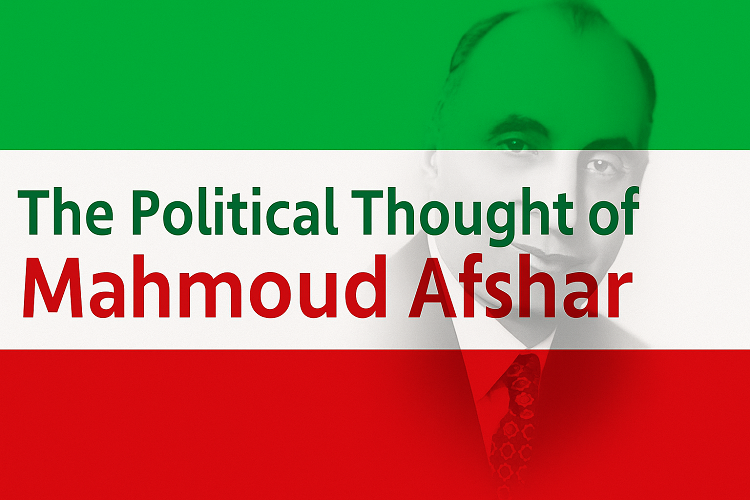
1. Historical Context and Mahmoud Afshar’s Place in Iranian Political Thought
The Political Thought of Mahmoud Afshar emerged during one of the most turbulent and transformative periods in modern Iranian history — an era when the very idea of the nation-state, territorial integrity, and collective identity were under fundamental re-examination. The Constitutional Revolution of the early twentieth century marked Iran’s first attempt to move from absolute monarchy toward a rule of law and civic participation. Yet, the incomplete realization of constitutional ideals, the weakness of administrative institutions, and the persistent interference of foreign powers left the country in a crisis of legitimacy and cohesion.
In this setting, the discourse of nation-building and state centralization gained urgency as a historical necessity. Mahmoud Afshar (1893–1983), born in Yazd and educated in Europe, became one of the leading intellectual figures to articulate this vision. Having studied law and political science at the University of Lausanne in Switzerland, Afshar returned to Iran as a nationalist thinker, translator, and reformist writer. His major intellectual platform was the influential journal Ayandeh (“The Future”), which he founded in 1925. The periodical was not merely a cultural magazine but a vehicle for promoting a new conception of “Iran” — an Iran undergoing transition from tradition to modernity.
Afshar belongs to that generation of Iranian intellectuals who sought to bridge traditional identity with the modern idea of the nation-state. Unlike some contemporaries who simply borrowed European nationalist models, Afshar aimed to develop a distinctly Iranian version of nationalism, one rooted in historical continuity and cultural unity. For him, a strong, centralized, and rational state was a prerequisite for both social justice and civilizational progress.
His political thought reflects the broader transition from constitutional idealism to pragmatic state-building. Whereas the first generation of constitutionalists had emphasized limiting royal power and expanding civil liberties, Afshar and his contemporaries in the post-constitutional era insisted on the need for order, unity, and centralized governance. In this sense, Afshar’s ideas represent an intellectual response to the perceived failure of liberal constitutionalism and the social fragmentation that followed it. His writings illustrate a distinctly Iranian form of political realism, grounded in the conviction that without a cohesive state, liberty and reform would remain hollow.
Yet Afshar never entirely abandoned the emancipatory spirit of the Constitutional Revolution. His work reflects an effort to reconcile order and freedom, authority and law, rational statehood and civic awakening. On the one hand, he defended a powerful state as the guardian of territorial integrity; on the other, he viewed public education and legal consciousness as indispensable for a modern and just society. This balance between top-down modernization and bottom-up enlightenment distinguishes Afshar’s political vision from the purely authoritarian tendencies of his era.
In the historical evolution of Iranian political thought, Afshar stands as a transitional thinker — a mediator between the idealism of constitutional reformers and the pragmatic nationalism of the Pahlavi period. His central question was how to forge a unified national state in a land marked by ethnic, linguistic, and sectarian diversity. His answer lay in the triad of Persian language, modern education, and centralized authority, which he saw as the cultural and institutional foundations of Iranian nationhood.
2. Core Elements of the Political Thought of Mahmoud Afshar
The Political Thought of Mahmoud Afshar revolves around a coherent vision of Iran as a unified and independent nation-state. Afshar believed that without cultural cohesion and political centralization, no meaningful reform could take root. His writings consistently highlight four central elements: national unity and state centralization, the Persian language as the core of national identity, political and cultural independence, and modern education as the foundation of nation-building. Together, these ideas form one of the earliest systematic formulations of modern Iranian nationalism.
2-1. National Unity and Centralized Authority
At the heart of Afshar’s political philosophy lies the idea of national unity. He viewed Iran as a country that, throughout its long history, had been weakened by tribal divisions, linguistic diversity, and the absence of a strong central administration. In Afshar’s analysis, these fragmentations prevented the emergence of a shared sense of political belonging. His proposed solution was the establishment of a strong, law-based, and centralized government capable of guaranteeing stability and territorial integrity.
For Afshar, centralization did not mean despotism. Rather, he regarded it as a historical necessity for transition — a means to move from chaos to order. In his view, a society lacking institutional maturity required an authoritative but rational state to lay the groundwork for progress. Afshar can thus be seen as an advocate of what might be termed “rational authority”: a state whose legitimacy derives not from personal rule, but from its role in protecting the collective national interest.
He also understood unity as a psychological and cultural condition, not merely a political one. Afshar often wrote that unless Iranians across all regions perceived themselves as members of a single political community, no constitutional or economic reform would succeed. “The nation,” in his thought, was therefore not just a population within borders but a shared historical consciousness — a moral and emotional bond cultivated through education, language, and civic memory.
2-2. The Persian Language and the Reconstruction of National Identity
Perhaps the most distinctive feature of the Political Thought of Mahmoud Afshar is his emphasis on the Persian language as the essential bond of national unity. For Afshar, language was more than a tool of communication; it was the psychological and historical glue that held the Iranian nation together. In numerous essays published in Ayandeh, he argued that Iran’s survival depended on having a common national language — one that could be taught universally and serve as the medium for transmitting shared cultural values.
Afshar attributed to Persian a dual role: it was both the bearer of Iran’s civilizational heritage and the instrument of modern administrative and educational reform. By promoting Persian-language education across the country, he hoped to cultivate citizens who were simultaneously rooted in their historical identity and oriented toward a modern future. Language, in his view, was the bridge between Iran’s past and its aspirations for modernity.
Although later critics would fault this view for neglecting Iran’s linguistic and ethnic diversity, Afshar’s emphasis on linguistic unity must be read in its historical context — a period when fears of separatism and foreign influence loomed large. His goal was not to erase difference, but to secure national cohesion through a shared linguistic foundation. In this sense, his nationalism was cultural rather than ethnic: it sought inclusion under a common civic identity rather than domination by any particular group.
2-3. Political and Cultural Independence
Another pillar of the Political Thought of Mahmoud Afshar was the defense of independence, understood not only as liberation from foreign domination but also as intellectual and cultural self-reliance. His writings reveal a deep sensitivity to the political and economic penetration of Iran by Russia and Britain. Afshar insisted that national independence required two complementary strategies: internal reform — through modern institutions and education — and external resistance to dependency and subordination.
Afshar’s notion of independence was both practical and philosophical. He argued that Iran could only achieve true sovereignty when it ceased to imitate foreign models uncritically and rediscovered confidence in its own civilizational resources. While drawing inspiration from European modernization, he rejected cultural mimicry, asserting that Iran must modernize without losing its Iranian essence. In this regard, Afshar represents the pragmatic middle ground between radical Westernization and nostalgic traditionalism.
2-4. Education and Modernization as Instruments of Nation-Building
Education, in Afshar’s thought, was the cornerstone of nation-building and civic transformation. He repeatedly stressed that no political or economic reform could endure without cultivating an educated, disciplined, and self-aware generation. For him, schools were the crucibles in which a modern Iranian identity could be forged.
In Ayandeh, he called for a national education system that would teach both the sciences of the modern world and the cultural and historical heritage of Iran. The goal was not merely literacy, but moral and civic formation — to produce citizens who were globally competent yet emotionally attached to their homeland. Education was thus the primary tool for the transition from a tribal and traditional society to a civic and modern one.
Afshar’s intellectual framework linked knowledge and statehood: a modern state requires enlightened citizens, and mass education is the means to create them. In this respect, his political philosophy prefigured many later discussions about the relationship between education, nationalism, and modernization in the developing world.
These four elements — unity, language, independence, and education — define the architecture of the Political Thought of Mahmoud Afshar. His project sought to rebuild Iran as a modern, independent, and culturally coherent nation-state. While deeply rooted in Iranian history, his ideas were also shaped by the global currents of nationalism and modernization in the early twentieth century. Afshar’s vision thus represents an effort to reconcile Iran’s ancient identity with the demands of modern statehood — a balancing act that continues to shape Iranian political discourse today.
3. The Political Thought of Mahmoud Afshar and the Project of State-Building under Reza Shah
The rise of Reza Shah in the 1920s provided a historical context in which the Political Thought of Mahmoud Afshar found partial realization. Although Afshar was never a direct political actor or government official, many of his central ideas — particularly those concerning national unity, language policy, and modernization — resonated deeply with the intellectual and administrative agenda of the early Pahlavi state. His writings anticipated, and in some cases legitimized, the ideological framework that underpinned Iran’s transformation from a fragmented monarchy into a centralized modern state.
Afshar had long argued that the weakness of Iran derived not from a lack of resources but from the absence of a unified and disciplined political order. He envisioned a government capable of consolidating authority, implementing reforms, and instilling a sense of shared national identity. Reza Shah’s early policies — from the creation of a national army and bureaucracy to the standardization of education and the promotion of Persian as the official language — can be interpreted as the practical embodiment of this intellectual ideal.
It would, however, be overly simplistic to regard Afshar as a mere apologist for authoritarianism. His writings reveal a nuanced stance: while he welcomed the establishment of a strong state, he emphasized that true national progress must rest on rational law and civic virtue, not on arbitrary power. Afshar’s notion of authority was fundamentally moral and institutional. He believed that the legitimacy of the state stemmed from its role as the guardian of the collective interest, not from personal domination.
3-1. Nationalism and the Modern State
Reza Shah’s modernization drive was characterized by rapid infrastructural and administrative centralization. The introduction of a unified civil code, the suppression of tribal autonomy, and the reorganization of the provinces all aimed at forging a homogeneous national structure. These reforms mirrored Afshar’s conviction that Iran’s future depended on the creation of a rational, bureaucratic, and cohesive political system.
Yet there was also tension between Afshar’s intellectual ideal of civic nationalism and the coercive practices that often accompanied its implementation. The Pahlavi regime’s efforts to impose Persian language and culture sometimes marginalized local identities in ways that Afshar himself might not have fully endorsed. For him, linguistic and cultural unity were means toward voluntary solidarity, not instruments of cultural erasure. His nationalism was pedagogical and integrative, grounded in persuasion rather than compulsion.
3-2. Education as the Engine of State Formation
In line with Afshar’s belief in education as the foundation of national consciousness, the Pahlavi government launched extensive reforms in the educational system. The establishment of secular schools, teacher-training institutions, and a standardized national curriculum reflected Afshar’s call for an enlightened citizenry. The spread of public education during the 1930s can thus be seen as both a political and cultural project: it created a generation that identified itself primarily as Iranian rather than tribal, regional, or sectarian.
Afshar’s influence was also visible in the intellectual climate of the time. The Ayandeh journal continued to circulate among reform-minded bureaucrats and educators, shaping discussions about civic ethics, national service, and modernization. Through this channel, Afshar’s thought contributed to the ideological formation of the early modern Iranian elite.
3-3. Independence and the Challenge of Modernization
Another aspect of the Political Thought of Mahmoud Afshar that found resonance in the Pahlavi project was his emphasis on independence — political, economic, and cultural. Reza Shah’s policies of reducing foreign influence, renegotiating concessions, and asserting state control over key industries echoed Afshar’s insistence on self-reliance. Both men shared the conviction that modernization must not lead to dependency.
Nevertheless, Afshar remained intellectually cautious about the risks of imitative modernization. While he valued Western science and organization, he warned against wholesale imitation of European institutions without adaptation to Iranian conditions. In this sense, Afshar’s nationalism was not isolationist but selectively open — seeking a synthesis between indigenous values and modern techniques.
3-4. Between Ideal and Reality
The historical convergence between Afshar’s ideas and the policies of Reza Shah was both real and paradoxical. On one hand, the Pahlavi state realized many of the structural goals that Afshar had envisioned: a unified bureaucracy, a strong army, a standardized language, and a modern education system. On the other hand, the authoritarian form in which these reforms were executed contradicted Afshar’s moral conception of the state.
He envisioned a rational state grounded in civic virtue, not a centralized regime driven by coercion. Thus, while the Pahlavi era marked the practical triumph of his nation-building ideals, it also revealed their ethical and political limits. Afshar’s writings after the 1930s show a growing awareness of these contradictions. He began to stress more strongly the role of culture, scholarship, and civic education as correctives to authoritarian excess.
The interaction between Afshar’s political thought and the Pahlavi project demonstrates the complex relationship between ideas and power in modern Iranian history. The Political Thought of Mahmoud Afshar provided a conceptual vocabulary — unity, independence, education, rational authority — through which the new state articulated its legitimacy. Yet, in the process of implementation, these ideas were often transformed into instruments of control.
Afshar’s intellectual legacy, therefore, lies not only in what he proposed but also in the moral critique his ideas imply: that modernization without ethical grounding can reproduce the very despotism it seeks to overcome. This tension — between the necessity of order and the aspiration to freedom — defines both Afshar’s philosophy and the broader trajectory of Iranian political modernity.
4. Critical Evaluation and Contemporary Relevance of the Political Thought of Mahmoud Afshar
The Political Thought of Mahmoud Afshar occupies a pivotal place in the intellectual history of modern Iran. His reflections on state-building, national unity, and cultural identity were products of a time when Iran faced existential challenges, yet they also resonate with contemporary debates about citizenship, governance, and national cohesion. Examining his legacy today allows us to understand both the historical roots of Iranian political nationalism and the enduring dilemmas of modernization in multiethnic societies.
4-1. Afshar in the Context of Iranian Nationalist Thought
In the history of Iranian political thought, Mahmoud Afshar occupies a critical position between the cultural nationalism of the Constitutional era and the state-centered nationalism of the Pahlavi period. While intellectuals such as Malkam Khan and Mostashar al-Dowleh viewed modernization primarily through the lens of legal reform and administrative restructuring, and figures like Foroughi and Davar focused on institutional aspects, Afshar sought to articulate the cultural and psychological dimensions of a national state.
He was among the first to emphasize the necessity of “Iranianizing modernity” — that is, creating a modern state without cultural alienation. In his view, Iran should modernize while remaining firmly rooted in its historical identity. From this perspective, Afshar can be considered a pioneer of a form of cultural nationalism that is both faithful to Iranian civilization and attentive to the imperatives of social transformation.
4-2. Legacy and Contemporary Challenges
Afshar’s intellectual project remains relevant, but it also raises critical questions when evaluated through a contemporary lens. Three areas merit particular attention: cultural diversity, the concept of the nation, and the relationship between state and society.
First, Afshar’s emphasis on linguistic and cultural unity, while historically understandable, risks marginalizing the ethnic and linguistic diversity that characterizes modern Iran. Contemporary political theory emphasizes inclusive national identities that can accommodate pluralism. In this light, Afshar’s vision of cohesion may need reinterpretation to align with contemporary values of cultural rights and participation.
Second, Afshar conceived of the nation primarily as a cultural and historical entity, rather than as a participatory political community. Modern interpretations of nationhood stress the active role of citizens in governance and decision-making, suggesting that Afshar’s nation-building framework is incomplete without mechanisms for civic engagement and political inclusion.
Third, the relationship between state and society in Afshar’s thought is skewed toward top-down authority. He envisioned the state as the principal driver of modernization, with society playing a largely receptive role. Contemporary experience demonstrates that sustainable political and cultural development requires a dynamic interplay between an empowered citizenry and a capable state, highlighting a limitation of Afshar’s model.
4-3. Afshar and the Concept of Transition
A central concept in Afshar’s thought is transition. His writings reflect awareness of Iran’s historical passage: from the Qajar monarchy to a centralized nation-state, from tribalism to civic society, and from tradition to modernity. Afshar sought a middle path that avoided both the collapse of tradition and uncritical Western imitation.
From this perspective, Afshar exemplifies pragmatic rationalism: a careful calibration between freedom and order, tradition and modernity. His project of rational state-building, anchored in civic consciousness, underscores a lesson that remains relevant in contemporary Iran: nation-building is not an event but a process that requires both institutional strength and civic participation.
Conclusion
The enduring significance of the Political Thought of Mahmoud Afshar lies in its dual historical and contemporary relevance. Historically, Afshar contributed to the conceptual framework for the Iranian nation-state, advocating unity, education, independence, and rational governance. Conceptually, he attempted to reconcile authority with civic virtue, modernity with cultural continuity.
Yet Afshar’s work is also instructive for today. It reminds us that the creation of a cohesive and modern nation requires not only structural reforms and centralized authority but also civic engagement, cultural pluralism, and ethical governance. His vision of education, language, and cultural identity as instruments of nation-building continues to inform debates on governance, nationalism, and modernization in Iran and beyond.
In short, Afshar’s ideas remain a living conversation in Iranian political thought: unfinished, yet profoundly influential. They challenge policymakers, scholars, and citizens alike to consider how the ideals of national unity, independence, and civic consciousness can be reconciled with the realities of a complex, multiethnic society in the twenty-first century.

