


Introduction
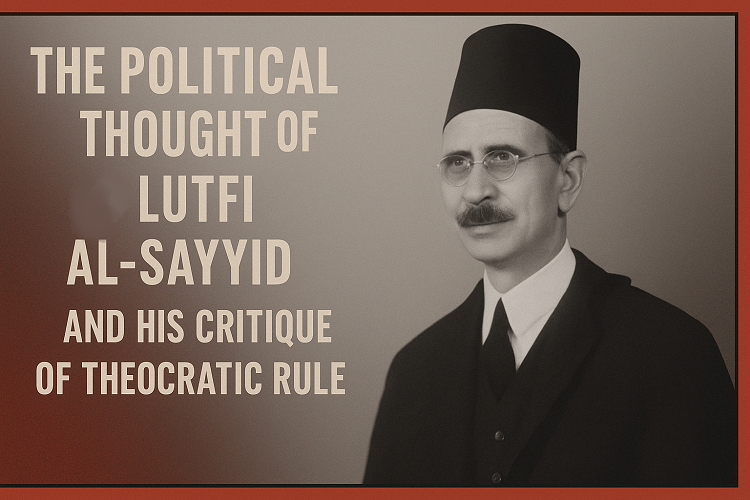
The political thought of Lutfi al-Sayyid, the Egyptian nationalist intellectual widely known as Ustadh al-Jil (the teacher of the generation), remains one of the most influential currents in modern Arab intellectual history. At the heart of his philosophy lies a deep critique of theocratic government and a strong advocacy for the secular nation-state as the only path toward political stability, social justice, and cultural progress.
What makes the political thought of Lutfi al-Sayyid particularly significant is not only its impact on early 20th-century Egypt but also its enduring relevance in contemporary debates on religion and politics. When compared with the experience of the Islamic Republic of Iran, his warnings about the dangers of fusing religion and state have been proven strikingly accurate. This article explores, in detail, his life, intellectual background, critique of religious government, and the virtues of his secular nationalist vision, while also drawing comparisons that highlight the continued applicability of his ideas today.
Life and Intellectual Background
Lutfi al-Sayyid was born in 1872 in a rural Egyptian family under British colonial domination. Growing up during a period of national humiliation instilled in him a strong sense of independence and pride in Egyptian identity. His early education exposed him to traditional religious studies, but his later pursuit of law at Cairo University and further exposure to European intellectual traditions marked a decisive shift.
During his studies in France, al-Sayyid encountered the works of Montesquieu, Rousseau, and John Stuart Mill. These encounters introduced him to liberal political philosophy and the principles of rationalism, constitutionalism, and individual liberty. Unlike many of his contemporaries who sought reform within the framework of Islam, al-Sayyid concluded that Egypt’s liberation and modernization could only be achieved through secular governance and civic nationalism.
Social and Cultural Engagement
In 1907, al-Sayyid founded the influential newspaper al-Jarida, which became the intellectual hub of Egypt’s liberal nationalist movement. Through its pages, he championed freedom of expression, equal citizenship, educational reform, and the separation of religion and politics.
Al-Sayyid’s role as the first president of Cairo University was equally transformative. He spearheaded reforms that emphasized modern scientific education and critical inquiry over traditional religious instruction. For him, education was not merely about producing skilled workers; it was about cultivating enlightened citizens capable of participating in national life. In his view, the university was to serve as the backbone of a modern, secular Egypt.
Core of the political thought of Lutfi al-Sayyid
At the center of the political thought of Lutfi al-Sayyid stood the principle of the secular nation-state. Al-Sayyid believed that Egypt’s identity was defined not by religion but by its land, history, and shared culture. In a society comprising Muslims, Christians, and Jews, theocratic governance would inevitably marginalize minorities.
Thus, his concept of civic nationalism was inclusive and pluralistic. All citizens, regardless of faith, were to be equal before the law. Al-Sayyid’s nationalism was not based on ethnicity or religion but on shared belonging to the Egyptian homeland. For him, only such a secular state could guarantee stability, justice, and independence from both colonial domination and internal strife.
A Fundamental Critique of Theocratic Rule
Dogmatism and Rigidity
According to al-Sayyid, religion, by its very nature, is tied to absolute truths and immutable doctrines. Politics, however, requires flexibility, pragmatism, and constant adaptation to social and economic changes. Theocracy, therefore, locks society into intellectual rigidity and obstructs necessary reforms.
Suppression of Intellectual Freedom
Al-Sayyid argued that theocratic systems suppress free thought because political criticism is easily conflated with religious dissent. In such contexts, sacred taboos stifle creativity, philosophy, and scientific inquiry. For him, genuine progress was only possible where critical debate was allowed to flourish.
Discrimination Against Minorities
A key aspect of his critique concerned the structural discrimination inherent in theocratic states. In Egypt, the significant Coptic Christian community would always be treated as second-class citizens under an Islamic government. For al-Sayyid, this outcome was both unjust and destabilizing.
Religious Despotism
Perhaps most importantly, al-Sayyid foresaw that theocracy inevitably concentrates political power in the hands of a small clerical elite, who wield both spiritual and temporal authority. This dual legitimacy fosters authoritarianism far more repressive than secular despotism, because it cloaks political domination in divine sanction.
Egypt and the Rise of Islamism
During al-Sayyid’s lifetime, Egypt saw the emergence of Islamist movements such as the Muslim Brotherhood. Their slogan, “Islam is the solution,” reflected a desire to impose religious law on public life. Al-Sayyid, while recognizing the spiritual importance of religion, warned that this approach would undermine freedom and invite authoritarian rule.
His counter-strategy was rooted in education, civic engagement, and rational politics. He consistently argued that the future of Egypt did not lie in turning backward toward a religious state, but in embracing modernity while preserving national culture and independence.
Comparison with the Islamic Republic of Iran
Fulfillment of Al-Sayyid’s Warnings
The 1979 Iranian Revolution resulted in the establishment of the Islamic Republic, a political system where clerical authority occupies the apex of power. The institution of the Supreme Leader illustrates exactly what al-Sayyid had warned against: the centralization of unchecked authority in a religious figure.
Practical Consequences
- Concentration of Power: Political authority in Iran rests in a body of clerics, insulated from democratic accountability.
- Suppression of Freedoms: Press, universities, and civil society face heavy restrictions.
- Systemic Discrimination: Religious minorities, as well as women and dissenting Muslims, are subjected to institutionalized inequality.
- Religious Authoritarianism: The regime fuses spiritual legitimacy with coercive political control, creating a uniquely durable form of despotism.
The Value of Comparison
The Iranian case vividly illustrates the dangers al-Sayyid articulated decades earlier. It demonstrates that his secular vision was not merely theoretical but offered a pragmatic alternative to theocratic rule.
The Merits of the Political Thought of Lutfi al-Sayyid
Equality and Inclusivity
Al-Sayyid’s insistence on equal citizenship remains a cornerstone for any democratic project in plural societies. His civic nationalism offers a model that transcends sectarian divisions.
Freedom and Progress
By elevating freedom of thought and expression as essential conditions for advancement, he aligned Egypt with universal values of enlightenment and modernity.
Positive Secularism
His secularism did not amount to hostility toward religion. Rather, it safeguarded both religion and politics by keeping them in separate spheres. This approach preserved religion’s moral role while protecting politics from dogma.
Civic Nationalism
Unlike ethnic or religious nationalism, his civic nationalism bound people together through shared territory and history. This inclusivity remains highly relevant in today’s multicultural states.
Rationalism and Adaptability
Politics, for al-Sayyid, had to remain open to revision and adaptation. Unlike theocratic systems that cling to immutable laws, his approach enabled societies to respond dynamically to new challenges.
Relevance of His Ideas Today
In Egypt
Post-Mubarak Egypt briefly experienced the rise of the Muslim Brotherhood to power. The subsequent backlash against religious politics reaffirmed the urgency of al-Sayyid’s vision. Calls for a secular and civic national identity continue to draw upon his legacy.
In Iran
The Iranian case highlights the urgent need for a political alternative that avoids the pitfalls of theocracy. Al-Sayyid’s framework offers precisely such a model: a secular state rooted in national identity, freedom, and equality.
In the Arab World
Across the Middle East, where debates on religion and politics remain unresolved, al-Sayyid’s thought offers a “third way.” It does not reject religion, but it insists on separating it from state affairs to ensure justice and liberty.
Conclusion
The political thought of Lutfi al-Sayyid represents a milestone in Arab intellectual history. His critique of theocratic government was both profound and prophetic, anticipating the crises that later unfolded in states such as Iran. By advocating for secularism, civic nationalism, equality, and freedom, al-Sayyid offered not only a critique of the past but also a roadmap for the future.
Today, as many societies in the Middle East remain entangled in the dilemmas of religion and politics, revisiting his thought is more than a historical exercise—it is a necessity. His vision of a secular, inclusive, and rational state continues to provide hope for building democratic and just societies in the Arab world and beyond.

