Introduction: The Political Thought of Ibn Tufayl in the Mirror of Islamic Philosophy
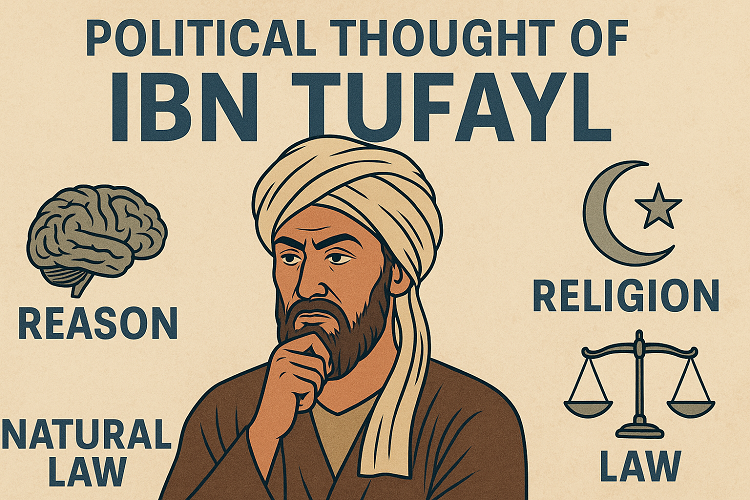
Abu Bakr Muhammad ibn Abd al-Malik ibn Muhammad ibn Tufayl, a prominent Andalusian philosopher of the 6th century AH (12th century CE), played a significant role in integrating philosophy, religion, and politics. The political thought of Ibn Tufayl cannot be separated from his philosophical and mystical background. Through his famous work Hayy ibn Yaqzan, he sought not only to chart a path for individual enlightenment but also to symbolically depict the ideal ruler and political order. This article analytically explores various dimensions of Ibn Tufayl’s political philosophy.
Historical and Intellectual Context of Ibn Tufayl
Andalusia: A Civilizational Platform Amid Political Challenges
In the 6th century AH, Andalusia faced political turmoil, a weakening caliphate, and the rise of local dynasties. Philosophers served as mediators between thought and power. Ibn Tufayl, who was both a physician and a political advisor at the Almohad court in Morocco, had a privileged position to articulate philosophical-political perspectives.
Intellectual Influences: From al-Farabi to Ibn Sina and Ibn Bajja
The political thought of Ibn Tufayl emerged from the Neoplatonic and Islamic philosophical tradition. He was influenced by al-Farabi, particularly in the concept of the “virtuous city,” as well as by Ibn Sina and his contemporary Ibn Bajja. However, through his allegorical narrative Hayy ibn Yaqzan, he introduced a unique layer of political reflection.
Philosophy, Religion, and Politics in Hayy ibn Yaqzan
Allegory as a Political Instrument
Hayy ibn Yaqzan tells the story of a boy who grows up alone on an island, developing his intellect and spirituality without human contact, ultimately arriving at the knowledge of God and the cosmos. The narrative symbolizes the philosopher-king who attains truth. Upon entering human society, Hayy realizes that truth cannot be conveyed directly to the masses but must be communicated symbolically. This realization is deeply political: the sage must implement a measured and ethical politics using allegorical language.
The Philosopher-King and the Duty of Guidance
Ibn Tufayl revives the Platonic ideal of the philosopher-king, but with a key difference: he emphasizes not just rationality but a synthesis of reason and intuition. In his view, a true political leader must possess spiritual insight, moral discipline, and a profound understanding of divine law.
State, Law, and Legitimacy in Ibn Tufayl’s Political Thought
Does Ibn Tufayl Have a Theory of the State?
Although Ibn Tufayl did not write a formal political treatise like al-Farabi or Ibn Sina, his allegorical text contains essential elements of state theory. He believes that the state must be grounded in reason, divine guidance, and an understanding of the varying intellectual capacities of people.
Social Stratification and the Role of Education
A key concept in The Political Thought of Ibn Tufayl is the gradation of human understanding. He divides society into philosophers, theologians, and the general populace. While only philosophers can access the truth directly, they must use symbolic language—religion, myth, and parables—to guide the public.
Shari‘a and Haqiqa: Religion as Political Medium
In Ibn Tufayl’s view, Shari‘a (revealed law) is a tool for transmitting Haqiqa (truth) to the masses. Thus, a political leader must preserve Shari‘a while also embodying a deeper esoteric wisdom. Politics must strike a balance between the outer religious form and inner philosophical essence.
Comparison with al-Farabi and Ibn Rushd
Similarities and Differences with al-Farabi
Both philosophers endorse the concept of the philosopher-king. However, al-Farabi constructs a more systematic vision of statecraft, social hierarchy, and laws. Ibn Tufayl, by contrast, conveys his ideal polity through poetic and allegorical storytelling.
Ibn Tufayl and Ibn Rushd: Diverging Paths
Ibn Rushd, who succeeded Ibn Tufayl at the Almohad court, adopted a more rationalistic approach. He explicitly championed Aristotelian political philosophy and emphasized active intellect and theoretical reasoning. Ibn Tufayl, in contrast, valued intuition and mystical insight alongside reason, giving his political philosophy a more spiritual and symbolic character.
Ethics, Reason, and Governance in Ibn Tufayl’s Political Vision
Moral Self-Discipline as a Prerequisite for Leadership
For Ibn Tufayl, a ruler must first govern himself. Without ethical self-cultivation, political authority degenerates into tyranny. Hence, governance must begin with personal morality, not merely the management of state affairs.
Reason: Essential but Not Sufficient
Reason plays a vital role in The Political Thought of Ibn Tufayl, but it is not sufficient. He argues that reason must be complemented by intuition, mystical insight, and divine inspiration to achieve true wisdom.
Justice as the Essence of Politics
In the conclusion of Hayy ibn Yaqzan, the protagonist realizes that truth must be adapted to the people’s intellectual level through symbols and narratives. Justice, in this view, is not simply equality or rational law, but the measured, symbolic, and wise governance of diverse human capacities.
The Impact of Ibn Tufayl’s Political Thought in the Islamic World and the West
In the Islamic World
Though unique among Islamic philosophers, Ibn Tufayl’s ideas influenced later thinkers such as Suhrawardi, Mulla Sadra, and Sufi political schools. His emphasis on intuition and symbolic language resonated with esoteric traditions in Islamic political theory.
In the West: From Robinson Crusoe to Enlightenment Thinkers
The Latin translation of Hayy ibn Yaqzan in the 17th century was met with widespread interest in Europe. Scholars argue that the work influenced the development of Robinson Crusoe, as well as the political philosophies of John Locke and Rousseau, particularly in theories of education, self-reliance, and the relationship between reason and nature.
Conclusion: Politics in the Light of Philosophical Allegory
Though expressed through allegory, Ibn Tufayl’s political thought offers profound insights into Islamic political theory. By integrating reason, religion, intuition, and symbolism, he presents a model of the just ruler and harmonious state that continues to inspire both Muslim and Western thinkers. For Ibn Tufayl, politics is not merely the management of society but the ethical art of guiding souls through symbolic truth toward justice.