Introduction
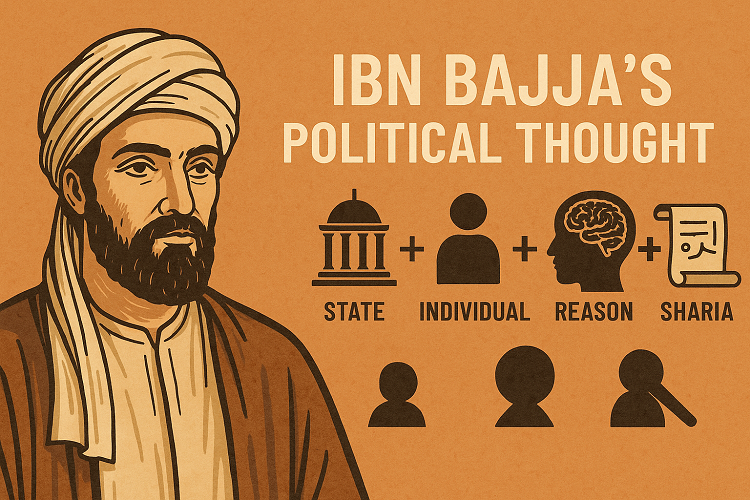
The political thought of Ibn Bajja stands out as one of the key pillars in Islamic political philosophy during the Middle Ages. “The political thought of Ibn Bajja” is rooted in a synthesis of Platonic and Aristotelian principles, infused with ethical and religious considerations. As one of the earliest Muslim philosophers of Al-Andalus, Ibn Bajja laid the groundwork for a political philosophy that remained faithful to Greek rationalism while remaining compatible with Islamic cultural and religious norms.
This article examines the historical context, theoretical foundations, and practical implications of Ibn Bajja’s political thought. Through analysis of the structure of the state, the relationship between the individual and society, the connection between religion and reason, and the role of the philosopher, a comprehensive view of his political theory will be presented.
Biography and Historical Context
To better understand Ibn Bajja’s political philosophy, we must first explore his life and historical context. Ibn Bajja, whose full name is Abu Bakr Muhammad ibn Yahya al-Saigh al-Tujibi, was born around 1105 CE in Zaragoza (Saragossa), northeastern Spain (Al-Andalus). He lived during a politically turbulent era marked by the decline of the taifa kingdoms and the rise of the Almoravid dynasty.
In addition to his contributions to philosophy, Ibn Bajja was a polymath who excelled in logic, music, medicine, mathematics, and astronomy. He was among the few intellectuals who managed to participate in the royal court while engaging in scholarly work. However, due to political intrigues and envy, he was eventually marginalized and lived the remainder of his life in isolation.
Theoretical Framework of Ibn Bajja’s Political Thought
Influence of Greek Philosophy
Ibn Bajja was deeply influenced by Greek philosophy, especially by Aristotle and Plato. Nevertheless, he was not merely an imitator; through critical and comparative analysis, he developed a unique philosophical perspective. Like Al-Farabi, he believed in the concept of the virtuous city, but unlike Plato, who proposed that the philosopher should rule, Ibn Bajja portrayed the philosopher as solitary and detached from political authority.
Reconciliation of Reason and Religion
A notable feature of the political thought of Ibn Bajja is his effort to harmonize rational philosophy with Islamic religious teachings. He held that reason should guide both individual and collective life, yet it cannot be entirely divorced from revelation. In his view, reason and religion are complementary paths to human perfection.
The Concept of “Tadbir al-Mutawahhid”: The Solitary Philosopher
One of Ibn Bajja’s most renowned works is the treatise “Tadbir al-Mutawahhid” (The Governance of the Solitary). This treatise outlines his political theory regarding the individual’s relationship with society and the state. In it, he introduces the concept of the “solitary individual” (al-mutawahhid)—a person who, living in a corrupt society, seeks human perfection through rational and philosophical contemplation.
From Ibn Bajja’s perspective, when society is unhealthy and morally degenerate, an individual cannot attain virtue through social interaction. Therefore, the best path to perfection is through isolation and intellectual self-development. This perspective bears resemblance to Stoic philosophy, though Ibn Bajja framed seclusion as a tool for intellectual and spiritual cultivation.
Ibn Bajja’s Vision of the Virtuous City
Features of the Ideal State
Like Al-Farabi, Ibn Bajja described the virtuous city as one where people strive for human felicity. This city is governed by rational and ethical principles, where rulers possess wisdom, and laws are grounded in both reason and revelation. In such a society, there is no need for judges or doctors, as citizens are intrinsically just and healthy.
The Imperfect State and Its Challenges
However, Ibn Bajja was acutely aware of the realities of his time. He acknowledged that most existing states were far from ideal. In these flawed political environments, individuals are unable to achieve virtue due to widespread corruption and injustice. Consequently, he emphasized the need for philosophers to detach themselves from society.
The Role of the Philosopher in Politics and Society
Philosopher: Leader or Outsider?
A fundamental question in the political thought of Ibn Bajja is whether the philosopher should engage in politics or remain removed. Unlike Plato and even Al-Farabi, Ibn Bajja did not believe philosophers should wield political power. Instead, he viewed the philosopher as a purified intellect incapable of thriving in the tainted realm of politics.
Strategic and Ethical Leadership
Although Ibn Bajja discouraged direct political involvement, he did see a strategic and moral role for the philosopher. Through education and mentorship, the philosopher could cultivate virtuous individuals who might one day help transform society from within.
The Relationship Between Reason and Sharia in Ibn Bajja’s Political Philosophy
Like other Islamic philosophers, Ibn Bajja attempted to reconcile philosophical reason with Islamic law (Sharia). He believed both are sources of knowledge and ultimately converge on the same truth. While philosophers can access this truth through intellect, the masses must rely on religion to achieve moral and spiritual growth.
Thus, Ibn Bajja affirmed the legitimacy and necessity of Sharia, considering it essential for societal cohesion. In his framework, reason is the path for the elite, while revelation guides the general populace.
Comparative Analysis: Ibn Bajja and Other Philosophers
Comparison with Al-Farabi
Al-Farabi envisioned the philosopher as the ruler of the virtuous city, someone equipped with theoretical and practical knowledge to lead society. In contrast, Ibn Bajja portrayed the philosopher as a withdrawn figure who guides from the periphery.
Comparison with Ibn Rushd
Ibn Rushd emphasized the integration of reason into the interpretation of religion and law, adopting a more active rationalist stance. While Ibn Bajja also valued reason, he stressed solitude and intellectual development over collective reform.
Comparison with Ibn Tufayl
In “Hayy ibn Yaqzan,” Ibn Tufayl also depicted a solitary philosopher but ultimately concluded that the sage should return to society. Ibn Bajja, on the other hand, upheld prolonged seclusion as essential to the philosopher’s integrity.
Strengths and Limitations of Ibn Bajja’s Political Thought
Strengths
- Emphasis on reason in an era of intellectual decline
- Highlighting individual virtue as the foundation of politics
- Initiating an authentic tradition of Islamic political philosophy
- Maintaining intellectual independence from political institutions
Limitations
- Overlooking the reformative potential of the philosopher within society
- Excessive focus on isolation, bordering on escapism
- Lack of a practical roadmap for political reform
Influence and Legacy of Ibn Bajja’s Political Thought
Ibn Bajja’s political ideas significantly influenced later thinkers such as Ibn Tufayl and Ibn Rushd. The notion of the solitary philosopher and the principles outlined in “Tadbir al-Mutawahhid” resonate throughout their works. In Western scholarship, figures like Adamson and Rosenthal have analyzed his thought, viewing him as a critical bridge between Greek philosophy and the Islamic intellectual tradition.
Conclusion
Ibn Bajja’s political philosophy represents an original effort to blend Greek wisdom with Islamic foundations. By introducing the theory of the solitary philosopher and analyzing both ideal and imperfect states, he offered a distinctive perspective within the Islamic political tradition. Despite occasional tendencies toward isolationism and pessimism, his contributions are foundational and enduring.
In today’s world, revisiting Ibn Bajja’s thought can inspire reflection on the relationships between the individual, society, and political authority. He reminds us that intellectual independence, rational contemplation, and moral integrity can offer a path to transcendence, even within the most corrupt political systems.