


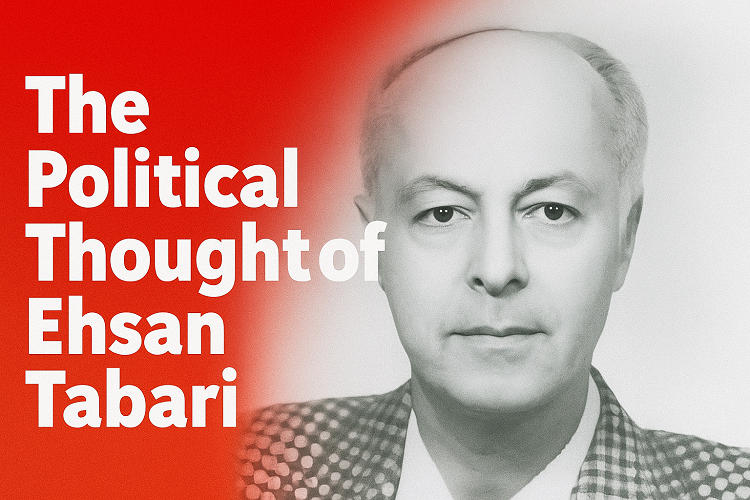
Introduction: The Place and Importance of The Political Thought of Ehsan Tabari
In the study of the history of modern Iranian political thought, the name of Ehsan Tabari has always stood among the most prominent intellectual and theoretical figures of the leftist movement. The Political Thought of Ehsan Tabari not only reflects the Iranian intellectual encounter with Marxism and socialism, but also represents a continuous effort to integrate revolutionary theory with the specific social and cultural conditions of Iranian society. As the principal theoretician of the Tudeh Party of Iran, Tabari sought to connect the fundamental Marxist concepts with Iran’s historical and cultural realities, thereby offering a localized interpretation of historical materialism and socialism.
Thus, studying his political thought not only acquaints us with the internal developments of the Tudeh Party but also opens a window into understanding the formation of leftist discourse in Iran. Another dimension of Tabari’s significance lies in the fact that his writings and intellectual positions—from the 1940s until the end of his life—demonstrate a continuous evolution in his political outlook: a transformation that began with firm belief in Marxism–Leninism and culminated, in his final years, in a kind of philosophical rethinking and even an internal critique of ideology.
Moreover, Ehsan Tabari cannot be regarded merely as a party ideologue. He was a thinker who intertwined philosophy, history, literature, and sociology, and through a deep understanding of Iranian culture, sought to transform Marxism from a rigid and formulaic doctrine into a living and dynamic system of thought. In this sense, his political thought functioned as a bridge between tradition and modernity, and between ideology and rational critique.
In this article, we will first examine Tabari’s life and the historical background that shaped his thinking. Next, we will analyze the theoretical foundations and key concepts in his works. The subsequent sections will explore the evolution of his thought during and after the Iranian Revolution, and finally, his historical and intellectual position among Iranian thinkers will be evaluated.
-
Life and the Historical Context of the Formation of The Political Thought of Ehsan Tabari
Childhood and Early Education
Ehsan Tabari was born in 1916 (1295 in the Iranian calendar) in the city of Sari, into a middle-class, culturally inclined family. His childhood coincided with the turbulent years following the Constitutional Revolution and the rise of the modern Pahlavi state. This historical context exposed his inquisitive mind from an early age to questions about social justice, political power, and the role of thought in social transformation. Tabari completed his elementary education in Sari, attended high school in Tehran, and later studied philosophy and social sciences at the University of Tehran.
From his student years onward, socialist and justice-oriented inclinations began to take shape in his mind. Familiarity with the works of European thinkers such as Karl Marx, Engels, Lenin, and Plekhanov—as well as his engagement with leftist intellectual circles in Tehran—soon led Tabari toward Marxism. Fluent in Russian, French, German, and Arabic, he gained access to a vast body of philosophical and political works in their original languages, which greatly broadened his intellectual horizons.
1.1. Joining the Tudeh Party of Iran
Ehsan Tabari was one of the early and active members of the Tudeh Party of Iran, founded after the fall of Reza Shah in 1941. Alongside figures such as Iraj Eskandari, Noureddin Kianouri, Khalil Maleki, and Abdolsamad Kambakhsh, he was among the party’s first theoreticians. During this period, The Political Thought of Ehsan Tabari was fully shaped within the framework of Marxism–Leninism, and he sought to translate and localize the complex philosophical ideas of Marx and Engels into Persian.
As editor of the party’s publications and head of its theoretical commission, Tabari played a central role in formulating the party’s ideological orientation. In his works—such as On Man and Human Society, Worldviews and Ideologies, and Some Studies on Historical Materialism—he attempted, for the first time in Iran, to present a coherent system of Marxist philosophy. He regarded Marxism not merely as an economic theory but as a “scientific worldview” and a “philosophy of human liberation.”
1.2. Exile, Migration, and Philosophical Reflection
After the 1953 coup d’état and the suppression of the Tudeh Party, Tabari was forced into exile, spending over two decades in the Soviet Union and East Germany. This period was intellectually highly productive for him. He taught philosophy at Moscow State University and interacted with Marxist thinkers from Eastern Europe in an academic setting. During these years, he became acquainted with more critical strands of Marxist philosophy, such as the Frankfurt School and the works of Lukács and Gramsci, and sought to develop a renewed understanding of the relationship between ideology and culture.
His writings from this period took on a more profound theoretical tone. Tabari emphasized the role of culture, ethics, and human values in socialism, arguing that genuine socialism must embrace not only economic and political dimensions but also the deepest layers of human existence. Gradually, he distanced himself from the rigid and dogmatic interpretations of Marxism, approaching instead a form of cultural or humanist Marxism.
1.3. Return to Iran and Encounter with the Islamic Revolution
Following the victory of the 1979 Islamic Revolution, Ehsan Tabari returned to Iran with other members of the Tudeh Party leadership. During this period, he sought to create a theoretical convergence between socialism and the Islamic Revolution. In his articles and speeches, he referred to the notion of a “monotheistic worldview” that could overlap with the justice-oriented goals of socialism. This attempt to initiate an intellectual dialogue between revolutionary Islam and Marxism reflected his theoretical flexibility and his historical understanding of Iran’s transformations.
However, the political landscape soon underwent a dramatic shift. In the early 1980s, as tensions between the Islamic Republic and the Tudeh Party intensified, a broad wave of repression struck the party’s members. Tabari was arrested in 1983 and spent several years in prison. During this time, a profound transformation occurred in his thought—a transformation that remains the subject of scholarly debate to this day.
1.4. The Prison Years and Reconsideration of Thought
During his imprisonment, Ehsan Tabari wrote several works that appeared to mark a return from Marxism toward religious and spiritual ideas. Books such as The Deviated Path (Kajraheh) and Some Reflections on Worldviews were written during this period, in which Tabari criticized official Marxism and emphasized the moral and spiritual dimensions of human life. Many critics believe these writings were produced under political pressure, while others argue that at least part of this transformation stemmed from his sincere philosophical reflection on the limitations of ideology.
In any case, this period can be considered a turning point in the development of The Political Thought of Ehsan Tabari. He moved from strict party ideology toward a form of critical, human-centered philosophy. In his later writings, he placed greater emphasis on human dignity, freedom of conscience, and the necessity of moral self-awareness.
1.5. Death and Intellectual Legacy
Ehsan Tabari died in Tehran in 1989. His death marked the end of an era in Iran’s political-intellectual history—an era in which Iranian intellectuals sought to explain social justice through comprehensive philosophical frameworks. Despite the fluctuations in his political and theoretical path, Tabari remains one of the most coherent Marxist theorists in Iran’s history—someone who not only interpreted and translated Marxism but also sought to reconcile it with Iran’s cultural and historical traditions.
Today, revisiting The Political Thought of Ehsan Tabari is more important than ever, for it reveals the Iranian intellectual’s struggle to understand justice, freedom, and human emancipation from the grip of unequal structures. With all his contradictions and transformations, Tabari stands as a symbol of the enduring tension between ideology and rationality in modern Iranian history—a tension that continues to shape our intellectual and political landscape.
-
The Theoretical Foundations of The Political Thought of Ehsan Tabari
The Political Thought of Ehsan Tabari is founded on a synthesis of Marxist philosophy, historical consciousness, and cultural sensitivity. At the center of this intellectual framework stands the human being—as a social, historical, and self-aware entity. Unlike many party theorists who regarded Marxism merely as an instrument of political justification, Tabari sought to understand it as both a philosophical and ethical system. Therefore, grasping the theoretical foundations of his thought is impossible without attention to its philosophical, epistemological, and sociological underpinnings.
In this section, we will first examine his philosophy of history and historical materialism; then the relationship between ideology and science in his works will be discussed. Subsequently, his views on humanity, class, and the state will be analyzed, and finally, his moral and aesthetic perspectives will be addressed.
2.1. Philosophy of History and Historical Materialism in The Political Thought of Ehsan Tabari
In his numerous books and articles, Tabari viewed history not as a collection of scattered events, but as a lawful and dialectical process. Drawing inspiration from Marx and Engels, he believed that “the movement of history is based on the internal contradictions between the productive forces and the relations of production.” However, his interpretation of historical materialism was more humanistic and cultural than the official Soviet versions.
In Some Studies on Historical Materialism, he wrote that man is a “conscious agent” in history and should not be regarded merely as an instrument of production. For Tabari, history is the stage of a dialectic between necessity and freedom: necessity arises from economic structures, and freedom from human consciousness. This emphasis on awareness distinguished him from the dogmatism of orthodox Marxism.
Furthermore, Tabari attached great importance to the role of culture and values in historical transformation. Unlike certain Marxists who viewed culture as a mere reflection of the economic base, he stressed its relative autonomy, arguing that ideologies can themselves become active forces for economic and political change. Thus, one may say that Tabari subscribed to a kind of “cultural materialism,” in which culture and economy mutually influence one another.
In other words, in The Political Thought of Ehsan Tabari, history is a process in which the human being is not a captive of structure but an active participant in shaping it. This outlook led him toward a human-centered philosophy of history that, while rooted in Marxism, transcends the narrow confines of ideology.
2.2. Ideology and Science: Distinction and Connection
One of the central discussions in Tabari’s works is the distinction between “ideology” and “science.” In writings such as Worldviews and Ideologies, he argues that science seeks to uncover reality, whereas ideology concerns itself with directing and mobilizing social forces to change reality. In other words, science describes, but ideology prescribes.
From this perspective, Tabari did not regard Marxism as merely a science of society; he called it a “science–ideology”—a synthesis that both provides a scientific understanding of the laws of social motion and pursues the emancipatory goal of humankind. This dual character of Marxism—both scientific and ideological—is one of the distinctive features of The Political Thought of Ehsan Tabari, reflecting his attempt to maintain a balance between rationality and social commitment.
At the same time, particularly in the later years of his life, he warned against the dangers of ideological rigidity. In his later writings, he insisted that when ideology hardens into dogma, it destroys critical reason and imprisons humanity within closed conceptual frameworks. Thus, by the end of his life, Tabari had turned to critique the very ideological structure he had once helped to build.
2.3. Humanity, Society, and the Concept of Freedom
At the core of Tabari’s thought stands the human being as a historical and creative entity. Unlike some structuralist Marxists, he emphasized the active role of human agency in social transformation. From his perspective, the human being is not merely a product of the relations of production, but also their creator.
For Tabari, freedom and consciousness are two sides of the same coin. Freedom without consciousness leads to chaos and blind individualism, while consciousness without freedom results in dogmatism. Therefore, the task of a socialist society is to nurture human beings who think freely and act responsibly.
In his writings—especially in his essay Man and Human Society—Tabari regarded freedom not as an abstract notion, but as the outcome of material and social conditions. Genuine freedom, he argued, is realized only when the relations of production are purged of exploitation and when human beings are liberated from alienation from their labor and its products. Yet, in his later works, he began to speak of “inner freedom”—a form of freedom linked to moral self-awareness and human responsibility. This transformation indicates that over the course of his life, he moved from economic Marxism toward a form of ethical existentialism.
2.4. Social Classes and the State
In analyzing power structures, Ehsan Tabari drew upon the classical Marxist framework. He believed that the state is an instrument of class domination, its form determined by the stage of development of the productive forces and the balance of power among classes. However, in his writings, he did not view the state merely as an apparatus of repression, but also as an “organizing system of collective life.”
He argued that in the transitional phase toward socialism, the state must play a dual role: on one hand, to dismantle capitalist structures, and on the other, to foster the formation of democratic and popular institutions. In other words, Tabari believed in a kind of “democratic socialism,” in which social justice is meaningless without political participation by the people.
In his articles on the 1979 Revolution, he sought to demonstrate that any revolution lacking a clear class foundation and a socio-economic program would sooner or later reproduce domination. Thus, he stressed that class consciousness must be combined with cultural and moral awareness in order to bring about lasting transformation.
2.5. Ethics, Aesthetics, and Culture
Among Iranian Marxists, Ehsan Tabari was perhaps the one most attentive to the role of culture, art, and ethics. He regarded culture as “the soul of society,” believing that without cultural development, no political or economic transformation could endure.
In his literary and philosophical works—such as From Encounter with the Self (Az Didar-e Khishetan) and With the Whisper of Autumn (Ba Pichpiche-ye Paeez)—Tabari employed a poetic and reflective language to explore the interrelation between beauty, truth, and freedom. He believed that art possesses the power to awaken the social conscience and thus constitutes a form of ideological struggle, though it must never be reduced to a mere tool of political propaganda.
In his final years, Tabari turned his attention to ethics and spirituality as inseparable dimensions of human freedom. In his writings, he spoke of “submission to conscience,” “inner truth,” and “enduring human values.” This shift from pure materialism to a form of human ethics and introspective philosophy indicates that The Political Thought of Ehsan Tabari evolved from an outward revolution to an inward one.
2.6. Section Summary: A System Between Philosophy, Politics, and Culture
In summary, The Political Thought of Ehsan Tabari constitutes a complex and multifaceted system in which philosophy, politics, and culture are intricately interwoven. In his early years, he was a committed Marxist who sought justice through transformation of the relations of production; by the end of his life, however, he connected justice with consciousness, ethics, and beauty.
Thus, his intellectual journey exemplifies the Iranian intellectual’s passage from ideology to critique, from party certainty to philosophical reflection. For this reason, studying his works is essential for understanding the evolution of leftist thought in Iran. He teaches us that political thought, if it is to remain alive, must always remain in dialogue with its own history and culture—and must resist dogma and fanaticism.
-
Freedom, Justice, and Democracy in The Political Thought of Ehsan Tabari
In examining The Political Thought of Ehsan Tabari, three fundamental concepts stand out more prominently than others: freedom, justice, and democracy. These three constitute the main pillars of every political system of thought; however, in Tabari’s intellectual framework, they possess meanings and positions distinct from the common interpretations within liberalism or classical socialism. Throughout his intellectual journey, Tabari sought to balance historical necessity and human freedom, social justice and individual dignity, as well as democracy and revolutionary discipline.
During different periods of his life, he began with a Marxist–Leninist interpretation of these concepts but gradually moved toward a more humanistic, cultural, and ethical outlook. Therefore, an analysis of his views on freedom, justice, and democracy is, in fact, an analysis of the spiritual and intellectual evolution of his thought.
3.1. The Concept of Freedom in The Political Thought of Ehsan Tabari
In his early works, Tabari considered freedom to be a relative and class-bound matter. He believed that freedom in a class-based society is a formal concept restricted to the owners of capital. In his book Man and Human Society, he asserted that “bourgeois freedom” is merely the freedom to own and accumulate, not the freedom to live humanly. From his perspective, true freedom is possible only in a socialist society, for only there can human beings be liberated from the shackles of exploitation and alienation.
However, unlike many dogmatic Marxists, Tabari did not view freedom merely as the result of an economic structural change. He emphasized the role of consciousness, believing that economic liberation without intellectual and cultural emancipation is unstable. In this regard, he wrote: “Freedom is the product of the evolution of man’s awareness of himself and his world.”
In his later works, especially after his years in prison, the concept of freedom took on a more inward and moral character. In Deviation (Kajraheh), he spoke of the “freedom of the spirit,” emphasizing that no system—however justice-oriented—can guarantee human happiness if the individual is not inwardly free. This shift from social freedom to inner freedom marks a profound transformation in The Political Thought of Ehsan Tabari: a movement from structural socialism toward a kind of ethical humanism.
From this perspective, freedom in his thought encompasses three interrelated layers:
- Material freedom – liberation from poverty and exploitation;
- Social freedom – active participation in collective destiny;
- Spiritual freedom – self-awareness and inner autonomy.
Tabari believed that genuine freedom can be realized only through the integration of these three layers, since the human being is simultaneously an economic, social, and moral creature.
3.2. Social Justice and Human Morality
Throughout his life, Ehsan Tabari placed justice at the center of his political thought. For him, justice was both a moral and historical concept—not merely an economic one. In his earliest writings, justice meant economic equality and the abolition of private ownership of the means of production; yet, as time passed, he came to interpret justice as balance in all dimensions of human life.
In an essay titled A Few Words on Justice, he wrote:
“Justice is not merely the distribution of bread, but also the distribution of dignity, knowledge, and opportunity.”
This statement clearly reveals that Tabari perceived justice not only on a material level but also within the cultural and spiritual domains.
He believed that justice without morality and spirituality degenerates into a mechanical distribution of benefits. Therefore, in his later works, he linked justice to social conscience. In his view, socialism becomes truly human only when it is accompanied by moral awareness and compassion.
Tabari saw justice as the result of a scientific understanding of society but believed that its realization required love and human faith as well. In this context, he spoke of “passionate justice”—a form of justice born not out of legal compulsion but from empathy and the sense of human unity.
Ultimately, justice in his thought represents a synthesis between science and ethics: science serves to uncover the mechanisms of inequality, while ethics transforms this understanding into liberating behavior. Such a perspective moves justice beyond the purely economic sphere and elevates it to a universal human principle.
3.3. Democracy and Popular Sovereignty
One of the less-examined aspects of The Political Thought of Ehsan Tabari is his view of democracy. From the outset, he opposed the liberal concept of democracy—that is, the rule of the majority within the framework of capitalism—considering it a form of “formal democracy.” In his view, true democracy is possible only when the economic foundation of society is just.
At the same time, unlike the authoritarian traditions of some Marxist parties, Tabari did not regard democracy merely as a transitional tool, but as the enduring essence of socialist life. In his writings of the 1970s, he spoke of “people’s democracy”, in which councils, labor unions, and local institutions should play decisive roles in managing society.
Yet, Tabari was also acutely aware of the danger of bureaucratization within socialist states. Observing the Soviet experience, he warned that if the party and the state replace the people, socialism will degenerate into a new form of domination. In one of his essays, he wrote:
“Socialism without democracy leads to stagnation and lifelessness, just as democracy without justice leads to bourgeois deception.”
After the 1979 Revolution, Tabari attempted to initiate a dialogue between religious democracy and socialist justice. He believed that if the essence of democracy lies in “respect for the human being and his right to choose,” then a form of convergence between religious traditions and socialist ideals is possible. Although many of his contemporaries criticized this view, historically it reflects his inquisitive and adaptive spirit.
Ultimately, Tabari regarded democracy not merely as an institutional system but as a cultural space—a space for dialogue, criticism, and the growth of consciousness. Democracy, in his view, is an ongoing process, not a final destination.
3.4. The Triadic Link Between Freedom, Justice, and Democracy
In Tabari’s thought, freedom, justice, and democracy are three inseparable elements of a single whole; none can exist meaningfully without the others. He believed that justice without freedom leads to collective despotism, freedom without justice to individual selfishness, and democracy without both to political emptiness.
From Tabari’s perspective, justice constitutes the material foundation of society, freedom its human content, and democracy its institutional form. Therefore, true socialism can only be realized when these three are held in balance.
In his philosophical writings, he employed a poetic metaphor:
“Human society is like an orchestra: justice is its rhythm, freedom its melody, and democracy its harmony.”
This poetic image reflects his aesthetic vision of politics—not as a battlefield of power, but as an art of harmony among human beings.
3.5. The Final Transformation: From Ideology to Humanism
In the final years of his life, Tabari spoke of the concept of the “new human being”—a person who, as he put it, “has made a revolution within himself.” He came to realize that freedom, justice, and democracy, unless realized within the conscience of individuals, cannot endure externally.
This view represents the ultimate transformation in The Political Thought of Ehsan Tabari: a transition from outer socialism to inner socialism, from ideology to ethics, from social programming to the cultivation of the human soul. In his later writings, he emphasized that “a free society is built by free individuals, not by free laws.”
Thus, in his final intellectual step, Tabari created a dialogue between Marxist philosophy and Eastern mysticism—a dialogue in which justice is united with love, and freedom with inner truth.
3.6. Section Summary
It may be said that Ehsan Tabari, over the long course of his intellectual evolution, passed through three stages in his interpretation of freedom, justice, and democracy:
- Revolutionary stage – emphasizing freedom and justice as the outcome of class struggle;
- Theoretical and cultural stage – linking justice to culture and education, and interpreting democracy as cultural participation;
- Philosophical and ethical stage – emphasizing inner freedom, moral justice, and spiritual democracy.
Therefore, the Political Thought of Ehsan Tabari can be understood as a journey from the outer to the inner, from structure to meaning, from society to the human being. He sought to show that freedom and justice are rooted not only in law and economics but also in human conscience and culture.
-
The Intellectual Transformation of Ehsan Tabari in His Final Years and Its Various Interpretations
In the study of The Political Thought of Ehsan Tabari, perhaps no subject has provoked as much debate as his intellectual transformation during the final years of his life. Tabari was a theorist who devoted more than four decades to the exposition and defense of Marxism. Yet, in the last years of his life—while imprisoned by the Islamic Republic—he wrote works that many have regarded as signs of a “spiritual return” or even an “ideological repentance.” However, a precise evaluation of this transformation requires a historical, philosophical, and human perspective, for it cannot be reduced merely to political pressures or individual psychological changes.
In the 1980s (1360s SH), Ehsan Tabari began to reconsider his convictions under conditions in which not only Iran’s political structure had been fundamentally transformed, but the global experience of state socialism was also facing internal crises. The gradual collapse of the Soviet ideological legitimacy, the rise of the New Left in the West, and the failure of Marxist experiments in the Third World—all these created an intellectual environment conducive to rethinking the foundations of socialism. Thus, Tabari’s transformation must be understood in connection with both global and national developments, not solely at the individual level.
4.1. Historical and Philosophical Contexts of Transformation
In the late 1970s and early 1980s, Ehsan Tabari encountered two major intellectual crises: first, the crisis of the model of “real existing socialism,” and second, the crisis in the relationship between the Tudeh Party and the Islamic Revolution. The Tudeh Party, which had long defended the Soviet Union and Comintern policies during its years in exile, sought after its 1979 return to Iran to establish some form of theoretical coexistence with the Islamic Republic. Tabari was one of the principal figures of this approach and attempted—by reinterpreting concepts such as tawhid (monotheism) and social justice—to find a form of convergence between Marxism and revolutionary Islam.
However, with the suppression of the party in the early 1980s and the arrest of its leaders, this policy collapsed. Tabari was arrested in 1983 and remained imprisoned for years. This period became the starting point for a profound reexamination of his thought.
Philosophically, Tabari had always been concerned with the connection between science and ethics. Even earlier, he had spoken about the limitations of ideology, but in prison, this concern deepened into an existential and inner dimension. In his notes, he wrote:
“If man does not reach the light of truth within himself, he will never be free in any system.”
This sentence reflects a fundamental shift in his worldview—from historicism to introspection, from the collective to the individual, from external revolution to inner revolution.
4.2. The Prison Works: Kajraheh (“Deviation”) and Some Studies on Worldviews
The most important documents from this period of Tabari’s life are his two works: Kajraheh (Deviation) and Some Studies on Worldviews.
In Kajraheh, Tabari delivers an unprecedented and sharp critique of classical Marxism and the experience of the Tudeh Party. In the preface, he speaks of the “neglect of the human spirit” and “captivity in pure materialism,” writing that “the world cannot be understood solely through the instrument of economics.” In this book, rather than rejecting Marxist aspirations for justice, he aims to show that exclusive reliance on historical materialism deprives humanity of meaning, faith, and moral values.
In Some Studies on Worldviews, his approach is more philosophical. Tabari compares materialist, idealist, and theistic worldviews, and implicitly defends a kind of “philosophical monotheism” in which humanity and divinity are linked in a spiritual bond. This work reveals that by that time, Tabari had moved from dialectical materialism toward a kind of ethical and mystical idealism.
Of course, scholars differ over the degree of freedom Tabari enjoyed in writing these works. Some of his former comrades argue that these writings were produced under political coercion and prison conditions. For instance, Noureddin Kianouri and F. A. Javanshir emphasized in their memoirs that Tabari was not in a position to think freely while imprisoned. Yet, several independent critics—including certain religious intellectuals and dissident leftists—believe that his transformation was at least partly genuine and intellectual, since his works exhibit philosophical coherence and a personal tone, rather than the language of forced declarations.
4.3. Thematic Analysis of His Transformation
An internal reading of Tabari’s later works reveals three main axes of his intellectual transformation:
a) From Economic Materialism to Ethical Humanism
In his later writings, Tabari emphasized human dignity, conscience, love, and faith, asserting that without these elements, no social theory could lead to human happiness. This shift transformed him from a social philosopher into a moral thinker.
b) From Ideological Dogmatism to Epistemic Relativism
He acknowledged that no doctrine—even Marxism—can claim a monopoly on truth. He spoke of the “plurality of paths to liberation,” writing:
“Man is always oscillating between error and truth; absolutism is the enemy of free thought.”
These statements clearly indicate his intellectual distance from the dogmatic logic of the Tudeh Party.
c) From External Revolution to Inner Reform
Ultimately, Tabari concluded that human liberation lies less in the transformation of political structures and more in the transformation of spirit and morality. He wrote:
“The person who is a tyrant within himself will reproduce tyranny if he comes to power.”
This insight reflects a deeply philosophical and experiential conclusion, not merely an outcome of external pressure.
4.4. Reactions and Interpretations
Ehsan Tabari’s intellectual transformation elicited a variety of often contradictory responses:
- The Tudeh Party’s reaction: The remaining party leaders deemed his writings “invalid,” insisting that Tabari spoke under political coercion. They argued that his change of stance was the result of psychological and physical pressure, not inner transformation.
- Religious intellectuals: Many Islamic thinkers, including Abdolkarim Soroush, regarded Tabari’s transformation as a sign of “the return of modern reason to faith.” They viewed his later works as a sincere attempt to find moral meaning beyond ideology.
- Critical and independent leftists: Some Marxist critics took an intermediate position. To them, Tabari neither completely renounced Marxism nor embraced religion; rather, he sought to reconcile socialism with human spirituality.
- Contemporary scholars: In recent decades, several academic researchers—particularly in Iran and Europe—have attempted to interpret Tabari’s final works free from political preconceptions. They argue that his transformation signifies philosophical maturity and a transition from ideological certainty to critical reflection—a path also taken by many twentieth-century intellectuals, such as Lukács and Sartre.
4.5. The Link Between His Transformation and the Fate of Iranian Intellectualism
Ehsan Tabari’s transformation can also be understood within the broader trajectory of Iranian intellectual history. In modern Iran, intellectuals have often oscillated between the poles of science and faith, reason and morality, modernity and tradition. By moving from party-bound Marxism to an ethical form of thought, Tabari experienced this historical tension within himself.
In his life, he represented three generations of Iranian intellectuals:
- The first generation, which arose with the ideal of social justice;
- The second, which became entangled in political struggle;
- And the third, which reached the stage of self-critique of ideology.
From this perspective, Tabari’s transformation was not a failure but a kind of historical maturation within Iranian leftist thought.
4.6. Final Evaluation: Return or Reconsideration?
The central question is this: Did Ehsan Tabari “return,” or did he “rethink”?
There is no simple answer. If “return” means a complete rupture from his past, then Tabari did not return—for even in his later works, he never abandoned his concern for justice and freedom. But if “reconsideration” means transcending dogma and opening a new intellectual horizon, then undoubtedly, Tabari rethought.
In truth, he did not move from Marxism to faith; he moved from ideology to ethics, from dogma to reflection, from revolutionary activism to self-knowledge. In his final years, he sought the image of a complete human being—one who could understand justice and experience love.
For this reason, Tabari’s intellectual legacy should not be viewed in opposition to his Marxist past but as its continuation—a continuation that opened the path of self-critique and the growth of rationality.
4.7. Section Summary
Ehsan Tabari’s intellectual transformation mirrors the turbulent trajectory of twentieth-century intellectual life: from faith in science to a return to ethics, from external revolution to inner liberation. At first, he represented classical Marxism in Iran; in the end, he became a thinker who placed human value and freedom of conscience above every ideology.
This transformation was not a sign of weakness but of the power to think. Tabari demonstrated that living thought is always in a state of becoming—just as he himself wrote in his final text:
“Man never reaches the shore of certainty, for the sea is boundless.”
-
Final Conclusion: The Place of Ehsan Tabari in Contemporary Iranian Political Thought
In the final analysis, The Political Thought of Ehsan Tabari can be viewed as a bridge between three significant phases in the history of Iranian intellectual life: the era of justice-oriented idealism, the era of ideological partisanship, and the era of moral rethinking. He was a figure who left a profound mark on Iran’s intellectual memory—not only as the chief theorist of the Tudeh Party but also as a philosophical thinker and poet of reflection.
Throughout his long life, Tabari evolved from a classical Marxist into a humanist and moral philosopher. Yet this transformation did not signify a negation of his past, but rather its maturation. In fact, he sought to reconcile two great traditions: socialist idealism rooted in the pursuit of justice, and the ethical spirituality of Iranian culture.
5.1. The Link Between Tabari’s Political Thought and the Iranian Intellectual Tradition
To understand Tabari’s historical position, one must situate him within the continuity of Iranian intellectual movements from the Constitutional Revolution (1906–1911) to the 1980s. Iranian intellectuals have always been torn between two central concerns: social justice and individual freedom. The constitutionalists sought justice through law, the socialists through revolution, and the religious thinkers through faith.
Unlike many of his contemporaries, Tabari tried to combine these two domains within a unified theoretical framework. In his view, justice without freedom leads to tyranny, while freedom without justice results in exploitation. This interdependence of freedom and justice formed the foundation of his political thought.
Moreover, in his philosophical writings, Tabari employed concepts deeply rooted in Iranian mystical tradition—such as “spiritual evolution,” “self-knowledge,” and “love for humanity.” He reinterpreted Marxism in a cultural and indigenous framework, blending it with the language of Persian poetry and philosophy. From this perspective, Tabari can be seen as the first major figure in the project of “Iranianizing Marxism”—an effort that later continued, in different forms, in the works of thinkers such as Bijan Jazani and Ehsan Naraghi.
5.2. The Relationship Between Philosophy and Politics in Tabari’s Thought
One of Ehsan Tabari’s most distinctive features was his integration of philosophy and politics. He was neither merely a party politician nor only a speculative philosopher; rather, he was a thinker who employed philosophy as a means to analyze and transform society.
From the 1940s to the 1970s, his political philosophy was based on historical materialism. Yet even within this framework, his materialism took on cultural and moral dimensions. From the very beginning, Tabari emphasized the importance of culture, myth, language, and ethics in shaping class consciousness—an aspect often neglected by classical Marxists.
He stated:
“Revolution does not occur only in factories; there must also be a revolution within consciences.”
This sentence encapsulates the essence of his thinking: the profound connection between external politics and internal transformation.
In the final years of his life, this same philosophical perspective led him to turn the reconsideration of his political beliefs into a moral reflection rather than a mere renunciation. Therefore, Tabari’s transformation should be seen as a continuation of his synthesis of philosophy and politics, not a rupture from it.
5.3. Tabari and the Iranian Left: A Dual Legacy
Undoubtedly, Ehsan Tabari was one of the most influential theorists of the Iranian Left in the twentieth century. He played a foundational role in formulating the theoretical basis of the Tudeh Party and in popularizing scientific Marxism in Iran. Nevertheless, his legacy for the Iranian Left is dual in nature:
- On one hand, Tabari symbolizes fidelity to socialist and egalitarian ideals. His early works, such as Worldviews and Ideologies, played a key role in articulating the intellectual foundations of socialism in Iran.
- On the other hand, in his later writings, he warned of the dangers of dogmatism and ideological alienation—constituting an inner critique of Iranian Marxism itself.
Since his death, the Iranian Left has continued to oscillate between these two legacies: the legacy of class struggle and that of ethical self-critique.
5.4. Ehsan Tabari and the Question of Iranian Modernity
At a broader level, Ehsan Tabari’s thought can be interpreted as an attempt to respond to the question of modernity in Iran. He sought to synthesize Western modernity with Iranian cultural values—not from a traditionalist stance, but from a critical and human-centered one.
In Tabari’s view, modernity without justice becomes unrestrained capitalism that empties the human spirit from within; justice without awareness, however, degenerates into ideological dictatorship. Therefore, he called for a form of “committed modernity” that would blend rationality with moral conscience.
In this sense, Tabari, with all his intellectual complexity, endeavored to build a bridge between “science” and “meaning”—the very tension that still lies at the heart of the crisis of Iranian intellectualism today.
5.5. The Enduring Value of Tabari’s Thought in Our Time
Today, in the twenty-first century, when we return to the works and life of Ehsan Tabari, we encounter a multifaceted figure: a political philosopher, a poet with a mystical sensibility, and a critical intellectual who oscillated between loyalty and doubt.
His legacy can be evaluated on several levels:
- Philosophically: Through his translations and interpretations of Marxist texts, Tabari played a crucial role in introducing modern philosophical concepts into Persian. He helped naturalize key terms such as dialectic, ideology, and historicism in Iran’s political lexicon.
- Politically: He was among the few thinkers who sought to unite theory and political practice, moving from ideology toward ethics.
- Culturally and Literarily: His poetic and metaphorical language liberated political thought from rigidity and dogmatism, giving it a human and aesthetic dimension.
In the end, Tabari was not a defeated figure but a man who preserved the courage to think until his last breath. Even in prison, instead of turning to hatred and vengeance, he turned to understanding and contemplation—and that may be his most profound lesson for future generations.
5.6. Final Summary
In summary, The Political Thought of Ehsan Tabari can be distilled into three central themes:
- Commitment to Justice: Throughout his works, social justice remained the central goal, though his understanding of it evolved from the economic to the ethical realm.
- Rational Humanism: Ultimately, Tabari placed the human being at the center of all values—not class, not party, not ideology.
- The Dialectic Between Certainty and Doubt: Rather than resting in dogma, he constantly moved between belief and critique. This intellectual dynamism keeps his thought alive.
From this perspective, Ehsan Tabari can be regarded as the reflective conscience of the Iranian Left—a thinker who, with all his mistakes and contradictions, traversed the path of intellectual and moral growth, moving from ideology toward humanity.
As he himself wrote in his final text:
“Truth lies neither in the party nor in the church; truth resides in the heart of the human being who asks.”

