


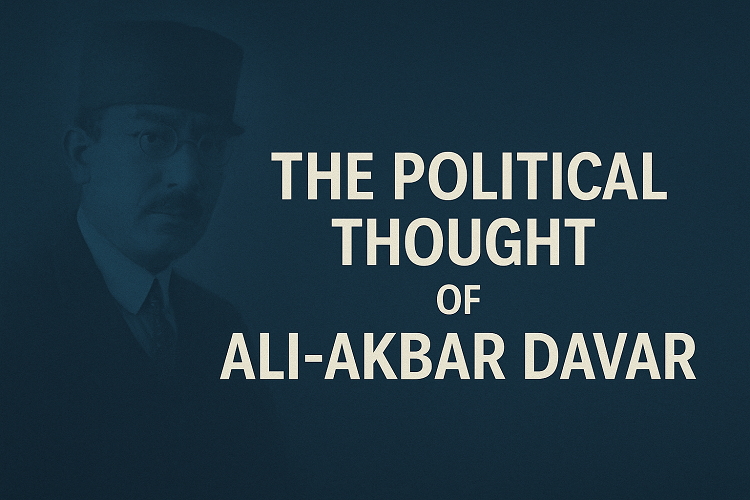
The Political Thought of Ali-Akbar Davar is one of the most significant yet least analyzed areas in the intellectual history of modern Iran. Davar was not merely a politician or the Minister of Justice during Reza Shah’s reign; he was a thinker who, inspired by Western legal and institutional models, sought to establish Iran’s judicial and administrative systems on new foundations. Understanding The Political Thought of Ali-Akbar Davar is impossible without grasping the historical context of his emergence during the transition from constitutionalism to modern authoritarianism—a period when the Iranian state was seeking order, centralization, and authority while still struggling with crises of legitimacy, corruption, and structural chaos.
Amidst this turmoil, Davar represented a form of technocratic and modern rationality whose goal was not merely to reform existing structures, but to build the foundations of a modern centralized state. As a political thinker, he believed that development and justice could only be achieved through institutional modernization and the concentration of power in the state. From this perspective, The Political Thought of Ali-Akbar Davar can be seen as a bridge between the liberal aspirations of the Constitutional Revolution and the power-oriented realism of Reza Shah’s rule.
However, Davar ultimately found himself in a profound contradiction: the man who began as a defender of “law” and the “independence of the judiciary” eventually became part of Reza Shah’s machinery of power—a power that regarded law itself as an instrument of political domination. This tension between ideal and reality, between reform and authority, has made Davar’s political thought a living and thought-provoking subject for scholars of political science and the history of ideas.
Furthermore, the study of The Political Thought of Ali-Akbar Davar not only helps illuminate Iran’s transformations in the early decades of the 20th century (14th century Solar Hijri), but also provides a key to understanding one of the most fundamental dilemmas of modern Iranian politics: how can a balance be achieved between modernization and freedom, between an efficient state and a vibrant civil society?
Accordingly, this article seeks, through an analytical approach grounded in historical evidence, to reconstruct the main components of Davar’s political thought. It will first examine his historical and intellectual background, then analyze the key elements of his thought concerning the state, law, and power. Finally, it will explore Davar’s role in Reza Shah’s political project and the intellectual conclusion of his career.
-
The Historical and Intellectual Background of Ali-Akbar Davar
The Political Thought of Ali-Akbar Davar cannot be understood apart from the intellectual and political developments that followed the Constitutional Revolution. The Constitutional Revolution of 1906 (1285 Solar Hijri) was, in fact, Iranians’ first historical attempt to establish a modern and law-based state. Yet, in practice, it faced profound institutional and cultural challenges. The weakness of the administrative structure, widespread corruption, the inability to enforce the law, and the intervention of foreign powers quickly turned the constitutional ideals of justice and freedom into crisis.
In such circumstances, a new generation of Iranian elites—including Ali-Akbar Davar—emerged in search of fresh ways to organize the state and society. Unlike the early constitutional intellectuals who emphasized political liberty and the constitution, this generation was more preoccupied with building a powerful state and administrative order. From their perspective, Iran’s most urgent needs were order, centralization, and efficiency—goals that could not be achieved without a strong central government.
Ali-Akbar Davar, who had studied law in Switzerland and become acquainted with European legal and administrative systems, brought back with him an image of the modern European state—one founded upon law, bureaucracy, and administrative authority. The failure of the Constitutional movement to achieve justice and security had instilled in Davar a certain skepticism toward premature political freedom. He believed that as long as a strong, law-based state was not established, freedom would be neither possible nor sustainable.
Thus, The Political Thought of Ali-Akbar Davar emerged at the intersection of two major intellectual currents in modern Iran: on one side, the legacy of constitutionalism and the ideal of the rule of law; on the other, a tendency toward authoritarian state-building and rapid modernization. Davar was influenced by both currents but ultimately leaned toward the latter—an orientation that later took concrete form in Reza Shah’s policies.
In the 1920s (1300s Solar Hijri), Iran suffered from chronic insecurity, fragmented power, and weak civic institutions. Tribal and feudal structures still dominated much of society, while the central government lacked genuine authority over many regions. In such a context, ideas like The Political Thought of Ali-Akbar Davar, emphasizing the centralization of power within the state, appeared not only appealing but essential to the elites of the time.
Moreover, from the very beginning of his political career in the National Consultative Assembly (Majles), Davar adopted a critical stance toward the judiciary and the administrative system. He argued that Iran’s judicial system—due to its dependence on traditional jurisprudence and lack of legal coherence—was an obstacle to modern development and justice. Hence, from his earliest years of public activity, he sought to create a new judicial institution based on secular and civil law—one that could replace individual fatwas and ijtihad with legal order and predictability.
During this period, the influence of European modernist thought on Davar’s mind became evident. Through his studies of French law and thinkers such as Montesquieu and Rousseau, he came to appreciate the significance of the separation of powers, legalism, and executive authority. However, in practice, he leaned more toward centralized power than a true separation of powers, for he believed that Iranian society was not yet prepared for democratic institutions and that modernization could not occur without authority.
From this perspective, Davar can be regarded as part of the generation of thinkers who, in the early decades of the 20th century, laid the groundwork for an “authoritarian modernization” project in Iran. Like Taqizadeh, Foroughi, and Teymourtash, he believed in institutional Westernization and reform from above; yet among them, he was the one most focused on the institutions of law and justice.
Ultimately, The Political Thought of Ali-Akbar Davar took shape amid the tension between the ideals of the Constitutional Revolution and the realities of Reza Shah’s state. It was a vision that sought not political participation, but institution-building for authority and order. This pursuit became the source of his far-reaching reforms—and the seed of the contradictions and the tragic end of his life.
-
The Main Components of The Political Thought of Ali-Akbar Davar
The Political Thought of Ali-Akbar Davar can be seen as an intellectual system grounded upon three foundations: state authority, modern legalism, and reform from above. In essence, Davar sought to strike a balance between two seemingly opposing concepts—“freedom” and “order.” Yet in practice, his inclination leaned more strongly toward order and centralized authority. To understand this thought in depth, it is necessary to examine its key elements separately.
2.1. The Modern State and the Necessity of Political Authority
One of the fundamental pillars of The Political Thought of Ali-Akbar Davar is his belief in a strong and centralized state. Unlike some of his contemporaries, who still spoke of “limiting power,” Davar believed that one must first create power before one can constrain it. In his view, the pre-modern Iranian state possessed neither power nor legitimacy; as a result, neither law could be enforced nor justice achieved.
This conception of the state was rooted in the experience of the Constitutional Revolution’s failure and Iran’s administrative disorder. Like many technocrats of Reza Shah’s era, Davar believed that a society without order required what he called a “preconditional authority.” From this standpoint, the modern state had to be built upon efficient bureaucracy, a coherent judicial system, and centralized power.
Within this framework, the state was not, for Davar, merely an executive apparatus but rather the embodiment of modern rationality. He viewed power not as an instrument of repression but as a necessary condition for societal modernization. Thus, although he often spoke of “law,” in practice he leaned toward a state capable of implementing reforms from above, through concentrated will and without facing social resistance.
In reality, within The Political Thought of Ali-Akbar Davar, political power and legal rationality complemented one another. He sought to institutionalize state authority through the mechanism of law—an idea he would later materialize in his project to establish the modern Iranian judiciary.
2.2. Law and Justice: From Concept to Institution
Davar can rightfully be called the father of modern Iranian judiciary, yet this title is not merely administrative—it also reflects the intellectual depth of his views on the role of law in political order. In The Political Thought of Ali-Akbar Davar, law is not simply a tool for achieving justice; rather, it is the precondition for the very existence of justice. In other words, justice cannot exist without institutional and bureaucratic foundations.
In pre-modern Iranian tradition, justice was often regarded as a moral or personal matter to be carried out by the ruler or the judge. Davar transformed this meaning, elevating justice from the ethical and individual level to the institutional and structural one. He sought to make law the substitute for personal will—both in governance and in the judiciary.
For this reason, Davar’s judicial reforms were not merely a set of legal changes but rather the practical realization of his political thought. He established a secular judiciary system to reduce the dependence of justice on religious authority and jurisprudential interpretation, making the courts subject to codified and systematic law instead.
Yet, it is here that the contradiction in his thought becomes apparent: while Davar aimed to establish law as a force independent of political power, in practice the new judiciary fell under the direct influence of Reza Shah’s state. Thus, law, instead of restraining power, became one of its instruments of legitimization.
Despite this contradiction, Davar’s achievement in institutionalizing the concept of law cannot be ignored. He was the first Iranian thinker to translate justice into the language of law and sought to move society from personal and traditional judgment toward a modern legal order.
2.3. Reform from Above and the Modernizing Bureaucracy
The third component of The Political Thought of Ali-Akbar Davar is his belief in reform from above and bureaucratic modernization. Like other reformist statesmen of Reza Shah’s era, Davar had grown disillusioned with gradual or socially driven reform. To him, a society still entangled in tribal traditions, religious authority, and educational weakness could not spontaneously follow the path of modernization. Therefore, the state had to assume the role of the vanguard of reform.
In Davar’s view, reform from above was not tyranny but rather a historical necessity for Iran. He saw the state as the teacher and organizer of society, not its mere servant. This perspective closely resembles what modern development theory calls “authoritarian modernization”—a model that became prevalent in many transitional countries during the twentieth century.
In practice, Davar tried to implement precisely this vision. The establishment of the new Ministry of Justice, the drafting of new civil and criminal codes, the training of judges, and the abolition of religious courts were all steps that demonstrated his belief in structural, not symbolic, reform.
However, this top-down reform came at a heavy price: a reduction of freedom, unprecedented concentration of power in the hands of the Shah, and the elimination of independent institutions. Midway through this process, Davar realized that reform without social participation inevitably leads to the reproduction of despotism. This conflict between the ideal of modernization and the reality of authoritarianism turned his political thought into a tragedy.
In summary, The Political Thought of Ali-Akbar Davar was founded upon three core principles: state authority, institutionalization of law, and reform from above. He sought to transform the state from disorder to order, and society from dependence to legalism. Yet, in pursuing this ideal, he became entangled in a paradox that continues to shape Iranian politics to this day: how can a state be powerful while remaining faithful to the law and committed to freedom?
-
Davar and Politics in the Reza Shah Era
While the previous sections examined theory and intellectual foundations, here we must see how The Political Thought of Ali-Akbar Davar was realized in the arena of political practice—and, simultaneously, how contradictions arose between his ideas and his actions. Davar returned to the political stage in the early 1920s (1300s Solar Hijri), at a moment when Iran stood on the brink of major transformation: the end of the post-Constitutional instability and the rise of Reza Shah as the architect of a powerful modern state.
Davar quickly realized that achieving his dream of building a lawful and efficient state was impossible without the backing of political authority. Reza Shah, who sought to centralize power and reorganize the administrative machinery of the country, also recognized the intellectual and managerial genius of Davar. This alignment of interests—between a reformist thinker and a pragmatic authoritarian—marked the beginning of a complex and fateful relationship.
3.1. The Ministry of Justice: Realizing Thought Through Institution
In 1926 (1305 Solar Hijri), Ali-Akbar Davar was appointed Minister of Justice, and he swiftly initiated sweeping reforms that can rightly be called an “administrative revolution” in Iran’s history. He dissolved the entire traditional judiciary and, within less than a year, established a new judicial system based on codified law and professionally trained judges.
This bold move was the full embodiment of The Political Thought of Ali-Akbar Davar in action. His aim was to end judicial chaos and transform justice into an institutionalized legal order. Yet his method of implementation was as modern as it was authoritarian: top-down decrees, the gradual removal of the clergy from judicial positions, and the complete centralization of judicial administration within a single ministry.
Although these reforms significantly increased the efficiency and unity of the judiciary, they also sacrificed judicial independence to the concentration of power. The courts became subordinate to the ministry, and Davar himself became subject to Reza Shah’s will. Law, which in his philosophy was meant to restrain power, in practice became an instrument serving power. This contradiction later led to both intellectual and personal crisis for Davar.
3.2. Davar as the Architect of the Modern Administrative State
Davar’s role was not limited to the Ministry of Justice. Later appointed as Minister of Finance, he launched major fiscal reforms—working to organize the national budget, reform taxation, and bring transparency to the government’s revenues and expenditures. These measures complemented the same principles he had applied in judicial reform: systematizing power through law and bureaucracy.
However, as reflected in The Political Thought of Ali-Akbar Davar, top-down reforms lacking social participation—though effective in the short term—are fragile in the long run. As a statesman, Davar used the tools of authority, but gradually realized that authority without accountability empties justice of meaning.
In cabinet meetings and correspondence, he repeatedly emphasized the importance of administrative discipline, financial integrity, and adherence to the law. Yet within a structure where all decisions depended on the will of a single monarch, such principles could not endure. Davar, who in thought had exalted the supremacy of law, saw in practice that law without independent political will degenerates into decree.
3.3. The Conflict Between Thought and Power: From Cooperation to Collapse
By the late 1930s (1310s Solar Hijri), Iran’s political atmosphere had become increasingly repressive. Reza Shah regarded any criticism or independence of mind as a sign of disloyalty. Davar, who for years had been the faithful executor of top-down reforms, now found himself ensnared by the very system he had helped construct—a system that was meant to be law-based but had turned into an instrument of political control.
It was at this stage that his intellectual crisis began. Historical accounts report that Davar, especially after the mounting pressures from the royal court and political accusations, fell into deep depression and despair. His sudden death in 1936 (1315 Solar Hijri)—which many interpret as suicide—marked not only the end of a political life but also the collapse of an idea that had remained trapped between “law” and “power.”
From an analytical perspective, it can be said that Davar became the victim of the very paradox embedded in The Political Thought of Ali-Akbar Davar: the attempt to construct a strong state without guaranteeing institutional independence. He had sought to advance both order and justice simultaneously, but in Reza Shah’s system, authority consistently triumphed over justice.
3.4. Davar’s Practical Legacy in the Construction of the Modern State
Despite his tragic end, Davar’s legacy in modern Iranian state-building remains undeniable. The institutions he founded—from the modern judiciary to the rule-based administrative and fiscal systems—still form part of the structure of the Iranian state today. More important, however, was the intellectual foundation behind these institutions: a belief in the necessity of legalism, efficiency, and administrative rationality.
In other words, although Davar failed as a political actor, he succeeded as an institutional architect. The Political Thought of Ali-Akbar Davar, even though it became an instrument of authoritarianism under Reza Shah, endures in Iranian history as a genuine attempt to reconcile legal modernity with political authority.
Davar’s political career demonstrates that he was not merely an executor of Reza Shah’s policies, but rather a theorist and designer of one of Iran’s most significant modernization projects. The Political Thought of Ali-Akbar Davar led, in practice, to extensive reforms—but once state power escaped the control of law, this thought collapsed under the weight of absolute authority. The tragedy of Davar is, in truth, the tragedy of every political vision that seeks to achieve modernization and justice under the shadow of authoritarian power.
Conclusion and Final Analysis: The Intellectual Legacy of Ali-Akbar Davar in the History of Iranian Political Thought
At the end of this study, it can be said that The Political Thought of Ali-Akbar Davar reflects one of the most fundamental tensions in modern Iranian history: the struggle to build a modern state within a society still entangled with tradition, religion, and pre-modern structures. Davar was neither an idealist intellectual nor merely a politician; he was a combination of intellectual rationalism and political realism. Yet this very combination—initially the source of his success—eventually turned into the paradox that consumed both his thought and his life.
Davar sought to construct the modern state on the foundation of law and bureaucracy—a state capable of realizing justice not through personal will, but through institutional mechanisms. This goal was, in essence, consistent with the spirit and ideals of the Constitutional Revolution. Yet, to achieve it, he was compelled to rely on the authority of Reza Shah. Thus, The Political Thought of Ali-Akbar Davar simultaneously carried two conflicting tendencies: constitutionalist legalism and modernizing authoritarianism.
From an analytical perspective, Davar stood between two major intellectual traditions of modern Iran. On one side, he understood the liberal heritage of the Constitutionalists and appreciated the value of the constitution and civil institutions. On the other, he was acutely aware of the failures of the Constitutional experiment and the weakness of popular institutions, and thus believed that only a powerful and centralized state could rescue the country from chaos. Consequently, between liberty and authority, he chose the latter—hoping that power would serve order and justice rather than tyranny.
Historical experience, however, proved this hope unfounded. Absolute power, though capable of bringing order in the short term, inevitably weakens the law in the long run. In the final years of his life, Davar came to realize this truth. His judicial and administrative reforms—meant to liberate law from the dominance of personal will—became ensnared in the personal authority of Reza Shah himself. His death, whether self-inflicted or imposed, symbolized the failure of a project that sought to unite modernization and authority within a single framework.
Yet Davar’s intellectual and historical significance lies not in whether his reforms achieved perfection, but in the fact that he was the first Iranian thinker to speak in political language of law as a tool for building the modern state. In his intellectual universe, law was not merely a constraint on power, but a creative force through which a new state could emerge. For this reason, The Political Thought of Ali-Akbar Davar can be considered one of the earliest attempts to theoretically formulate an “Iranian modernity”—a modernity seeking to reconcile Western order with Eastern reality.
From today’s perspective, Davar can be viewed as a thinker standing on the threshold of Iran’s modern age, yet still trapped within the instruments of traditional power. Intellectually, he was ahead of his time; politically, he operated within a system whose logic contradicted his own. This gap between thought and structure not only defined his personal destiny but also echoed in the fates of many later Iranian reformers.
At the theoretical level, The Political Thought of Ali-Akbar Davar reveals a model of Iranian technocratic rationality—one that seeks modernization without democracy. This model would reappear repeatedly in later decades—from the reforms of the 1960s to policymaking after the Revolution—and continues to raise one of the central questions of Iranian politics: Can a modern state be built without civil liberties?
Ultimately, Davar was less a historical victim than a historical warning—a warning against reducing law to an instrument of power and modernization to a cover for authoritarianism. His intellectual legacy reminds us that development without justice, and authority without law, inevitably lead to dead ends. Yet at the same time, his effort to impose order and legalism marked an important starting point in the rationalization of politics in Iran.
For this reason, in revisiting the history of Iranian political thought, the name of Ali-Akbar Davar should be remembered not merely as that of a statesman of Reza Shah’s era, but as that of a thinker who sought to create rationality out of power itself. His legacy still stands before us: a fragile equilibrium between law and authority, between modernization and freedom—the very dilemma that continues to confront Iranian politics today.

