Introduction
Abu al-Hasan Ali ibn al-Husayn al-Masudi, one of the most renowned historians and thinkers of the fourth century AH, contributed substantially to Islamic political thought. The approach in The Political Thought of Al-Masudi blends empirical observation, rational inquiry, and historical analysis, aiming to discover the underlying causes behind the rise and fall of states and civilizations.
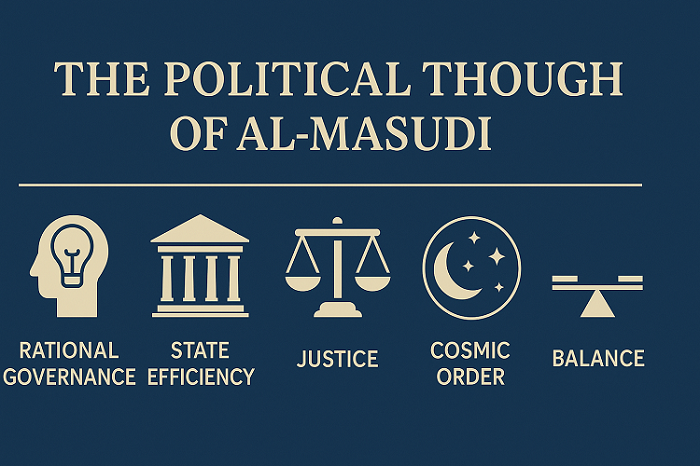
This article explores The Political Thought of Al-Masudi, arguing that the core of his thought lies in the concept of effective state governance. Through historical narratives, geographical descriptions, and philosophical reflections, al-Masudi seeks to establish a coherent vision of political order grounded in reason, justice, and cosmic balance.
The article is structured into three sections: (1) Life and historical context; (2) Epistemological and methodological foundations; and (3) Political theory and state analysis.
Part I: Life and Historical Context
1. Biography
Born in Baghdad around 280 AH (893 CE), al-Masudi was a descendant of the Prophet’s companion Abd Allah ibn Mas‘ud. His deep passion for knowledge and exploration led him on extensive journeys across the Islamic world — from India and Sri Lanka to East Africa, Egypt, and the Levant. He sought firsthand accounts of societies, religions, and political structures, combining oral traditions with textual sources.
Al-Masudi passed away in Egypt in 346 AH (957 CE), leaving behind works that reflect a remarkable balance between empirical detail and philosophical insight.
2. The Political Climate
Al-Masudi lived during a time of political fragmentation within the Abbasid Caliphate. The weakening of central authority, the rise of provincial warlords, and the dominance of non-Arab military elites such as the Turks had undermined the unity of the Islamic world. He critically observes:
“The Muslims are weak, Islam’s grandeur has faded… Each governor acts as a petty king, as happened after Alexander’s death…”
Despite political disarray, the period was intellectually rich, with active scholarly exchanges across the Islamic world. The Political Thought of Al-Masudi emerges within this tension between disintegration and intellectual flourishing.
Part II: Intellectual and Methodological Foundations
1. Knowledge and the Principle of Balance
The Political Thought of Al-Masudi is embedded in the Islamic epistemological triad of reason, revelation, and experience. Central to his worldview is the principle of balance (i‘tidāl). He posits that all creation — physical, moral, and political — is governed by harmony and proportionality.
Citing earlier sages, he asserts a link between climate, geography, temperament, moral character, and governance. Balanced environments produce rational and ethical humans, and consequently stable and just political systems. In contrast, extremes in nature or culture breed political dysfunction and moral decay.
2. Anthropology, Divine Law, and Historical Causality
For al-Masudi, the human being is a dual creature — capable of both virtue and vice. Human history is a stage for the continuous clash between good and evil. Yet, divine justice manifests through the downfall of oppressive rulers and corrupt states, offering moral instruction to future generations.
Drawing on both sacred traditions and empirical patterns, he insists that state formation and collapse follow specific causes and regularities. Political outcomes are not accidental; they are products of rational or irrational governance.
3. Methodology: Observation and Comparative Analysis
Al-Masudi’s distinctive methodology combines empirical observation and comparative historiography. He doesn’t merely compile chronicles but seeks underlying patterns through firsthand travel accounts and detailed comparisons between cultures, religions, and empires. This method reflects a proto-scientific approach to political science — an early attempt at theorizing political dynamics through evidence and logic.
Part III: The Political Thought of Al-Masudi: Political Analysis and Theory of the State
1. The Nature of Politics
In al-Masudi’s view, politics (siyāsa) is the rational management of collective affairs. He evaluates governments not by ideology or lineage but by their administrative wisdom, fairness, and ability to sustain public order.
He praises the political system of ancient Persia:
“Their kingship was ancient and orderly, their politics wise, their cities well-governed, and they were kind to their subjects…”
Political efficiency, for al-Masudi, is an indicator of philosophical and moral integrity.
2. Critique of Contemporary Rulers
Al-Masudi does not hesitate to criticize rulers of his own era, especially Abbasid caliphs like al-Muqtadir, whom he condemns for incompetence and excessive delegation of power to courtiers and women. Conversely, he praises figures such as Hisham ibn Abd al-Malik for his diligence in state management and fiscal oversight.
This comparative critique allows him to construct a normative framework for governance, distinguishing between states that flourish through reason and those that decay through corruption and negligence.
3. Comparison with Later Islamic Political Thought
The Political Thought of Al-Masudi anticipates many themes later developed by thinkers like Nasir al-Din Tusi, who defined political order through the dual principles of “the pen” (knowledge) and “the sword” (power). Although al-Masudi does not formalize this binary, his emphasis on intellectual governance and moral authority aligns closely with that model.
4. Criteria for the Ideal State
From his writings, we can infer the following criteria for a legitimate and successful state in al-Masudi’s vision:
- Governed by reason and deliberation
- Committed to justice and fair distribution of resources
- Administratively competent and strategically planned
- Morally grounded and free from tyranny or indulgence
- Supportive of science, philosophy, and ethical learning
- Aligned with the cosmic and natural order of balance
Conclusion
The Political Thought of Al-Masudi transcends conventional historical narrative to offer a rational, ethical, and empirical framework for understanding governance. His work marks a shift from descriptive history to analytical historiography — an attempt to make sense of political life through patterns, causes, and philosophical principles.
At the heart of his political theory is the belief that sustainable governance is inseparable from wisdom, justice, and rational planning. For al-Masudi, the state is not merely a mechanism of power but a moral and intellectual institution embedded within the cosmic balance of the universe.
His vision, both critical and constructive, remains a valuable contribution to classical Islamic political thought and an early precursor to later theories of statecraft in Islamic and global traditions.
Reference
- Alikhani, Ali Akbar. Yousefi Rad, Morteza. (2011) The Political Thought of Muslim Thinkers. Volume 1. Publications of the Research Institute for Cultural and Social Studies. Tehran. Iran