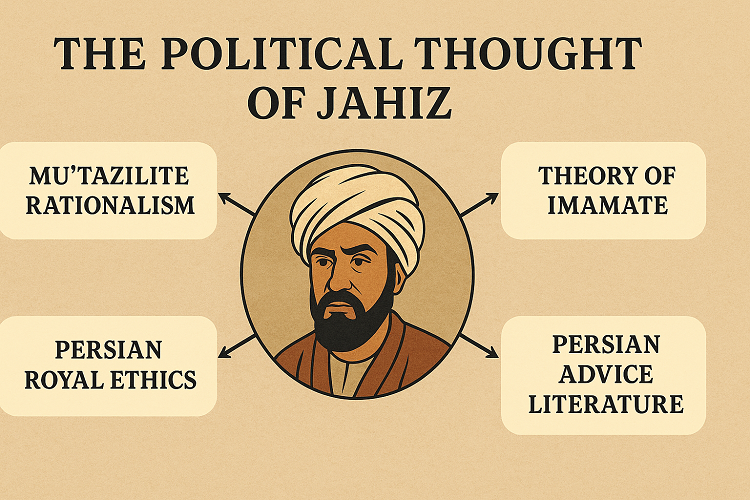
Al-Jahiz (d. 869 CE), one of the most brilliant intellectuals of the Abbasid era, emerged as a pivotal figure among the early Mu’tazilite theologians. Renowned for his eloquent prose and deep engagement with theology, philosophy, and politics, he authored seminal works such as al-Bayan wa al-Tabyin and al-Rasa’il. The political thought of Al-Jahiz reflects multiple layers, from a rational defense of the Abbasid caliphate to a strong affinity for Persian royal traditions and political advice literature. This article aims to unpack these dimensions and comprehensively analyze his political worldview.
Jahiz and Mu’tazilism: Reason, Justice, and Leadership
As a committed Mu’tazilite, Jahiz embraced the core principles of rationalism, divine justice, and human free will. In contrast to Ash’arite determinism, the Mu’tazilites emphasized moral responsibility and the rational pursuit of justice, values that Jahiz upheld with remarkable consistency.
For Jahiz, reason was not merely a philosophical instrument but a political necessity. It was through reason that humans could discern public interest (maslaha) and evaluate the legitimacy of rulers. He viewed political leadership as a rational institution designed to serve justice and communal welfare, not divine command.
The Political Thought of Jahiz on the Imamate
Within the Mu’tazilite school, the question of imamate (leadership of the Muslim community) was hotly debated. Jahiz adopted a pragmatic and reason-based approach, viewing the imamate as a man-made institution, rather than one divinely ordained.
In his works, such as Fadl al-Mu’tazila and al-Radd ‘ala al-Imama, he advocates for the Abbasid caliphs, insisting that an imam’s legitimacy rests on merit, competence, and rational governance, not lineage or tribal affiliation. He firmly rejected the Shi‘ite notion of divinely appointed imams.
Moreover, Jahiz acknowledged the principle of taghallub (dominance): although rational selection by the community is the ideal basis for leadership, he accepted that political stability through forceful dominance could retroactively justify authority. This idea aligned him with Sunni realist doctrines.
Abbasid Caliphate and Rational Political Defense
The third century AH witnessed intense political fragmentation: Shi‘ite uprisings, Kharijite revolts, and even traditionalist Sunni dissent challenged Abbasid authority. Amidst this, Jahiz undertook the intellectual defense of the Abbasid state using rational, theological, and historical arguments.
He argued that the caliphate was indispensable for preserving religion, justice, and civil order. The ruler must embody both moral and administrative excellence, possessing reason, strategic wisdom, and fairness. He advocated for a merit-based model of leadership, rejecting hereditary entitlement and insisting on practical governance rooted in public interest.
Royal Ethics and Persian Political Heritage
One of the most distinctive aspects of the Political Thought of Al-Jahiz is his fascination with Persian royal traditions. He frequently referred to the Sassanian model of kingship and admired rulers like Khosrow Anushirvan for their justice, wisdom, and statesmanship. In al-Rasa’il and al-Taj fi Akhlaq al-Muluk, he highlighted the virtues of Persian kings as models of ethical and rational governance.
Jahiz was deeply influenced by Persian mirrors for princes (andarz literature), which emphasized moral education, administrative efficiency, and the social contract between ruler and ruled. His own writings incorporate these themes through rhetorical excellence and narrative techniques, offering a synthesis of political ethics and pragmatic statecraft.
Arab-Persian Synthesis in the Political Thought of Jahiz
Jahiz was among the first to effectively synthesize Arab eloquence (balagha) with Persian political wisdom. While many Arab scholars were exclusively proud of their tribal heritage, Jahiz openly praised the achievements of the Ajam (non-Arabs), especially in statecraft and philosophy.
He argued that Muslims could and should learn from the political structures and moral frameworks of pre-Islamic civilizations, especially the Persians. This cross-cultural synthesis enriched Islamic political theory and laid the groundwork for later political treatises like Nizam al-Mulk’s Siyasatnama and Nasir Khusraw’s works.
The Political Thought of Al-Jahiz: Rhetoric, Politics, and the Ideal Ruler
Another key element in the political thought of Al-Jahiz is the emphasis on rhetoric as a tool of governance. He believed language to be not just a medium of communication but a vehicle of persuasion, legitimacy, and political control.
In his political vision, the ideal ruler resembles a philosopher-king, versed in both law and governance, in theology and ethics. This ruler must command eloquence, intellectual depth, and moral clarity—traits derived from both Hellenistic and Persian traditions.
Critical Assessment: Rationality in the Service of Power?
While Jahiz is rightly celebrated as a pioneer of rational Islamic thought, one must also recognize the political context of his work. His rationalism was often employed in the service of Abbasid power. He harshly criticized Shi‘ite and other revolutionary movements, arguing for the centralization of authority under the Abbasid caliphs.
Nevertheless, his works also contained critical elements. He consistently emphasized justice, public interest, and the moral accountability of rulers. Unlike authoritarian theologians, Jahiz refused to sanctify political authority and maintained that leadership must be assessed through reason and ethical conduct.
Conclusion: A Founding Thinker of Islamic Political Rationalism
The political thought of Al-Jahiz stands as a seminal contribution to the development of rational political theory in Islam. By blending Mu’tazilite theology, Persian royal ethics, and Arab rhetorical excellence, he articulated a vision of governance rooted in reason, justice, and civic responsibility.
In today’s context of ideological conflict and calls for reform, revisiting Jahiz offers valuable insights. His thought encourages a balance between tradition and reason, ethics and statecraft, providing a model for political thought that remains relevant across time and culture.