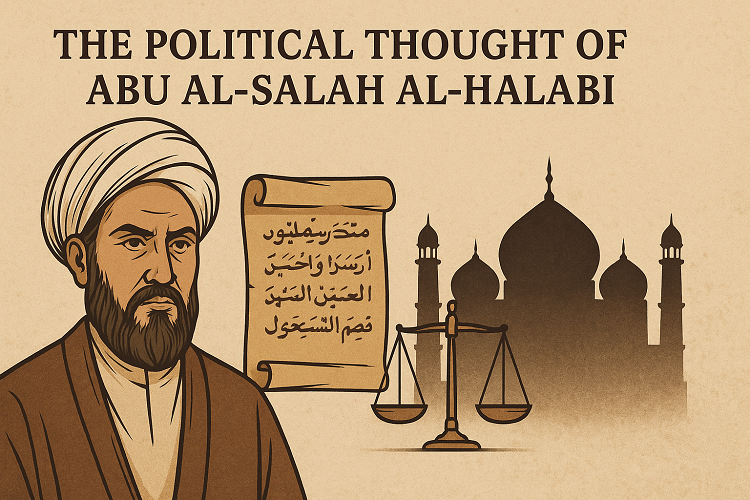
The political thought of Abu al-Salah al-Halabi represents one of the most significant developments in the juristic and political theory of Twelver Shiism in the fifth century AH. This prominent Shiite scholar, through his writings in jurisprudence, theology, and politics, sought to formulate a rational and jurisprudence-based framework for organizing the relationship between religion and state. This article focuses on the political thought of Abu al-Salah al-Halabi, exploring its principles, foundations, and implications for understanding the nexus between religion, law, and power. Through this lens, we can better appreciate the evolution of political theory within the Islamic world, particularly among Shiite scholars.
Biography and Historical Context of Abu al-Salah al-Halabi
Taqi al-Din ibn Najm al-Din al-Halabi, better known as Abu al-Salah al-Halabi, was one of the leading Twelver Shiite jurists of the fifth century AH. Born in Aleppo—a key Shiite intellectual center at the time—he was trained by renowned scholars such as al-Shaykh al-Mufid and Sayyid al-Murtada. He lived during a period after the Minor Occultation, when the Shiite community was gradually consolidating a coherent theological and juristic framework for navigating life in the absence of the infallible Imam.
At the time, the Abbasid Caliphate had lost much of its practical authority, and local dynasties like the Buyids and Seljuks held real power. Faced with this reality, Shiite jurists increasingly emphasized ijtihad (independent reasoning) and rational interpretation. Within this context, Abu al-Salah al-Halabi sought to articulate a model of political engagement that could reconcile religious authority with social and political order in the Imam’s absence.
The Concept of Wilayah in Occultation
At the core of Abu al-Salah al-Halabi’s political thought lies the question of religious authority and governance during the occultation of the Imam. Like his teachers, he argued that religious and social leadership among Shiites must continue through reliance on reason, scripture, and qualified jurists. In his seminal work al-Kafi fi al-Fiqh, he carefully outlines the limits and responsibilities of jurists in this era.
The Political Thought of Abu al-Salah al-Halabi on Legitimacy of Power
One of the most fundamental aspects of Abu al-Salah al-Halabi’s political thought is his theory of political legitimacy. Unlike Sunni political theorists who viewed the caliphate as a historical and customary institution, Abu al-Salah maintained that political legitimacy must be rooted in divine appointment, which is continued through the line of Imams. Since the infallible Imam is in occultation, no political authority can claim full legitimacy. However, in order to maintain social order and implement religious law, jurists who fulfill certain qualifications may assume some of the Imam’s functions by proxy.
In this respect, Abu al-Salah follows the line of reasoning advanced by al-Shaykh al-Mufid and Sayyid al-Murtada, though he extends it further. Notably, he insists that jurists have the authority to implement hudud (Islamic penal laws) and public duties even in the absence of a fully legitimate government. His theory thus lays the groundwork for the idea of a jurist-led governance structure, though he stops short of proposing a fully developed political model.
Reason, Sharia, and Politics in the Thought of Abu al-Salah al-Halabi
Another crucial component of Abu al-Salah al-Halabi’s political theory is his reliance on reason as a means to interpret and derive rulings relevant to politics and society. Drawing upon Mu’tazilite theology and Shiite rationalism, he elevates the role of reason in addressing political justice, human rights, and mutual obligations between rulers and the ruled.
This rationalist orientation enables him to redefine the relationship between Sharia and politics in a way that respects both divine law and the practical realities of governance. He argues that Sharia cannot be properly implemented without the guidance of sound reasoning and a focus on the public interest. As such, the jurist becomes not merely a legal scholar but a guardian of social justice and ethical governance.
The Political Thought of Abu al-Salah al-Halabi and the Principle of Social Justice
Social justice occupies a central place in the political thought of Abu al-Salah. He emphasizes that the primary duty of any government is to ensure justice at all levels—ranging from fair distribution of resources to the defense of the oppressed. Inspired by the legacy of Imam Ali, Abu al-Salah positions justice as the cornerstone of both legal and political legitimacy.
In his writings, he outlines key state responsibilities such as poverty alleviation, border defense, security provision, and the prevention of oppression. Relying on Quranic principles and hadiths, he insists that any political entity’s legitimacy hinges on its commitment to justice and public welfare. Should a ruler deviate from these principles, their authority loses its binding nature—even if it was initially tolerated.
The Relationship Between the Jurist and the Sultan in Abu al-Salah’s Theory
A major concern in Abu al-Salah’s political theory is how jurists should interact with ruling powers, especially illegitimate or tyrannical ones. He adopts a pragmatic stance, allowing jurists to act as advisors, critics, or overseers of public functions when necessary—provided that their involvement does not endorse oppression or corrupt the ethical integrity of religion.
Thus, he permits limited engagement with ruling authorities under duress, while never ascribing full legitimacy to usurping regimes. This results in a dual approach: on the one hand, adherence to religious principles; on the other, political flexibility in navigating real-world constraints.
Comparison of Abu al-Salah with Other Shiite Jurists
To better understand Abu al-Salah’s contribution, it is useful to compare his political thought with that of other prominent Shiite jurists such as al-Shaykh al-Mufid, Sayyid al-Murtada, Shaykh al-Tusi, and Allama al-Hilli. Unlike al-Mufid, who focused primarily on theology, or al-Tusi, who inclined toward political quietism, Abu al-Salah sought to integrate politics into the framework of jurisprudence and ethics.
While he inherits the notion of the jurist’s general guardianship from Sayyid al-Murtada, he expands it by assigning the jurist an active administrative role in society. At the same time, unlike Allama al-Hilli, who engaged with political theory in greater detail, Abu al-Salah remains more general, focusing on foundational principles rather than institutional design.
The Legacy of Abu al-Salah’s Works in Shiite Political Jurisprudence
Abu al-Salah’s primary work, al-Kafi fi al-Fiqh, while mainly legal, includes crucial insights on political matters. In sections dealing with the judiciary, penal laws, and enjoining good and forbidding evil, he outlines frameworks that would later influence the theory of Wilayat al-Faqih (Guardianship of the Jurist).
Thus, the political thought of Abu al-Salah al-Halabi serves as a transitional link between early Shiite jurisprudence (e.g., al-Kulayni and al-Saduq) and later developments in the Safavid era and beyond. His ideas opened a path that would be explored further by later jurists such as al-Muhaqqiq al-Karaki and scholars of the contemporary Islamic Republic.
Conclusion
In conclusion, the political thought of Abu al-Salah al-Halabi represents a critical stage in the gradual development of Shiite political jurisprudence during the era of occultation. By combining reason, Sharia, and justice, he sought to articulate a framework for religious and political engagement in the absence of the infallible Imam. His efforts provided a coherent foundation that enabled the Twelver Shiite tradition to preserve its identity and vision of justice through changing political landscapes.
Today, the political thought of Abu al-Salah al-Halabi remains a rich source of insight for jurists, Islamic thinkers, and political theorists seeking to re-examine the complex relationship between religion and governance—particularly in times of uncertainty and transformation.