Introduction: Who Was Tabari and Why Does Tabari’s Political Thought Matter?
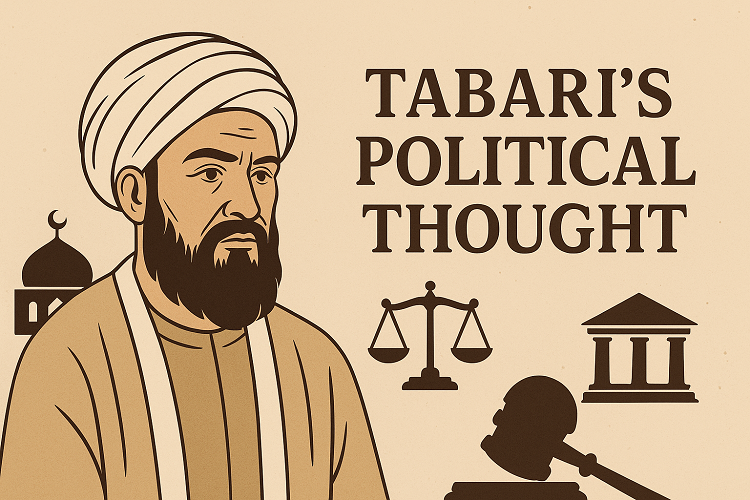
Tabari’s political thought represents a unique intersection of Islamic tradition, rational inquiry, and historical realism. Muhammad ibn Jarir al-Tabari (224–310 AH / 839–923 CE) was not a political philosopher in the strict sense, yet his monumental works—Tafsir al-Tabari and Tarikh al-Rusul wa al-Muluk—offer deep insights into power, legitimacy, law, and political conduct in the Islamic world.
Tabari contributes profoundly to Islamic political heritage by combining scriptural exegesis with meticulous historiography. His approach remains relevant for understanding the foundations of Islamic governance and its moral boundaries.
Foundations of Legitimacy in Tabari’s Political Thought
The Role of Bay‘ah and the Elite Consensus
In Tabari’s political thought, legitimate authority is rooted in religious and rational principles. The bay‘ah (oath of allegiance) by ahl al-ḥall wa’l-ʿaqd (people of authority and discernment) is central. This act signifies the elite’s endorsement and communal acceptance of a ruler.
Kinship vs. Competence
While Tabari acknowledges kinship to the Prophet as a possible source of preference, he does not equate it with automatic legitimacy. Rather, justice, knowledge of the sharia, and the capacity to govern wisely are prerequisites.
Stability and the Avoidance of Fitna
A major theme in Tabari’s political thought is political stability. Tabari emphasizes that even flawed governance is preferable to chaos. Legitimacy, therefore, includes public order and rejection of widespread rebellion.
The Caliphate in Tabari’s Political Thought: Between Ideal and Reality
Tabari’s depiction of the Rightly Guided Caliphs presents a normative model of leadership—just, consultative, and sharia-abiding. However, when addressing the Umayyads and Abbasids, he shows restraint. He acknowledges their rule as legitimate but does not ignore their faults.
This dual approach in Tabari’s political thought reveals a commitment to preserving Islamic order while recognizing human limitations.
Sharia and Governance
In Tabari’s interpretation of governance, sharia is supreme. Politics is not autonomous but subservient to divine law. In his Qur’anic commentary, especially on verse 4:59 (“Obey Allah, obey the Messenger, and those in authority among you”), Tabari insists that obedience to rulers is conditional—it must not contradict God and His Messenger.
This conditional loyalty is at the core of Tabari’s political thought, placing limits on authoritarian power and emphasizing the role of sharia as the guiding framework for any legitimate political system.
Rebellion and Political Ethics in Tabari’s Political Thought
Tabari takes a cautious and pragmatic view of rebellion. He opposes radical movements like the Kharijites and critiques Shi‘ite revolutionary narratives. His historical accounts frequently show the disastrous consequences of uprisings, suggesting an ethic of reform over revolution.
In Tabari’s political thought, rebellion is only justifiable under extreme tyranny and when public interest outweighs the risks. Even then, the preference is always for gradual correction through internal mechanisms.
Rationalism and Historical Realism
A striking feature of Tabari’s political thought is its analytical realism. Unlike purely normative approaches, Tabari explains political developments through tribal dynamics, military power, economic conditions, and human ambition.
This is evident in his account of the transition from ‘Ali to Mu‘awiyah, where he blends moral critique with rational explanation. Tabari’s political thought thus fuses ethical ideals with the realpolitik of early Islam.
The Role of Reason and Consensus in Tabari’s Political Framework
Tabari does not shun reason, as some of his contemporaries did. He uses rational inference in both legal and political matters. Importantly, he upholds the authority of ijma‘ (consensus), particularly of qualified elites, as a source of legitimacy and as a corrective to despotic rule.
Tabari’s political thought views consensus not only as a foundation for initial legitimacy but also as a continuous check on political power.
Religion and the State
In Tabari’s thought, the state is not a secular construct but an extension of the religious order. The caliphate is tasked with enforcing divine law, protecting the ummah, and ensuring justice.
Tabari does not argue for the separation of religion and politics. Instead, he advocates for a sacred political order governed by sharia and guided by moral leadership.
Comparing Tabari with Other Islamic Thinkers
Compared to thinkers like Abu Hanifa or al-Jahiz, Tabari is characterized by moderation and depth. He avoids polemics and philosophical abstraction, instead rooting his analysis in scripture, law, and historical observation.
Tabari refrains from speculative political theory, focusing instead on applied governance and historical outcomes—making his thought practical and enduring.
The Legacy of Tabari’s Political Thought
Tabari left a lasting mark on Islamic intellectual history:
-
His historical methodology influenced major Sunni historians like Ibn al-Athir, al-Dhahabi, and Ibn Kathir.
-
His legal and political views contributed to the mainstream Sunni doctrine on caliphate and political obedience.
-
His balance between idealism and realism continues to offer a model for navigating Islamic political ethics.
Conclusion
To summarize Tabari’s political thought:
-
Legitimacy arises from a balance of religious law and public consensus.
-
Sharia is the moral and legal compass of governance.
-
Political rebellion is discouraged unless absolutely necessary.
-
Rational analysis and historical understanding are vital to ethical politics.
Tabari offers a paradigm that avoids the extremes of absolutism and revolution. His thought is deeply rooted in Islamic tradition, but never blind to historical complexities.