


1. The Concept of Sovereignty: From Absolute Order to the Crisis of Legitimacy
The concept of Sovereignty and Oligarchy is among the most fundamental notions in political science and the philosophy of power. Since the moment humans began to contemplate their political organization, the central question has always been: “Where does power come from, and how should it be legitimized?”
In response to this question, theorists of the early modern era—most notably Jean Bodin and Thomas Hobbes—sought, for the first time, to define sovereignty as a foundational and indivisible principle of political power. This concept, which might at first appear simple, in fact constitutes the very heart of modern political order and continues to lie at the center of global transformations—from the era of absolute monarchies to the crises of globalization and the digital age.
In the sixteenth century, Jean Bodin, in his renowned work Six Books of the Commonwealth, defined sovereignty as “the absolute, perpetual, and indivisible power of the state to make and enforce laws.” He lived during a time of political and religious turmoil in France, when conflicts among kings, the Church, and the nobility had driven the state to the brink of collapse. Bodin believed that only the concentration of power in the hands of the state could restore stability and order. From his perspective, sovereignty had to stand above all social and religious forces; for if multiple centers of authority existed simultaneously, the state would descend into chaos.
A few decades later, Thomas Hobbes, in Leviathan, presented a more philosophical and realistic interpretation of sovereignty. For Hobbes, humans in their natural state are selfish beings driven by survival instincts; hence, without a central power, society inevitably falls into a state of perpetual war. Sovereignty, in this sense, is the “Leviathan”—a political monster to whom people surrender part of their freedom in exchange for security and collective life. According to Hobbes, the legitimacy of the state arises not from religion or tradition, but from a social contract that elevates humans from the natural state to the political one.
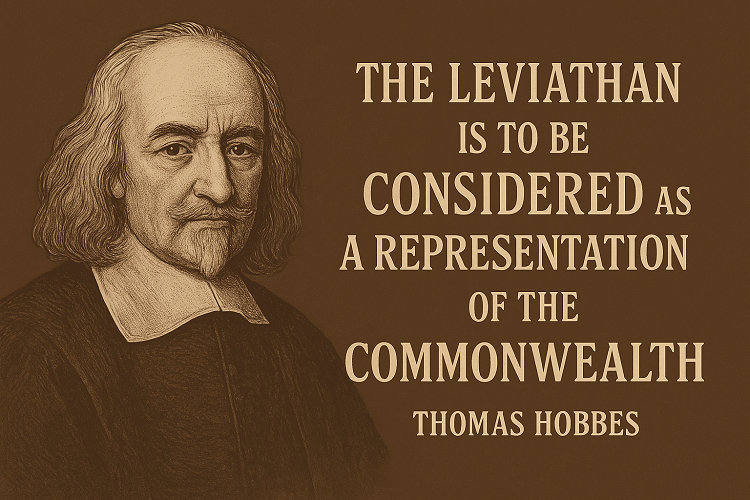
Hobbes, for the first time, explained sovereignty through reason and the necessity of order, rather than divine sanction or hereditary right. Thus, absolute power was not an arbitrary act but a condition for the survival of society. Although his ideas were later challenged by philosophers such as John Locke and Jean-Jacques Rousseau, they laid the foundation for the modern concept of the state. Rousseau, by emphasizing the “general will,” shifted legitimacy from the ruler to the people, thereby democratizing the theories of Bodin and Hobbes.
In the modern era, the concept of sovereignty followed two parallel paths: one toward the absolute power of the state, and the other toward popular legitimacy and the rule of law. In Europe, political revolutions from the seventeenth to the nineteenth centuries transferred sovereignty from the person of the monarch to the nation. In this transformation, the “nation-state” emerged as the bearer of sovereignty—a state defined by clear borders, an identified populace, and laws grounded in the general will.
However, this definition did not materialize uniformly everywhere. In many regions outside Europe, including the Middle East, the modern state arose under very different circumstances—not through gradual social evolution, but largely due to colonial pressures and the geopolitical rivalries of external powers. Consequently, the notion of “sovereignty” in this region was less the product of an internal social contract and more the result of an externally imposed redefinition of political order. As a result, in the Middle East, sovereignty never became truly “popular” or “national” in the precise sense of the term; rather, it often persisted through authoritarian or oligarchic institutions.
From this point onward, the path opens toward the emergence and entanglement of the second concept of this discussion: oligarchy.
While classical theorists described sovereignty as a unified and absolute power, the historical experience of many societies—particularly in the Middle East—reveals that political power rarely remains in the hands of a single institution or individual. Within the formal structures of power, networks of economic, military, religious, and familial elites emerge—networks without which sovereignty becomes effectively paralyzed. These multilayered and often hidden structures constitute what may be called “the oligarchy within sovereignty.”
Thus, the modern concept of sovereignty in the Middle East is marked by a fundamental duality: on one hand, formal, law-based states that claim to represent the nation; and on the other, networks of power that control resources and decisions beyond any mechanisms of accountability. This historical tension is key to understanding the political, economic, and social crises that define the contemporary Middle East.
To grasp the depth of this issue, one must trace the historical and cultural trajectory of sovereignty in the region—from premodern empires and colonial penetration to rentier states and tribal structures. Such an examination reveals why, in this region, sovereignty is not opposed to oligarchy but rather finds its meaning in coexistence and even identification with it.
-
The Historical Transformation of Sovereignty in the Middle East: From Empire to the Rentier State
2.1. Imperial Legacy and the Problem of the Modern State
In the Middle East, the concept of sovereignty did not emerge through a gradual process of social contract formation or internal institution building, but rather through the collapse of empires and external pressures. To understand this transformation, we must distinguish between two distinct trajectories:
(a) the path of the Ottoman Empire and the Arab lands that succeeded it, and
(b) the path of Iran, which, though influenced by global developments, maintained its own historical and cultural continuity.
In the Ottoman Empire, sovereignty in its modern sense did not exist. The Ottoman state was less “nation-centered” and more a multiethnic and religious monarchy. The Sultan was both the caliph of Muslims and the political ruler of the empire. His legitimacy derived from Sharia and the order of the caliphate—not from the will of the people or any civil law.
When the empire collapsed in the early twentieth century, new states emerged whose borders were drawn by colonial powers. Although these states were nominally “national,” they lacked shared social and cultural foundations. Sovereignty in these lands reflected not popular representation but rather the contours of a newly imposed colonial order.
From Egypt to Syria and Iraq, the newly established states were caught between two conflicting logics: on the one hand, the effort to construct a modern state with bureaucratic institutions; and on the other, the persistence of patrimonial, tribal, and military traditions. The result was a kind of “dual sovereignty”: formally, there existed a legal state with modern institutions, but beneath the surface, networks of military, religious, and tribal elites held the real power. This duality produced the first manifestation of oligarchy within the state.
2.2. The Iranian Path: From Ancient Monarchy to the Modern State
In Iran, unlike the Ottoman territories, the modern state arose upon an indigenous and historically continuous imperial foundation. From the Achaemenids to the Qajars, Iran had always maintained a certain degree of political continuity—a concept that can be described as the continuity of sovereignty. Thus, despite dynastic changes, Iranians retained a deep historical understanding of centralized authority and the necessity of political order.
However, this historical continuity did not necessarily equate to modern sovereignty. During the Qajar period, the Iranian state still lacked a cohesive bureaucratic structure. Power was divided among the royal court, tribal leaders, clerics, and local notables. From this configuration emerged a distinctive pattern of governance: a multi-centered sovereignty centered around the monarch.
In this model, the king possessed symbolic authority but could make no major decision without the support of local power networks. This pattern amounted to a form of informal oligarchy embedded within the monarchy itself.
With the rise of Reza Shah in the 1920s, this multi-centered order gave way to extreme centralization. Inspired by European modernism, Reza Shah sought to rebuild the state on the basis of bureaucracy, the military, and codified law. Outwardly, he represented a modern form of sovereignty; yet in practice, the new structure rested on personal power and military authority. Thus, from its inception, the modern Iranian state oscillated between modernization and authoritarianism.
During this phase, a new oligarchy formed around the state—comprising military officers, bureaucrats, landowners, and urban merchants who benefited from the government’s centralizing policies. In appearance, sovereignty rested with the state, but in reality, a network of elites close to power controlled the key economic and political decisions. This oligarchy expanded under Mohammad Reza Pahlavi, acquiring a distinctly economic character with the influx of oil revenues in the 1960s and 1970s.
2.3. Rentier Sovereignty and the Birth of the Modern Oligarchy
The phenomenon of the rentier state marked a turning point in the history of sovereignty in the Middle East. From the 1950s onward, oil revenues fundamentally transformed the structure of power. States no longer needed to collect taxes from their citizens, since national wealth was extracted directly from the ground and placed under the control of sovereignty itself. This shift profoundly altered the relationship between state and society.
According to classical theory, a government’s dependence on taxation fosters accountability and legitimacy. In rentier states, however, the state’s financial independence from society weakens this accountability. Instead, governments distribute portions of oil revenue in the form of subsidies, public employment, or infrastructure projects, thereby purchasing a kind of implicit consent from their citizens.
This structure became the dominant pattern of power across the region—from Saudi Arabia and Iraq to Iran and Algeria.
In Iran, oil became not only a source of wealth but also a political instrument. From the 1950s onward, the state evolved into the country’s largest employer and investor. The concentration of wealth in the hands of sovereignty gave rise to a new bureaucratic and economic oligarchy—a network of administrators, technocrats, military commanders, and state capitalists whose shared interests depended on the maintenance of the status quo.
By contrast, in the Arab lands that had emerged from the Ottoman realm, oligarchy took on a more military and tribal form. In Egypt, Syria, and Iraq, army officers and ruling parties monopolized power. In Saudi Arabia and the Gulf sheikhdoms, tribal and familial structures remained the central mechanisms of distributing wealth and authority. Thus, although all these countries were nominally called “modern states,” their prevailing pattern was that of oligarchic sovereignty cloaked in the guise of the nation-state.
2.4. The Fundamental Difference Between the Iranian and Former Ottoman Paths
The essential difference between Iran and the territories of the former Ottoman Empire can be observed on two levels:
- The historical roots of the state: In Iran, the state existed before modernization, and modernity penetrated into tradition. In the Ottoman world, modernity arose only after the collapse of tradition.
- The nature of oligarchy: In Iran, oligarchy acquired a bureaucratic–military and religious character; in the Arab and former Ottoman countries, it remained primarily tribal–military.
Yet in both trajectories, the outcome was the same: formal sovereignties that, while outwardly operating through law and modern institutions, in practice possess no real power without oligarchic networks. This coexistence is not accidental but structural, because the region’s states were not born out of civil society—they were established above it.
In other words, in the Middle East, the state did not emerge as the product of society; it became its replacement. And this is precisely the point where the concept of Sovereignty and Oligarchy becomes intertwined: where the state ceases to be a tool for the people’s governance and turns instead into an instrument for elites to control resources.
-
Oligarchy Within Sovereignty: The Inner Mechanisms of Power and the Continuity of Elites
In classical theories of the modern state, sovereignty is understood as an institution standing above society, independent from social forces. Yet the historical experience of the Middle East demonstrates that sovereignty is not only not independent of elites, but cannot even survive without them. These elites, through interwoven networks of power, wealth, and influence, form a hidden yet enduring structure that can be described as the oligarchy within sovereignty.
Politically, oligarchy refers to the domination of a small group over society’s major decision-making processes. These groups do not necessarily hold formal authority but, in practice, determine the direction of decisions and the allocation of resources. In the Middle East, since the 1950s, such oligarchic structures have become formally institutionalized within states and have turned into one of the essential pillars of sovereignty.
3.1. Mechanisms of Oligarchic Penetration into Sovereignty
Oligarchies typically infiltrate the state apparatus through three main channels:
- Control of economic resources (rents, oil, banking, imports, state contracts);
- Domination of power and decision-making institutions (the military, security agencies, high bureaucracy);
- Engineering of ideological and cultural legitimacy.
In most Arab states, the first two channels have been more prominent. However, in Iran, the third channel—religious–ideological oligarchy—has played the decisive role. The clergy, not merely as a religious authority but as an organized network of economic, educational, and political power, is woven into the very fabric of Sovereignty and Oligarchy.
From this perspective, Iran’s religious oligarchy is unique: it simultaneously generates religious legitimacy, directly participates in politics, and commands vast economic resources through religious and quasi-state institutions.
3.2. The Triad of Power: Bureaucratic, Military, and Religious
In contemporary Iran, oligarchy can be divided into three interrelated layers, each connected to sovereignty through distinct mechanisms, yet together sustaining the overall structure of power.
- a) Bureaucratic Oligarchy
This layer consists of senior government officials, technocrats, and managers of state-affiliated corporations. Through their expertise and access to economic decision-making, they control significant portions of the budget and large-scale contracts. Although they appear to operate within the law, in practice they govern informal networks and closed circles of decision-making.
In Iran, this oligarchy was established during the late Pahlavi era and persisted after the revolution through new institutions such as foundations and quasi-state enterprises. - b) Military–Security Oligarchy
In many Middle Eastern countries, the military has not only been the guardian of order but also the principal political actor. From Gamal Abdel Nasser in Egypt to Hafez al-Assad in Syria, officers have directly or indirectly seized control of power.
In Iran, too, after the Iran–Iraq War, military institutions gradually expanded from the security sphere into the economic and political realms. The result was the emergence of a military–economic oligarchy that now plays a central role in national decision-making. This oligarchy benefits not only from oil rents and public budgets but also exercises direct influence across key sectors of the economy—from infrastructure and energy to media and technology. - c) Religious Oligarchy
What distinguishes Iran from Arab states is that, at the apex of its structure of sovereignty, there exists a religious network that enjoys both spiritual legitimacy and immense financial and economic resources.
These institutions—from seminaries to religious foundations and clerically linked economic conglomerates—form a parallel system of authority that is simultaneously legislator, arbiter, and beneficiary. What makes this oligarchy distinctive is its capacity to merge material and spiritual power—what political theory describes as ideological–institutional authority.
Collectively, these three layers constitute the pyramidal structure of power in Iran: bureaucracy at the executive level, the military at the controlling level, and the clergy at the legitimizing level. This composition makes political power at once pervasive, adaptive, and unaccountable.
3.3. Mechanisms of Survival and Reproduction
Oligarchy in the Middle East rarely disappears through coups or revolutions; rather, it endures through reproduction within the formal structure itself. This reproduction occurs through three principal mechanisms:
- Co-optation of new elites: Newly emerging economic or academic elites are integrated into the power structure through bureaucratic or religious networks.
- Limited distribution of privileges: To maintain balance, the state allocates portions of resources among rival groups, ensuring that none becomes too dominant while all remain dependent.
- Invocation of ideological or security legitimacy: Whenever political legitimacy weakens, the oligarchic system redefines itself by invoking external threats or religious values.
Thus, the structure of power in the Middle East—particularly in Iran—operates not on the basis of political competition but on the equilibrium of interests within the elite. This equilibrium is the cornerstone of the persistence of Sovereignty and Oligarchy in the region.
3-4. The Difference Between Iranian and Arab Oligarchies
If the oligarchy in Arab countries is considered mainly military and tribal, the oligarchy in Iran possesses more complex and multifaceted characteristics.
In the Arab world, legitimacy often derives from nationalism or tribal tradition, whereas in Iran, religious legitimacy is combined with bureaucratic and military authority.
For this reason, the Iranian oligarchy is more flexible; it can reconstruct itself in the form of a modern state, a religious system, or even a populist discourse of justice. This adaptability is the secret to its longevity.
However, this same characteristic has made the process of accountability and democratization in Iran far more difficult than in neighboring countries, because the power structure is not only centralized but also multilayered and multipolar.
As a result, in the Middle East—and particularly in Iran—Sovereignty and Oligarchy are not two rival forces, but rather two sides of the same coin. The formal sovereignty cannot function without its internal oligarchies, and the oligarchy loses its legitimacy and legal instruments without the formal sovereignty.
This reciprocal relationship gives the political structure a seemingly stable appearance, yet beneath the surface, it remains chronically fragile—because every economic or political crisis, instead of reforming the structure, usually results in the redistribution of power among the elites.
-
The Roots of the Tendency of Sovereignty Toward Oligarchy in the Middle East
The key question here is:
Why has sovereignty in the Middle East, instead of moving toward institutionalizing political participation and democracy, chronically gravitated toward oligarchy?
The answer lies in a combination of historical, cultural, economic, and psychological factors that have shaped the relationship of power in these lands over centuries.
4-1. The Absence of National State Experience and Civil Institutions
In Europe, the concept of “national sovereignty” emerged through the gradual formation of nation-states, civil rights, and intermediary institutions (such as parties, parliaments, and a free press).
In the Middle East, however, the modern state was largely created from above—either through colonial intervention or authoritarian reform.
The result was that the state did not emerge from society but was rather a construct of centralized power; and instead of participating in governance, society became an object of control and political engineering.
In Iran, although the Constitutional Revolution marked the beginning of an effort to establish the rule of law, it failed in practice—due to the absence of deeply rooted civil institutions and the weakness of an independent middle class—to hold the state accountable.
Therefore, Iranian sovereignty has always revolved around a “centralized authority,” an authority that survives only through networks of limited elites and loyalists—that is, the very structure that later took on an oligarchic form.
4-2. The Political Culture of Guardianship and the Absence of the Political Subject
In the political-psychological analysis of Middle Eastern societies, one essential phenomenon is the lack of an independent political subject.
In many of these societies, the citizen is not regarded as a political agent, but rather as a mowla (a dependent, someone in need of guidance and guardianship).
This outlook, rooted in tribal and religious traditions, reduces political participation to obedience to a “guardian” or “father of the nation.”
In Iran, this culture of guardianship merged with a religious-patriarchal mentality. As a result, instead of monitoring power, the people entrusted it to the Vali-e Faqih (the supreme jurist), the religious authority, or the political father.
Such a mindset not only destroyed the possibility of forming an independent civil society, but also allowed the oligarchy to monopolize power under the guise of serving the nation.
In such an environment, the oligarchy assumes the role of “intermediary between the people and sovereignty,” but in practice, it turns into a privileged and unaccountable class—one that both feeds off the state and bears no responsibility toward society.
4-3. Oil Rent and the State Economy: The Material Infrastructure of Oligarchy
In Europe, wealth flowed from the labor and taxation of citizens to the state; in the Middle East, the direction is reversed: the state derives wealth from natural resources (especially oil and gas) and distributes it to society.
As Hazem Beblawi has argued, the rentier economy made oil states neither dependent on public participation nor obliged to be accountable.
In Iran, oil revenues since the 1950s became the backbone of the modern state and enabled the rise of a bureaucratic oligarchy.
After the Revolution, with the expansion of semi-state institutions, this rent was distributed in even more complex ways.
Each oligarchic institution—from religious foundations to the IRGC, from clerical networks to quasi-state corporations—took its own share of the national rent.
Thus, oil became not the link between the people and the state, but the connecting bond between elites and sovereignty.
The same phenomenon is observed in the Arab world: in Saudi Arabia and the UAE, royal oligarchies turned oil into a source of political loyalty; in Iraq and Libya, it became a tool for controlling opposition.
4-4. Tribe, Religion, and Kinship: Traditional Networks of Power
One of the defining features of the Middle East is the persistence of tribal and kinship structures within modern states.
On the surface, the modern state operates through laws and bureaucracy, but in reality, decisions are made based on personal loyalties and family ties.
In such conditions, oligarchy is not merely a political network, but a web of tribal, religious, and economic relations.
In Iran, these relations were reproduced in the form of “insiders and outsiders.”
Power circles were defined based on ideological, religious, or institutional affiliation rather than merit or open competition.
In the Arab world as well, ruling families integrated the structure of the state with their kinship networks—from the Al-Sabah family in Kuwait to the Al-Thani in Qatar and the Al-Saud in Saudi Arabia.
4-5. Religious Legitimacy and the Sanctification of Power
In Iran, the addition of a religious dimension to the oligarchic structure has given the political system a unique character.
Here, power is legitimized not only through rent and coercion, but also through sanctity.
The clergy, as an enduring institution, operates both in the symbolic realm (producing meaning and legitimacy) and in the material realm (through endowed properties, religious foundations, and the economic-religious network).
The result of this fusion between power and the sacred is that criticism of power is no longer seen as a political act, but rather as an act of sacrilege—or even apostasy.
In other words, the religious oligarchy elevates oligarchy from the level of expediency to the level of faith—and this transformation makes its influence deeper and resistance against it far more difficult.
4-6. Evasion of Responsibility and Political Distrust
At the cultural level, the tendency toward oligarchy arises from a historical distrust of politics.
In Iran, politics has often been perceived as a realm of deceit, corruption, or danger; hence, parts of society have preferred withdrawal over participation.
This collective passivity has reproduced the same cycle in which power always remains in the hands of a minority who claim to know better than the people what must be done.
Oligarchy in the Middle East is not the product of conspiracy or accident; it is the outcome of historical structures of power centralization, weak civil society, oil rent, tribalism, and the sanctification of religious legitimacy.
In such a context, every effort to institutionalize democracy or the separation of powers quickly becomes entangled in a web of intersecting oligarchic interests.
In Iran, too, the bureaucratic–military–religious triad has gradually covered all channels of power.
This structure has become so internalized and intricate that distinguishing between the state and oligarchy is no longer possible; the state itself has become an institutionalized oligarchy.
-
Sovereignty, Oligarchy, and the Crisis of Legitimacy in the Digital Age
The digital transformation has, on the surface, dismantled traditional boundaries of power.
Citizens can now, with a smartphone, access information in seconds, form networks, and challenge official narratives.
Yet the same technology has also provided unprecedented means for surveillance, manipulation, and control of public opinion.
In the Middle East, these two opposing processes have become uniquely intertwined: digital emancipation on one side, and the consolidation of digital oligarchy on the other.
5-1. The Gap Between Traditional and Digital Legitimacy
In the pre-digital era, political legitimacy rested on three pillars: ideology, official media, and physical control of space.
But in the digital age, public opinion has escaped state control to an unprecedented extent.
Every individual user can potentially become a media outlet, and every message can spread globally.
As a result, the source of political legitimacy has shifted from state monopoly to networked space.
In Iran, this phenomenon became particularly visible after the 2010s.
Protest movements were organized not through parties or formal organizations, but through virtual networks.
However, the response of sovereign powers was swift: strengthening cyber-control, producing guided content, and even constructing a “media oligarchy” composed of a network of platforms, news agencies, and state-affiliated users.
Here, we witness a form of digital oligarchy—the same traditional power groups now using new tools to preserve their hegemony.
5-2. The Digitalization of Control: From Physical Surveillance to Data Surveillance
One of the defining features of sovereignty in the digital age is the shift of surveillance from the physical realm to the realm of data.
In the past, political control was based on police and bureaucracy; today, it is grounded in behavioral data and algorithms.
Middle Eastern states—especially those with oligarchic structures—quickly recognized this opportunity.
They deployed digital infrastructures not for transparency, but for smarter surveillance of society.
Thus, the traditional oligarchy transformed into a technological oligarchy—a network of security institutions, data-driven companies, and media actors that together reproduce political power in the online sphere.
In Iran, the establishment of national information systems, internal internet infrastructure, and content control across social networks all fit this new pattern: digital sovereignty as the continuation of oligarchic sovereignty.
5-3. The Collapse of the Boundary Between Power and Information
In the digital age, information has become the main form of capital.
In open systems, this capital is shared with citizens and contributes to democracy;
in oligarchic systems, however, information becomes the exclusive tool of power.
Digital oligarchy, unlike traditional oligarchies based on land, oil, or tribe, now relies on the monopoly of data and the interpretation of reality.
Through algorithms, they direct the flow of information; through data analysis, they predict and manage political behavior in society.
As Shoshana Zuboff puts it, this is a form of “surveillance capitalism”; yet in the Middle East, this surveillance is not primarily economic but political.
In fact, political power has reached a level of control where it no longer needs physical repression—because it can neutralize collective actions before they occur.
5-4. The Crisis of the Political Subject in Digital Space
At first glance, the digital sphere could create a new political subject: a connected, critical, and network-based citizen.
But the reality is more complex.
In a context where information is manipulated and networks are infiltrated, the digital subject is caught in a paradox of freedom and control.
They appear free but in practice operate within a framework of media and algorithmic guidance.
In Iran and many Arab countries, internet users face a kind of “illusion of freedom.”
They believe they have gained the power to criticize through cyberspace, while in fact the infrastructure of that very space is controlled by security agencies and state media.
Thus, the digitization of politics has not necessarily led to democratization, but rather to a more sophisticated form of control.
5-5. Digital Oligarchy in the Middle East: Reproduction or Collapse?
In many Middle Eastern countries, governments have followed two main paths in confronting the digital revolution:
• Some (like the UAE and Saudi Arabia) have sought to project an image of efficiency through “technological modernization,” without relinquishing their oligarchic authority.
• Others (like Iran) have turned toward “engineering the digital space” and building native platforms to control the flow of information.
In both cases, the oligarchy has not been destroyed but rather reproduced; its form has merely shifted from bureaucratic and military to technological and informational.
Yet this process comes at a cost. A society where information does not flow freely will inevitably face a crisis of legitimacy.
Even under surveillance, the digital generation gradually develops a different understanding of truth and power.
This cognitive gap is now visible across the Middle East: states that appear powerful on the surface but are internally fragile.
5-6. The Emergence of Digital Spaces of Resistance
Conversely, digital networks have become arenas for new forms of resistance.
From citizen journalism to social movements, these spaces have turned into tools of expression and exposure.
Although such acts of resistance are often short-lived or fragmented, they signify one profound truth:
the end of the oligarchy’s monopoly over the narrative of truth.
In Iran, recent waves of protest have shown that even under filtering and censorship, society can create its own channels of communication.
This networked dynamism, while not yet resulting in democracy, has placed the oligarchy in an existential dilemma:
How can one remain hidden in a world where everything is visible?
In summary, in the digital age, Sovereignty and Oligarchy in the Middle East stand in a dual condition.
On one hand, technology has provided them with new tools of control, surveillance, and opinion engineering.
On the other hand, the same technology has eroded their traditional legitimacy and given rise to a networked citizenship demanding transparency and participation.
In Iran, this contradiction has reached its peak:
A state that remains oligarchic, hierarchical, and religious in its internal structure is compelled to operate in a world where public opinion has become horizontal, free, and global.
In such circumstances, the crisis of legitimacy is no longer merely political but cognitive — a gap between what the state says and what the citizens know.
-
From Centralized Sovereignty to Digital Oligarchy: The Future of Power in the Middle East
The evolution of the concept of Sovereignty throughout history has always depended on changes in technology, economy, and culture.
If in the seventeenth century Thomas Hobbes imagined Leviathan as a unified political body necessary to restrain human chaos, in the twenty-first century we face a phenomenon that might be called the Networked Leviathan:
A sovereignty that no longer rests on a single centralized body but consists of thousands of informational, security, and economic nodes — a web of power both expansive and concealed.
In the Middle East, this transformation has occurred in a distinct and paradoxical way.
Governments in the region have outwardly embraced technology and modernity, yet inwardly preserved the age-old logic of centralization and oligarchy.
Thus, the outcome is not a “modern state” but a modern oligarchy — a system that uses digital, economic, and religious instruments to reproduce its authority.
6-1. The Historical Continuity of Oligarchy and Sovereignty
Historical analysis shows that oligarchy in the Middle East has not been the enemy of sovereignty but its partner.
In ancient empires, local elites and tribal aristocracies were the instruments of central power.
In modern states, this role was assumed by bureaucrats, military officers, and clerics.
In the digital era, technological, media, and data elites have taken up the same function.
In this sense, oligarchy is the internal continuity of the concept of sovereignty in societies where civil institutions and cultures of accountability have not evolved.
Each time the state has distanced itself from society, a network of intermediary elites has filled the void.
6-2. The Paradox of Stability and Fragility
Oligarchies provide stability to sovereignty by creating internal mechanisms of control and balance; yet that same stability produces long-term fragility.
When power circulates within a closed loop and accountability is absent, any economic or political crisis can upset the internal balance.
In Iran, recent decades have shown that whenever the gap between society and sovereignty widens, oligarchies devour more resources to preserve order — thereby intensifying the crisis of legitimacy.
A similar cycle persists across the Arab world: states that appear powerful yet are internally eroded by elite rivalries and conflicting interests.
In other words, the oligarchy does not threaten sovereignty from the outside — it corrodes it from within.
6-3. Iran’s Religious–Military Oligarchy: A Unique Model
In Iran, unlike many Arab states, religion is not merely a tool of legitimacy but an integral part of power itself.
The clerical network, long an independent and deep-rooted institution, became embedded within the state structure after the revolution.
The result has been the formation of a religious–military–bureaucratic oligarchy that fulfills three key functions:
legitimization, security control, and economic distribution.
This structure, in terms of cohesion, is one of the most complex modern oligarchies, as it operates both in the mind of society (through faith) and in the body of society (through economy and repression).
Yet this very entanglement has made it resistant to reform.
In such a system, any political reform quickly clashes with the multiple interests of religious and military elites; hence, gradual transformation becomes extremely difficult.
6-4. The Digital Age and the Cognitive Crisis of Power
The advent of the digital age marks a turning point in the history of Middle Eastern sovereignty.
In this era, power can no longer rely solely on secrecy and physical control, as information transcends all boundaries.
At the same time, new technologies have provided new tools for surveillance and perception manipulation.
The result is what may be called a cognitive crisis of power:
a rift between public knowledge and official discourse, between lived reality and propaganda.
In Iran, this crisis has intensified through the rise of independent online media, networked exposés, and digital movements.
In such an environment, legitimacy can no longer be secured by ideology alone — it must be continuously rebuilt within the arena of public opinion, something the oligarchic structure is ill-prepared to handle.
6-5. Possible Futures: Collapse, Adaptation, or Gradual Reform
Given current trends, three scenarios can be imagined for the future of sovereignty in the Middle East:
a) Collapse of the oligarchies:
If the gap between society and elites grows too wide, oligarchies may collapse.
Yet history shows that in the absence of democratic institutions, the fall of an oligarchy often leads to chaos or a new form of despotism.
b) Digital adaptation:
Some governments attempt to reconstruct themselves by integrating young elites, pursuing economic reforms, and introducing limited transparency.
This model is visible in the Gulf states, where sovereignty has built a more efficient oligarchy through technology and modern management.
c) Gradual internal reform:
In Iran, despite strong structural resistance, generational divides and digital pressures could open the way for a soft transition —
from a closed oligarchy to a more accountable form of sovereignty, provided that independent institutions (media, judiciary, civil society) are allowed to breathe.
6-6. Sovereignty in the Dilemma of Modernity and Tradition
Broadly speaking, sovereignty in today’s Middle East is caught between two opposing forces:
on one hand, the historical legacy of centralized power, paternalism, and religious legitimacy;
and on the other, global pressure for transparency, accountability, and digital freedom.
Oligarchies act as mediators of survival between these two forces: they draw nourishment from tradition while exploiting technology for their own continuity.
But the inner contradiction of this situation is becoming visible: no authority can remain hidden forever in a transparent world.
Therefore, the future of sovereignty in the Middle East will be shaped not by the destruction of oligarchy but by the redefinition of the relationship between power, legitimacy, and public awareness.
The digital world — even if it does not bring democracy — cannot fully accommodate the absolute dominance of oligarchy,
for every piece of data, every image, and every narrative can mark the beginning of the collapse of a historical lie.
Final Summary
Sovereignty in the Middle East has transformed from a centralized body into a network of oligarchies.
In Iran, this network operates through three layers — bureaucratic, military, and religious — and in the digital age, it has been reproduced in a technological form of oligarchy.
Yet this expansion has eroded the boundaries of legitimacy and created a new cognitive crisis.
If in the past the challenge of sovereignty was the control of territory, today it is the control of meaning.
And in a world where meanings are produced and circulated every second, no power — not even the most sophisticated oligarchies — is immune from critique and decline.

