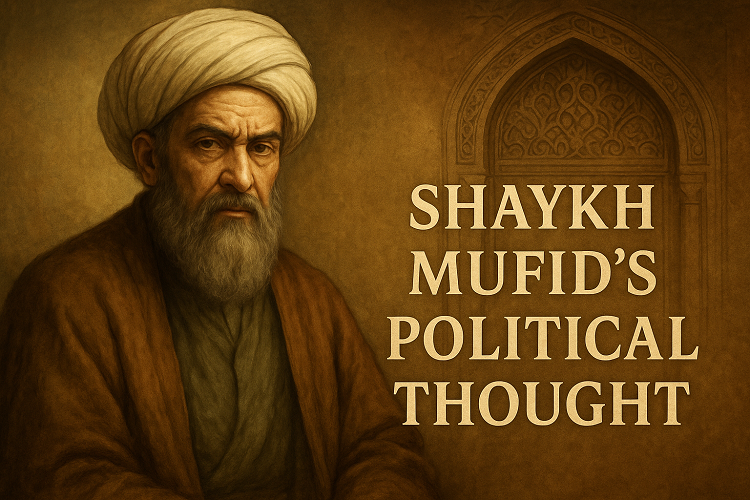
Shaykh Mufid (948–1022 CE), one of the most influential theologians and jurists of the Twelver Shi‘a tradition, lived in a period marked by intense theological disputes and political transitions. While his primary contributions lie in theology and jurisprudence, his interpretation of Imamate provided a coherent political doctrine that later became the foundation for Shi‘a political theory. Shaykh Mufid’s Political Thought was rooted in divine authority, the necessity of justice, and the unique role of the infallible Imam in guiding the ummah.
Historical and Social Context
The fourth Islamic century witnessed a shifting power balance under the weakening Abbasid Caliphate and the ascendancy of the Shi‘a-leaning Buyid dynasty. This environment provided Twelver scholars like Shaykh Mufid a relatively open space to articulate and institutionalize their doctrines. Consequently, his teachings emerged not in isolation but as a response to both Sunni political dominance and internal Shi‘a concerns regarding leadership during the occultation of the Twelfth Imam.
In such a context, the development of Shaykh Mufid’s political thought can be seen as both a defense of Shi‘a identity and an effort to construct an alternative vision of religious authority and governance.
The Centrality of Imamate in Shaykh Mufid’s Political Thought
Theological Definition of Imamate
For Shaykh Mufid, Imamate is not merely a spiritual office but a divinely ordained leadership that must fulfill both religious and political functions. In his works such as Awā’il al-Maqālāt and al-Irshād, he asserts that the Imam is chosen by God and is endowed with infallibility (‘ismah), supreme knowledge, and authority over all religious and worldly matters.
“The Imam is he whom God designates as the successor of the Prophet to uphold law and govern humanity.” — Awā’il al-Maqālāt
Thus, Imamate replaces the concept of Caliphate as seen in Sunni Islam and becomes the cornerstone of legitimate governance in Twelver Shi‘ism.
Critique of the Caliphs
In his critique of the first three caliphs of Sunni Islam, Shaykh Mufid argues that their rule lacked divine legitimacy. By rejecting the validity of shūrā and popular allegiance as bases for leadership, he makes a compelling case for the necessity of divinely appointed Imams. This rejection is essential to understanding Shaykh Mufid’s political thought, which insists that governance without divine sanction is both illegitimate and harmful.
Religion and State: An Integrated Model
The Imam as Supreme Leader
Within Shaykh Mufid’s framework, the Imam is both the spiritual guide and the temporal ruler. There is no separation between religion and politics; rather, governance is an extension of the Imam’s divine responsibility. The Imam enforces justice, implements divine law, and ensures the spiritual welfare of the community.
Occultation and Juristic Authority
Following the occultation of the Twelfth Imam, a pressing question arose: who governs in the absence of the infallible leader? While Shaykh Mufid did not develop a full-fledged theory of wilāyat al-faqīh (guardianship of the jurist), he laid the groundwork by recognizing jurists as general deputies (nawwāb ‘āmm) of the Imam. These jurists were authorized to issue legal rulings, resolve disputes, and manage community affairs—roles that extended beyond private jurisprudence into the public sphere.
Justice and Divine Legitimacy
The Role of ‘Adl (Divine Justice)
Deeply influenced by Mu‘tazilite rationalism, Shaykh Mufid incorporates the principle of ‘adl (justice) into his political philosophy. He argues that God is just and never endorses oppression; hence, any unjust ruler—regardless of their nominal claim to power—is invalid. Political legitimacy, in this view, is not only about origin (divine appointment) but also about the just exercise of authority.
The Infallibility Principle
The doctrine of ‘ismah (infallibility) is central to Shaykh Mufid’s political thought. Without infallibility, leaders are prone to error and injustice, thereby endangering the community’s spiritual and social wellbeing. This principle places the Imam—and by extension his rightful deputies—at the heart of both moral and political legitimacy.
Reason and Consensus
Although Shaykh Mufid grounds his theory in divine revelation, he does not dismiss human reason. In fact, he values rational inquiry as a means of theological understanding. This sets him apart from Ash‘arite theologians, who often subordinate reason to tradition. He also critiques the Sunni concept of ijmā‘ (consensus), insisting that any consensus lacking the presence of an infallible Imam cannot serve as a valid basis for law or leadership.
This epistemological framework further reinforces his political theory by limiting legitimate authority to those linked to divinely guided knowledge.
Shaykh Mufid’s Political Thought and Pragmatism
Despite his idealist conception of divine governance, Shaykh Mufid adopted a pragmatic stance in dealing with the Buyid rulers of his time. While he never sanctioned their rule as divinely legitimate, he engaged with them to protect Shi‘a interests and build religious institutions. This approach demonstrates a nuanced political realism that allowed for constructive interaction with existing powers without compromising theological principles.
Hence, Shaykh Mufid’s political thought was not merely utopian but deeply rooted in the socio-political realities of his time.
The Jurist as a Political Actor
One of Shaykh Mufid’s lasting contributions was the expansion of the jurist’s role from legal scholar to communal leader. In his works, he discusses duties such as establishing justice, administering ḥudūd (penal laws), and organizing collective obligations like jihad and amr bi-l-ma‘rūf (enjoining right). These responsibilities imply that the jurist, in the absence of the Imam, assumes not only legal but also executive authority.
Intellectual Legacy and Long-Term Influence
The influence of Shaykh Mufid extended far beyond his own era. His students—most notably Sharif al-Murtada and Shaykh al-Tusi—developed his ideas further, gradually articulating a coherent theory of juristic authority in the absence of the Imam. These developments culminated centuries later in the political theology of the Safavid state and eventually in modern doctrines like wilāyat al-faqīh in the contemporary Islamic Republic.
Therefore, his thought can be seen as the foundation stone of all subsequent Shi‘a political theory.
Conclusion
In summary, Shaykh Mufid’s political thought reflects a sophisticated synthesis of theology, jurisprudence, and practical engagement. By grounding political authority in divine appointment and infallibility, he rejected the legitimacy of historical caliphates and laid out an alternative model of governance based on Imamate. His approach to reason, justice, and juristic authority laid the intellectual foundation for later Shi‘a political developments.
While idealistic in its premises, his model was flexible enough to allow for political engagement during the occultation. In this way, Shaykh Mufid not only defended the Shi‘a identity but also redefined the terms of political legitimacy for centuries to come.
Suggested References for Further Reading:
- Shaykh Mufid, Awā’il al-Maqālāt
- Shaykh Mufid, al-Irshād
- Hossein Modarressi, Crisis and Consolidation in the Formative Period of Shi‘ite Islam
- Wilferd Madelung, The Succession to Muhammad
- Etan Kohlberg, Belief and Law in Imāmī Shī‘ism
- Robert Gleave, Scripturalist Islam