Sharif al-Murtada’s political thought stands as a remarkable synthesis of Shiite theology, rationalism, and a principled theory of legitimate governance. A prominent theologian, jurist, and philosopher of the 4th century AH, al-Murtada played a foundational role in redefining Shiite political theory under the relatively favorable conditions of the Buyid dynasty. This article examines the development of his political thought, its theological foundations, and its enduring impact on Shiite jurisprudence.
Historical Context and Intellectual Background
Sharif al-Murtada (355–436 AH), also known as ʿAlam al-Hudā, was born into a noble lineage in Baghdad. He was a descendant of Imam Musa al-Kazim and the elder brother of al-Sharif al-Radi, compiler of Nahj al-Balagha. His lifetime coincided with the rise of the Buyids. This Shiite dynasty governed parts of the Abbasid Caliphate and enabled Shiite scholars to emerge into the political and intellectual mainstream.
The Buyid Era and Shiite Empowerment
Under Buyid rule, Shiite thinkers enjoyed unprecedented patronage and security. The political atmosphere of Baghdad shifted to accommodate Shiite doctrine, opening space for theological and legal innovation. In this context, Sharif al-Murtada’s political thought served both as a theoretical framework and a response to new political realities.
Theological Foundations of Sharif al-Murtada’s Political Theory
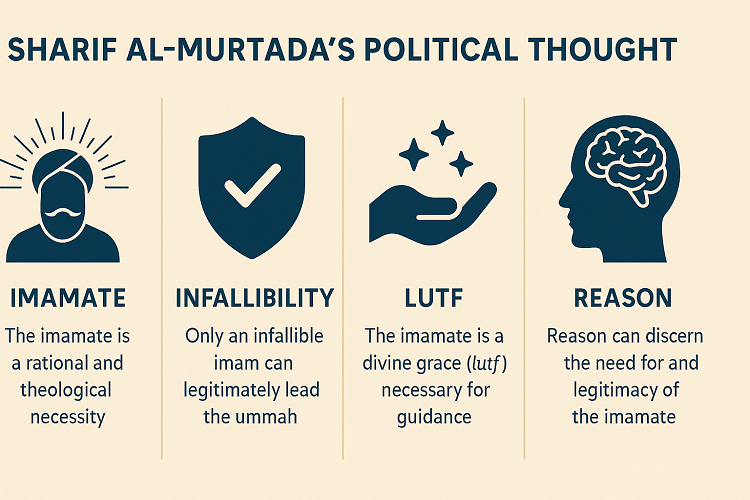
Al-Murtada’s political thought is deeply rooted in rationalist theology. Influenced by Mu’tazilite logic yet loyal to Shiite principles, he grounded his views in three central tenets: reason, justice, and imamate.
Reason as a Source of Political Legitimacy
Contrary to Ash’arite occasionalism, al-Murtada emphasized the independence of reason in discerning moral duties. Reason, according to him, could establish the necessity of an imam and the legitimacy of his rule. This rational foundation allowed al-Murtada to redefine imamate not merely as a religious office but as a rational and moral necessity.
The Principle of Divine Justice and the Doctrine of Luṭf
A key concept in his theology was the principle of luṭf (grace), which holds that God must provide humanity with the means to attain salvation. The existence of an infallible imam is seen as an act of divine grace. Thus, imamate is not a contingent social institution but an essential part of God’s plan for guiding humankind.
Imamate at the Core of Sharif al-Murtada’s Political Thought
The central pillar of al-Murtada’s political philosophy is the doctrine of imamate. For him, imamate is not a matter of juristic debate or historical contingency—it is a theological necessity confirmed by both reason and revelation.
Imamate as a Rational and Divine Institution
Al-Murtada argued that only a divinely appointed leader could possess the requisite knowledge and moral authority to lead the ummah. In his view, popular election or tribal consensus lacks the epistemic and spiritual foundations needed for legitimate governance.
Refutation of Sunni Caliphal Legitimacy
A large part of his work is dedicated to refuting the legitimacy of the first three Sunni caliphs. He systematically challenges the notions of shura, ijmaʿ, and historical precedent, claiming that they contradict the divine designation of ʿAli as the Prophet’s rightful successor.
Governance in the Occultation: Between Ideal and Reality
One of the most pressing issues for Shiite thinkers was the question of governance during the occultation (ghayba) of the twelfth Imam. Sharif al-Murtada contributed to this debate with a nuanced position.
The Just Jurist as General Deputy
While he maintained that only the infallible Imam holds full religious and political authority, al-Murtada allowed for the delegation of limited powers to qualified jurists (fuqaha) during the Imam’s absence. These jurists act as the Imam’s general deputies in administering justice and managing religious affairs.
Distinction Between Legitimacy and Necessity
Importantly, he distinguished between legitimate rule and necessary rule. While no government during the occultation can claim divine legitimacy, some may be tolerated or supported if they ensure social order and uphold justice. This pragmatic approach marked a significant evolution in Shiite political reasoning.
Religion and Politics: A Unified Vision
Al-Murtada rejected the secular division between religion and politics. For him, political authority must serve the divine law (shariʿa) and ensure the moral and spiritual well-being of society. Hence, political leadership is inseparable from religious responsibility.
Neither Secularism Nor Theocracy
His vision was neither a theocratic autocracy nor a secular republic. Rather, he imagined a state governed by divine principles, led either by the infallible Imam or, in his absence, by trustworthy and knowledgeable scholars acting within a divinely sanctioned framework.
The Role of the People in Political Structure
Although he emphasized divine appointment, al-Murtada did not entirely dismiss the role of the people. Public allegiance (bayʿa) and community support had value—not as sources of legitimacy, but as practical means of implementing the Imam’s rule.
Public Support Without Foundational Authority
In his framework, public participation plays a secondary role. While the people cannot create legitimate authority, their support can help realize and sustain it. This view bridges divine legitimacy with communal involvement.
Influence on Shiite Political Jurisprudence
Sharif al-Murtada’s political thought left an indelible mark on Shiite jurisprudence. His student, Shaykh al-Tusi, expanded and codified many of his ideas, laying the foundation for classical Twelver Shiite legal and political theory.
From Theology to Political Jurisprudence
Through his fusion of theology and law, al-Murtada transformed the landscape of Shiite political thought. He introduced rational theological principles into legal discourse, influencing generations of scholars, including Nasir al-Din al-Tusi and Allama al-Hilli.
Conclusion: Relevance of Sharif al-Murtada’s Political Thought Today
In conclusion, Sharif al-Murtada’s political thought presents a coherent and sophisticated model of governance rooted in reason, divine justice, and religious authority. His approach not only addressed the needs of his own time but also offers enduring insights into the relationship between religion and politics in the Islamic world.
By balancing theological fidelity with rational inquiry, al-Murtada laid the groundwork for a Shiite political philosophy that remains relevant in contemporary debates over authority, justice, and governance.