Abstract
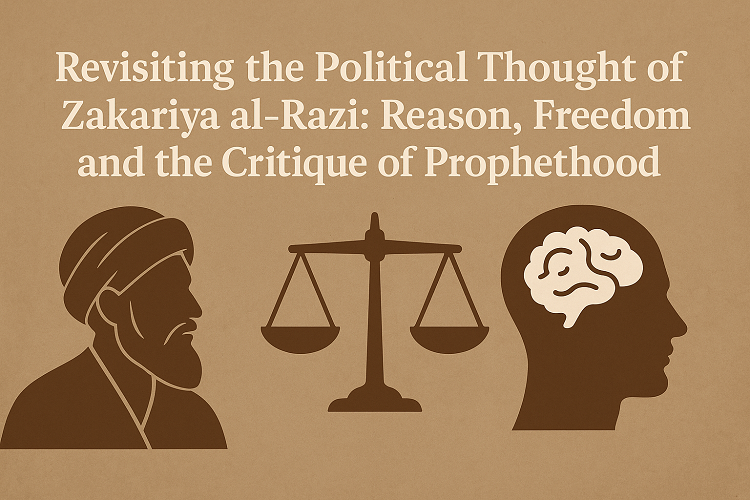
Abu Bakr Muhammad ibn Zakariya al-Razi (865–925 CE), the prominent Persian physician and philosopher, adopted a rational and experience-based approach that set him apart as one of the few thinkers of his time to engage in philosophical reflection on society, ethics, and politics outside the framework of traditional religious and philosophical systems. This article analyzes the Political Thought of Zakariya al-Razi framework and methodology to show that, although he does not present a formal political philosophy in the Greek or Islamic tradition, he offers deep and radical ideas concerning power, governance, freedom, and the human condition. His emphasis on the autonomy of reason, human equality, and rejection of prophecy as a source of political legitimacy holds important implications for modern concepts of human rights and governance.
Introduction
While al-Razi is best known for his contributions to medicine and chemistry, his philosophical, ethical, and social ideas reveal a distinctive form of political thought. Unlike most Muslim philosophers who operated within religious boundaries, the Political Thought of Zakariya al-Razi pursued an independent path guided by reason and experience. Through his critique of prophecy, rejection of tradition as an authority, and opposition to dissimulation (taqiyya), he articulated a new discourse on reason, human dignity, and the limits of political power.
1. The Political Thought of Zakariya al-Razi: Metaphysical Foundations
Al-Razi constructed a metaphysical system based on five eternal principles: the Creator, the Universal Soul, primordial matter, time, and space. These elements form the ontological base of his worldview. While some of his ideas intersect with Neoplatonism, Manichaeism, and Platonism, al-Razi was deeply influenced by pre-Socratic thinkers and remained a vocal critic of Aristotle, aligning more closely with Pythagorean doctrines.
2. Radical Rationalism
Al-Razi viewed reason as the sole instrument of human liberation and knowledge. In his book Spiritual Medicine (al-Tibb al-Ruhani), he describes reason as the sovereign of the human soul and upholds it as the final authority in all matters. Not only does he consider reason independent from religious or transmitted knowledge (naql), he also places philosophy in opposition to any institutionalized authority, including that of prophets and rulers.
3. Methodology: Reason, Experience, and the Rejection of Taqiyya
Al-Razi’s methodology—whether in science, philosophy, or authorship—is grounded in empirical observation and rational inquiry. His writings are almost entirely devoid of quotations from scripture or religious authorities. He deliberately avoids such references, believing that reliance on tradition compromises independent thought. He considers Socrates the ideal philosopher: one who speaks plainly and truthfully, without fear or concealment.
4. Al-Razi and Political Thought
Although some argue that al-Razi lacked a political philosophy in the classical sense, his reflections on reason, equality, and prophecy provide the basis for a novel political perspective. For him, reason is a universal gift, and no one has the right to claim authority over others. Therefore, political legitimacy cannot be derived from divine revelation or prophetic status.
5. A Contrast with Plato: Diverging Views on Philosophy and Rule
Unlike Plato, who envisages the philosopher-king as the ideal ruler, al-Razi believes that every individual must use their reason to guide themselves. For him, philosophy is a tool for the liberation of the soul, not a means for political rule. He never served in a governmental role and saw philosophy as inherently separate from politics in practice.
6. State, Fortune, and Signs of Success: A Political or Anthropological View?
In his treatise On the Signs of Prosperity and Power (Fi Imarat al-Iqbal wa al-Dawla), al-Razi argues that state and political power are matters of luck, temperament, and circumstances—not rational necessity or divine design. Traits such as ambition, charisma, and social behavior are, in his view, signs linked with success, but not with moral or divine legitimacy.
7. The Critique of Prophethood as a Critique of Power
In lost works such as The Fraud of the Prophets (Makhariq al-Anbiya) and The Tricks of the False Prophets (Hiyal al-Mutannabi’in), al-Razi critiques prophecy as a tool for domination and the incitement of religious wars. He argues that a wise God would not guide only a few individuals. Since reason is universal, any form of hierarchical distinction introduced by religion is irrational and unethical.
8. Political and Ethical Implications of al-Razi’s Thought
By denying prophecy, affirming radical rationalism, and asserting the equal intellectual capacity of all human beings, al-Razi laid the groundwork for a secular and libertarian mode of political thinking in the Islamic world. the Political Thought of Zakariya al-Razi anticipates key principles of modern democratic theory, including popular sovereignty, secular ethics, and universal human rights.
Conclusion
Zakariya al-Razi cannot be fully understood within the traditional frameworks of Islamic or Greek political philosophy. However, the Political Thought of Zakariya al-Razi—both methodologically and theoretically—offer a unique and powerful critique of authority, tradition, and inequality. By affirming reason over revelation and asserting the moral and intellectual autonomy of all humans, al-Razi stands out as one of the most radical and forward-thinking political minds in the Islamic intellectual tradition.
Reference
- Alikhani, Ali Akbar. Bahrani, Morteza. (2011) The Political Thought of Muslim Thinkers. Volume 1. Publications of the Research Institute for Cultural and Social Studies. Tehran. Iran