Since the arrival of modernism in Islamic lands, Islamic thinkers have tried to form a narrative of Islam that not only does not conflict with modernism but can be considered a modern narrative. In other words, Islamism, like fascism and Bolshevism, was a reaction to modernization, which brought with it traces of modernism. I tried to show in the series of previous articles by explaining the thoughts of 4 thinkers, a branch of Islamism that has become known as religious intellectual Islamism.
In this article, I show that with a phenomenological approach to the process and the end of Islamism, it is clear that combining two systems of religious knowledge and modern science is impossible. According to its characteristics, the system of religious knowledge leads to the formation of a mechanism that destroys any other epistemological narrative other than itself.
The two systems of religious knowledge and modernism use two different logics, and according to the formation of the mentioned mechanism, it will not be possible for these two to coexist in politics.
In other words, by reviewing the process that Islamism (The religious intellectual Islamism) has gone through and the results it has produced, it is clear that in the field of politics, trying to explain a new narrative of Islam that is compatible with the elements of the contemporary world is doomed to failure.
Religious logic is not capable of this adaptation. It should be accepted that entering the new world and normative interaction in the modern era requires a fundamental break between the old and new knowledge systems.
First, to reminding, a review of past articles is done.
The religious intellectual Islamism started with the reaction of Sayyid Jamal Al-din Asadabadi. After a period of confusion, he concluded that modernism and Islam do not contradict each other, what caused the difference is the illusions and superstitions that have been added to the religion.
Therefore, returning to pure Islam and removing illusions and superstitions from religion, caused to will bring Islam closer and adapt to modernism. Sayyid Jamal’s initial idea was an opportunity for others to add their comments. Muhammad Abduh tried to build his idea on the platform created by Sayyid Jamal, which was based on violating the “break” of knowledge between the old and the new.
Abduh knew that such a claim was not widely accepted, so to justify it, he tried to move the “break” to another place. He claimed that there is a fundamental difference between the rules of transactions and worship. What is called divine commandments and ancient knowledge are based on worship matters, and religion is silent about transactional matters so that people can make decisions about them according to the time.
Muhammad Iqbal Lahori tried to establish a close relationship between the old and the new by focusing on “experience” in modern sciences and Quranic knowledge. Iqbal emphasizes that although these two systems of knowledge consider two different areas, they both rely on experience. One gains experience in the concrete world and the other gains experience in abstraction and insight.
Iqbal considers one destination to be reality and the other to be truth, and he believes that although these two are achieved through two different fields of knowledge, they are not separate from each other. Reality is based on changing things and truth is eternal. Changing and eternal things are never separate from each other. It includes the changing affairs of human daily life and the eternal matters that define the horizon and the end of life. Both are the requirements of human life and neglecting each one causes the decline of the other.
At its inception, the religion of Islam could connect these two through the concept of “Thauhid”(monotheism). Such a capability is the responsibility of the “modern government” today. The three pillars of the modern state i.e. “equality, fraternity, and liberty” are considered the pillars of Islamic monotheism. Therefore, if the field of politics and the rudder of the modern state is in the hands of mujtahids, they can re-establish a connection between the changing things (daily life) and the eternal things.
The idea of forming a modern Islamic state through Ali Shariati‘s explanation of the ideological discourse of religion became a massive social movement that led to the Islamic Revolution in Iran. Previously, it was said in another article that Shariati’s ideological explanation of religion suffers from a catastrophic contradiction in nature. Shariati believed that a social movement needed an ideology that people could be transformed from impressionable people into effective actors.
The religious intellectual Islamism tried to provide a modern reading of a traditional religion. The idea of non-contradiction between Islam and modernism was soon brought to the field of epistemology, and the result of that was the will to establish a modern Islamic state, which was possible through revolutionary ideology. The result of this effort was the Islamic Revolution in Iran.
A unique revolution that was supposed to bring a new political system for the modern age. A system that is based on Islamic principles, but is considered an activism with an identity in the modern age.
After a brief review of the religious intellectual Islamism process from the beginning to the Islamic Revolution of Iran, now attention is paid to the state of formation of the modern state in Iran after the revolution.
Islamic Revolution
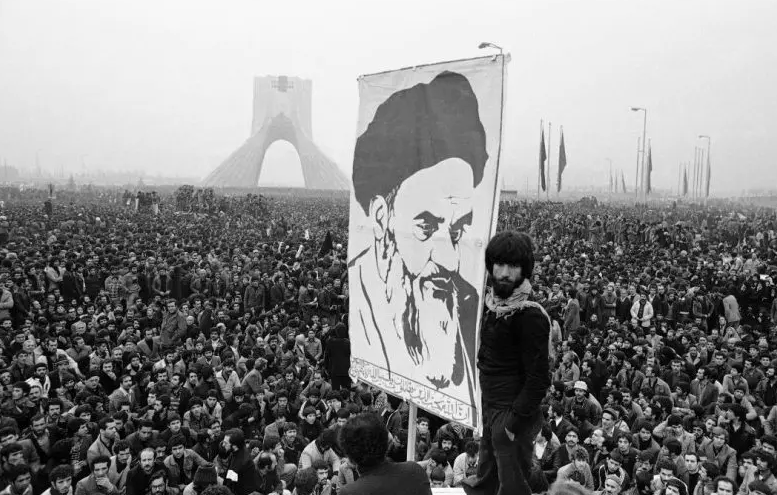
ISLAMIC REVOLUTION IN IRAN
From the day after the Islamic Revolution, the reactions to the current of Islamism intensified. The most important reaction was from the mullahs, who considered themselves the only guardians of religion for centuries, and now they were faced with new claimants(Thinkers of The Religious Intellectual Islamism).
Among these mullahs, Morteza Motahhari was known as their spokesman. Motahhari believed that Islam in its essence is a truth and not an expediency. It is a goal, not an instrument, and only people can benefit from this source of social energy who look at Islam with the eyes of truth and purpose and not with the eyes of expediency and instrument.
The one who looks at Islam as an instrument and an expedient and a temporary thing that is only used in special global and social conditions has not known Islam correctly and is alien to it. Therefore, it is better to leave it to those who look at it with the eyes of truth and purpose and not with the eyes of expediency and instrument, they see it as absolute and not relative.
Motahhari has taken a position exactly in front of Shariati who is an important thinker of The Religious intellectual Islamism. It is natural that during the revolutionary days, each group had its interpretation of religion. In the meantime, what is very important is people’s attitude and their understanding of religion. As a rule, in an intellectual conflict between thinkers, the winner will be the one whose narration is closer to the understanding of the people’s opinion.
From Motahhari’s point of view, Islam is not an answer and perspective for the modern world, but the goal itself. In the sense that the conformity of life with Islamic rulings is a definite ruling and not the matching of Islamic standards with modern knowledge.
This is the same understanding of Islam that people have had for many centuries. Religion is the source of truth that has been determined by God and humans are only obliged to obey and adapt their life standards to it. In such a trend, the source of determining is not human judgment. Rather, the rules are predetermined in religious texts. Motahhari explains his idea based on several concepts.
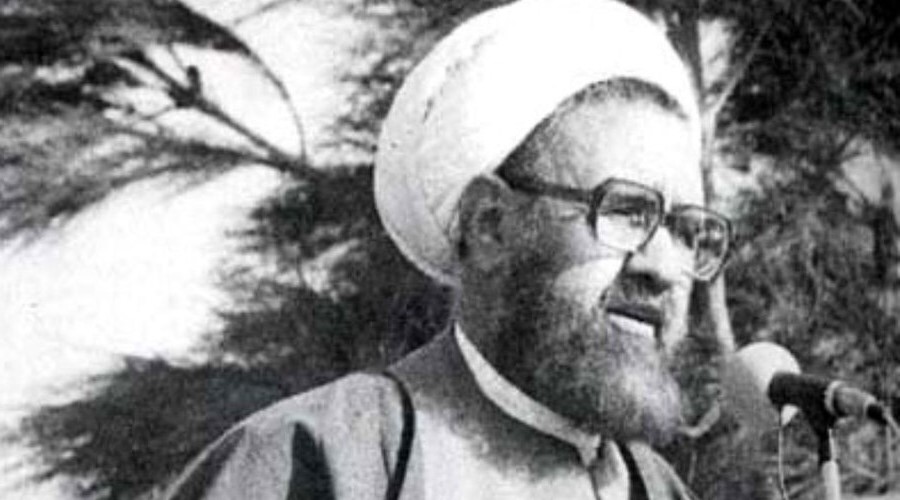
MORTZA MOTAHHARI
God-Consciousness:
Motahhari highlights this concept to contrast it with “self-consciousness”. self-consciousness is considered the centrality of modern knowledge, meaning that human consciousness of the state of his existence in the world in such a way that he has the possibility of the will to change the world.
The concept of “God-consciousness” is completely in conflict with self-consciousness. This means knowing and being conscious of the existence of God and trying to understand and follow the religious commands in the field of life.
The horizon of people’s understanding:
Motahhari always considers the acceptance of the people as an example of his claim to differentiate between his narrative of Islam and the Islam explained by religious intellectuals. He emphasizes that people’s understanding of Islam is completely consistent with what he narrates.
His claim is not wrong. On the one hand, people’s perception of religion has been the same for many centuries, and on the other hand, many people follow the traditional and Mullahs narrative of religion, which has led to the suppression of other groups after the Islamic Revolution.
Mohammad Beheshti also emphasizes the common understanding of Islam by the people and with the concept of “Resurrection” he tries to show that the purpose of human society, social relations, and the establishment of the government are all aimed at the end of man in the next world. He admits that the majority of people also have the same view of resurrection and the goal of Islam.
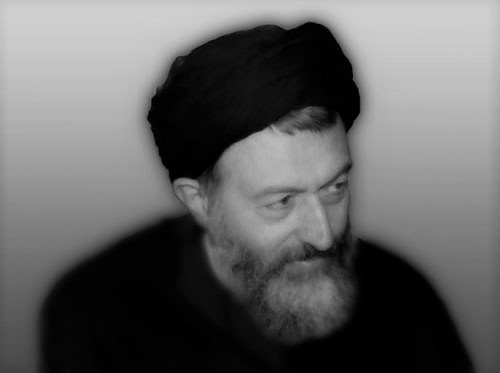
MUHAMMAD BEHESHTI
Mullahs
When looking at religion from the perspective of Motahari, that is, the traditional view, the mullahs are the only authority for the interpretation and claim of “God-consciousness”. To establish the role of mullahs in the political leadership of the society, Beheshti emphasizes that the Quran has a series of verses that everyone can understand well, but a significant part of religion requires a trained expert with the virtue and update.
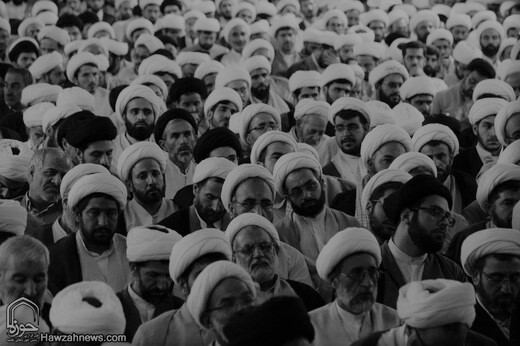
The monopoly of the political sphere by the mullahs
With these three concepts, one can imagine a structure that causes the formation of an effective mechanism. I represent this mechanism by the metaphor of gravitational potential and call it the “gravitational mechanism”. Gravitational potential is said to be the force that any object has when it is separated from the Earth. That is, a force is applied to it to return to the earth’s surface.
The fall of objects to the ground is due to gravitational potential. It seems that religious knowledge is like the earth and can impose a gravitational potential on any object that moves away from it. The existence of three components; “God-consciousness”, “the horizon of people’s understanding”, and “mullah” as the forces of religious knowledge create a gravitational potential that can return any new movement and ideas to traditional forms.
Organizing people becomes a massive force that can destroy anything. Based on their common understanding horizon, these people always tend to follow the pre-determined rules that have drawn the norms of social life instead of self-consciousness and taking responsibility for making decisions. The mullahs who claim to interpret these rulings are those who achieve the legitimacy to be in the political field.
Before the start of the parliament’s final review of the constitution on August 20, 1979, Ruhollah Khomeini (Leader of the Islamic Revolution) published a message with the content that the constitution and other laws in this republic! It must be 100% based on Islam, and the recognition of opposition and agreement with the rules of Islam is exclusively within the jurisdiction of the Mullahs who are present in the assembly.
The Religious intellectual Islamism movement was the product of those who knew modernism and were aware of its power and gifts, although each of them, for various reasons, thought that by integrating and coexisting with the new knowledge system and religious beliefs, they could obtain a normative narrative of it. But the result was the establishment of a regressive system.
The events and experience obtained show that the epistemological “break” between the old and the new system is necessary and unavoidable. This “break” is like a situation where objects are freed from the gravitational force. Like astronauts who can operate without gravity.
By ignoring this epistemological “break”, Islamism was looking for an identity and a personality that could enter into the interactions of the modern age and pursue its desired interests and development along with other modern subjects. But as observed, this intellectual and political movement cannot introduce itself as a modern subject due to the “gravitational mechanism”. Its epistemological foundations are such that it is inevitably thrown towards the pre-modern world.
After the Second World War, the world’s intellectual field was conquered by critics of modernism (postmodernists). Those who criticized the metanarratives and absolutisms of the new era believed that modernism should not necessarily be the result of a single approach and perspective. It was believed that it is possible to identify various narratives of the New Age depending on the traditions and plural cultures in the world.
However, the social and political experience in Iran showed that it is inevitable to recognize some requirements in the changes aimed at participating in the interactions of the new world. The experience of Islamism showed that the epistemological “break” between the old and the new world is one of the most important of these requirements. In the field of politics, human authority, and “self-consciousness” is the central point of the new era. Islamists made many efforts to show that religious rules are matched with the principles of modernism.
Some of these rulings may or may not be consistent with modern logic. What makes interactions between people possible in the modern era is the recognition of self-consciousness of people as the source of thought, decision, and action. Maintaining the authority of religion in the political system and decision-making ultimately resulted in replacing God-consciousness and, restricting those qualified to enter politics.
Those who claim that they are the only legitimate interpreters of divine decrees are obliged to implement and regulate human life relationships according to religious standards. These people cannot reach similar votes and collective decisions in interaction with others. The situation in Iran from the day of the Islamic Revolution until today is indicative of this claim.
The monopoly of politics in Iran has made democracy in this country impossible. On the other hand, the impossibility of interaction of religious leaders(Mullahs) with others, and various crises in the field of the international system have made not only the people of Iran but the entire region and even the world desperate.
Used resources:
-Motahhari, Morteza. (2006) The future of the Islamic revolution. Scientific and Cultural Foundation of Professor Shahid Motahhari. print twenty-fifth. [In Persian]
-Hosseini Beheshti, Sayyid Mohammad. (2012) Islamic Republic Party (speeches, conversations, writings).
Rozeneh Publications. [In Persian]
-Nurai, Mehdi. (2022) Basic Narrative (History of the Fundamental Rights of the Islamic Republic of Iran). Publishers Amir Kabir. [In Persian]