


Introduction
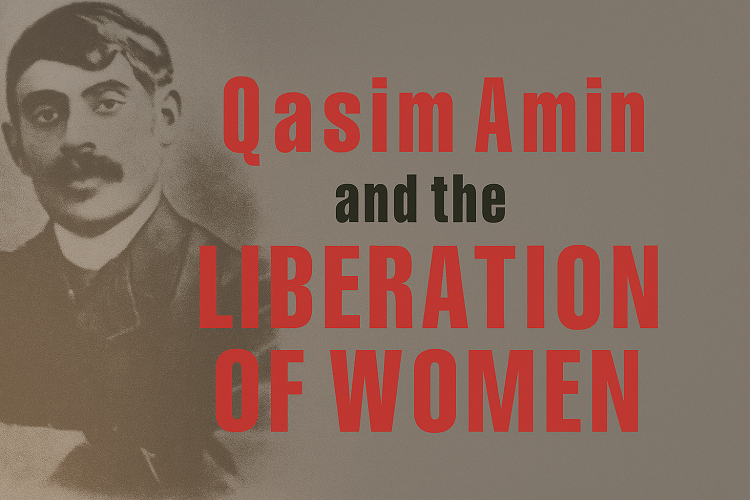
Qasim Amin and the Liberation of Women stand together as one of the pivotal turning points in the history of modern Arab thought. At the end of the nineteenth century, amid Egypt’s struggle between colonial domination and cultural stagnation, Qasim Amin emerged as both a reformer and a cultural revolutionary. His writings, especially The Liberation of Women (1899) and The New Woman (1900), were not merely intellectual reflections but a call for social transformation. Yet, while Amin sought harmony between Islam and modernity, his approach also laid the groundwork for a paradox that continues to shape the modern Muslim world: the attempt to modernize from within religion itself.
This article examines Qasim Amin and the Liberation of Women not only as a milestone in feminist reform in the Arab world but also as the starting point of a complex intellectual trajectory. It highlights how Amin’s religious reformism both advanced women’s emancipation and, unintentionally, contributed to later currents of Islamic revivalism that sought political power under religious authority.
Egypt on the Verge of Modernity
To understand Qasim Amin and the Liberation of Women, one must first grasp the Egypt of the late nineteenth century—a country trapped between British colonialism, Ottoman decline, and an internal crisis of identity. The intellectual climate was deeply influenced by the reformist movement led by figures such as Jamal al-Din al-Afghani and Muhammad Abduh, who believed that Islam, in its purest form, was compatible with reason and progress.
Qasim Amin belonged to this circle of Islamic modernists. Educated in both Egypt and France, he embodied the encounter between Islamic tradition and European rationalism. However, unlike Western feminists of his time, Amin’s argument for women’s liberation was framed within a religious and moral framework. He did not reject Islam but sought to reinterpret it.
Qasim Amin’s Reformist Vision
In his seminal work The Liberation of Women, Qasim Amin contended that the subjugation of women in Muslim societies did not stem from Islam itself but from distorted cultural practices that had accumulated over centuries. He argued that the Qur’an recognized the equal dignity of men and women, and that denying women education or public participation was contrary to the true spirit of the faith.
For Amin, the liberation of women was not merely a moral issue; it was a civilizational necessity. He maintained that no society could progress while half of its population remained intellectually and socially imprisoned. His vision, therefore, was that of a reformed Islamic society, one in which women’s education, participation, and dignity would pave the way for collective national advancement.
However, Amin’s modernism was deeply anchored in a theological framework. He consistently sought to prove that Islam itself contained the principles of enlightenment and equality. In doing so, he represented the first generation of Muslim thinkers who envisioned modernity as an Islamic rather than secular project.
Backlash and Opposition
The publication of The Liberation of Women in 1899 unleashed a storm of controversy. Religious scholars, conservative writers, and traditional politicians accused Amin of undermining Islamic values and imitating Western culture. One of the most prominent critics was Tal‘at Harb, who wrote The Education of Women and the Veil in direct response to Amin’s book.
For Amin’s opponents, the call to unveil women and educate them outside the home represented an assault on the moral and religious fabric of society. They framed their arguments in the language of defending Islam and preserving Egyptian identity, but beneath the surface lay a fear of losing patriarchal control.
This opposition revealed a crucial dynamic: the struggle over women’s liberation was not simply about gender but about authority—who had the right to interpret religion and define social norms.
Reason and Faith: The Core of Amin’s Thought
One of the most remarkable aspects of Qasim Amin and the Liberation of Women is the way it combined faith with reason. Amin believed that the Qur’an and authentic Islamic teachings supported rational inquiry and moral equality. For him, religion was not the enemy of progress but its foundation.
In his view, Western modernity had succeeded because it embraced knowledge and justice—principles that Islam had once embodied. Therefore, to modernize Egypt was not to Westernize it but to restore Islam’s original ethical and intellectual vitality.
However, this position also revealed a tension. By locating the source of modernity within Islam, Amin implicitly limited the autonomy of reason to what could be sanctioned by religious interpretation. This tension—between the desire for reform and the preservation of divine authority—would later become central to the ideological debates of the twentieth century.
Reformism and Its Limits
The reformist project of Qasim Amin and the Liberation of Women aimed to renew Islamic thought, not replace it. Amin’s discourse, while progressive for his time, was ultimately an internal critique rather than a radical break. He called for reinterpretation (ijtihad), not secularization.
From a contemporary perspective, this approach can be seen as both its strength and its limitation. On one hand, it made his message acceptable to a wider audience of believers, allowing him to advocate for women’s rights from within Islamic legitimacy. On the other hand, by refusing to challenge the very framework of religious authority, Amin’s reformism remained bounded. It opened the door to change, yet also reinforced the idea that all change must be sanctioned by faith.
This paradox is what later historians and political theorists identify as the intellectual precursor to modern Islamism—the belief that Islam, properly understood, can govern every sphere of life, including politics, society, and gender relations.
From Islamic Reform to the Roots of Islamism
It would be unfair to label Qasim Amin an Islamist in the political sense. He never called for a theocratic state or religious coercion. Nonetheless, his intellectual methodology—seeking modernity through Islam rather than beyond it—created a pattern that later movements would adopt.
The slogan “return to pure Islam,” which Amin used in a moral and cultural sense, later became the ideological cornerstone of twentieth-century Islamist movements. What began as a call for ethical reform evolved into a project for political domination. The attempt to reconcile religion and modernity, once a spiritual and intellectual endeavor, was transformed into a program of state control and doctrinal rigidity.
In this light, Amin’s reformism, though progressive in intention, can be read as the starting point of a trajectory that led, in some contexts, to religious authoritarianism. The dream of a “modern Islamic society” turned, in several countries, into a mechanism for consolidating clerical power and suppressing dissent—all under the banner of protecting faith.
A Critical Reassessment
The modern reader, looking back at Qasim Amin and the Liberation of Women, faces a dual legacy. On the one hand, Amin’s call for women’s education, dignity, and participation was revolutionary and laid the foundation for Arab feminist thought. On the other, his reliance on religion as the ultimate source of legitimacy limited the emancipatory potential of his ideas.
Contemporary scholars such as Leila Ahmed and Margot Badran have pointed out that Amin’s thought was situated within a patriarchal framework that never fully transcended male guardianship. His vision of the “new woman” was still tied to the moral supervision of men and to the preservation of family order.
Furthermore, from a philosophical standpoint, Amin’s synthesis of Islam and modernity raises the question: can modern rationality truly coexist with divine absolutism? The twentieth century provided sobering answers. In societies where religious reform evolved into political Islamism, the result was often not liberation but control—an outcome that exposes the fragile balance Amin tried to maintain.
The Legacy of Qasim Amin and the Liberation of Women
Despite these tensions, Qasim Amin and the Liberation of Women remains a landmark in the intellectual history of the Arab world. His writings inspired later pioneers such as Huda Sha‘rawi and opened the way for the emergence of Islamic feminism—a movement that seeks gender equality within the framework of faith.
At the same time, his works continue to provoke debate. Was Amin’s project a genuine path toward enlightenment, or did it merely reformulate patriarchy in modern language? Did his insistence on grounding women’s liberation in religion empower women, or did it confine their freedom within new theological boundaries?
Such questions underline the ambivalence of his legacy. Amin symbolized both the courage to challenge tradition and the hesitation to break from it completely. His reformism represents a middle ground—one that is historically significant but philosophically unstable.
Islam, Modernity, and the Politics of Reform
When examining Qasim Amin and the Liberation of Women through the lens of political theory, one observes how deeply intertwined his moral discourse was with the idea of nation-building. Amin believed that reforming women’s status was essential for creating a strong, independent Egypt. Yet, by making Islam the framework for this national renewal, he also affirmed religion’s central role in shaping political identity.
This fusion of national and religious reform would later influence many thinkers of the twentieth century, from Hasan al-Banna to Sayyid Qutb, albeit in radically different ways. The underlying premise remained the same: Islam as the comprehensive guide for modern life.
Here lies the danger that Amin’s project unintentionally foreshadowed—the possibility that moral reform could evolve into ideological domination. History shows that the fusion of religion and politics, even when born from noble intentions, can easily slide into authoritarianism. The experience of countries like Iran illustrates how the rhetoric of returning to authentic Islam, when coupled with state power, can lead to religious despotism rather than enlightenment.
The Continuing Relevance of Amin’s Debate
More than a century later, the questions raised by Qasim Amin and the Liberation of Women remain strikingly relevant. In many Muslim societies, debates about women’s rights, secularism, and the role of religion continue to echo his ideas.
Modern Islamic feminists still grapple with the same dilemma: how to achieve gender equality without severing ties with religious tradition. Meanwhile, secular reformers argue that true liberation requires separating religion from the structures of power. Between these two poles stands Qasim Amin, a figure whose thought bridges faith and freedom but also reveals the tensions between them.
Conclusion: Between Faith and Freedom
Qasim Amin and the Liberation of Women represents both the promise and the paradox of Islamic modernism. Amin sought to liberate women through a reinterpretation of Islam, proving that faith and progress need not be enemies. Yet, by keeping reform within the boundaries of religion, he left unresolved the fundamental contradiction between divine authority and human autonomy.
His work was a moral revolution wrapped in theological moderation. It ignited a movement for women’s education and dignity but also illustrated how reformist Islam, when transformed into ideology, can pave the way for religious authoritarianism.
Today, Qasim Amin’s legacy invites us to ask a deeper question: can a society truly modernize without freeing its moral imagination from the absolute control of religious orthodoxy? His life and writings suggest both an aspiration and a warning—the aspiration of reconciling faith with reason, and the warning that such reconciliation, if pursued through dogma, may reproduce the very chains it seeks to break.
In this sense, Qasim Amin stands as a bridge between two worlds: the traditional and the modern, the faithful and the rational. His call for women’s liberation remains one of the most courageous voices of his era, yet it also reminds us that every reform rooted in absolute authority carries within it the risk of its own reversal.
Ultimately, Qasim Amin and the Liberation of Women is not only a study of one man’s ideas but a mirror reflecting the enduring struggle of the Muslim world to define its path between belief and freedom—a struggle that continues, with all its contradictions, into the twenty-first century.

