


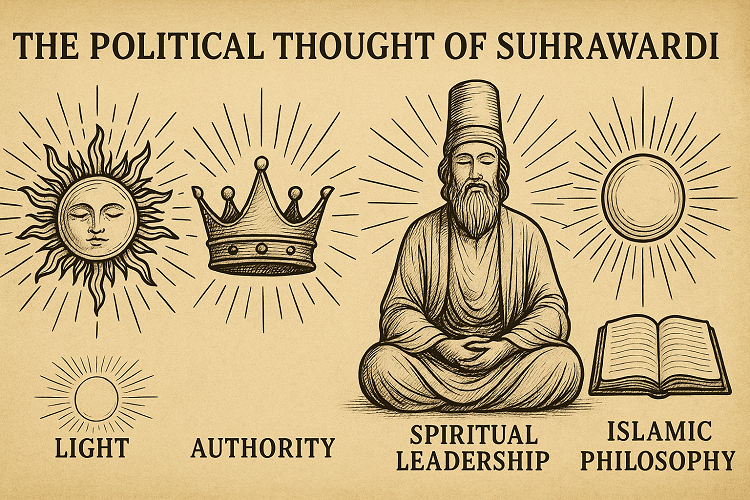
The political thought of Suhrawardi represents a profound attempt to integrate Illuminationist philosophy (hikmat al-ishraq) with the foundational concepts of governance in Islamic civilization. Shihab al-Din Yahya Suhrawardi, known as the Master of Illumination, not only revolutionized Islamic metaphysics but also offered a unique and visionary interpretation of politics grounded in light, spirituality, and knowledge. This article examines the key aspects of Suhrawardi’s political thought, particularly its relationship to the metaphysics of light, the theory of authority, the concept of the philosopher-king, and the revival of pre-Islamic Persian political philosophy.
Life and Historical Context of Suhrawardi
To understand the political thought of Suhrawardi, one must first explore the life and intellectual environment in which he lived. Born in 1154 CE in the city of Suhraward (present-day Iran), Suhrawardi emerged during the later Abbasid period when Islamic philosophy was influenced by Avicennian rationalism, Ash‘arite theology, and Sufi mysticism.
Suhrawardi studied philosophy and theology in Maragheh and Isfahan, then traveled to Syria, where he gained the attention of the Ayyubid prince al-Malik al-Zahir, son of Saladin. However, due to the controversial nature of his ideas—which were perceived by some as heretical—he was imprisoned and executed in Aleppo in 1191 CE at the young age of 38. Despite his early death, his legacy endured for centuries.
Philosophical Foundations of Suhrawardi’s Political Vision
Light as the Ontological Basis of Politics
At the heart of Suhrawardi’s metaphysics is light (nur), which he regarded as the first principle of existence. All beings are manifestations of light in varying degrees of intensity and purity. This metaphysical model translates directly into a political hierarchy, where rulers derive legitimacy based on their proximity to the Light of Lights (nūr al-anwār).
Therefore, in Suhrawardi’s system, true political authority belongs to those who possess higher degrees of spiritual illumination—namely, sages, prophets, and philosopher-mystics. Power, in this worldview, is not merely administrative but is rooted in divine metaphysical order.
The Active Intellect and the Luminous Human
Suhrawardi, like the Neoplatonists and Avicenna, emphasized the role of the Active Intellect. However, he went further by asserting that the truly luminous human being—through spiritual purification and intuitive knowledge—can attain direct contact with the Active Intellect. As a result, governance should not be entrusted to mere politicians but to those enlightened by divine light.
Suhrawardi’s Engagement with Plato and Political Philosophy
Plato’s Republic and the Philosopher-King
There are striking parallels between Suhrawardi’s political thought and Plato’s vision in The Republic. Plato believed that philosophers, due to their access to the Forms and rational insight, should govern. Suhrawardi similarly argued that the rule must be in the hands of philosopher-saints who have achieved illumination.
From Rationalism to Illuminationism
However, Suhrawardi diverges from Plato by moving beyond rationality toward ishraq, or intuitive illumination. While Plato grounded political legitimacy in philosophical reason, Suhrawardi rooted it in spiritual light. Thus, his system is both rational and metaphysical—a profound synthesis unique to the Islamic philosophical tradition.
Caliphate and Walayah in Suhrawardi’s Thought
Caliphate as Spiritual Succession
In Suhrawardi’s thought, the caliph is not merely the political successor of the Prophet Muhammad, but rather a spiritual successor to the source of divine light. Caliphate, therefore, is not confined to legal or political formalities but entails a deep metaphysical realization of truth.
Walayah and the Authority of the Illuminated
The concept of walayah (spiritual guardianship) in Suhrawardi’s system surpasses formal leadership. The wali is someone who has internalized divine light and is thus qualified to guide both the inner and outer life of the community. This means politics becomes a form of spiritual pedagogy, not just statecraft.
Reviving Persian Political Philosophy: The Khosrowani Wisdom
One of the most unique aspects of the political thought of Suhrawardi is his deliberate integration of ancient Persian political ideas. Through frequent references to the Khosrowani Hikmah (Royal Wisdom), Suhrawardi sought to revive the pre-Islamic tradition of sacred kingship and merge it with Islamic metaphysics.
The Divine Glory (Farr-e Izadi) and Legitimate Kingship
In ancient Zoroastrian thought, the rightful king possessed farr-e izadi—a divine light that legitimized his rule. Suhrawardi adopts this idea into his system, arguing that only rulers imbued with divine light are worthy of political authority. This concept reinforces his broader vision of a light-based political hierarchy.
The Perfect Man and the Illuminated Ruler
The Luminous Sage as the True Leader
For Suhrawardi, the Insan al-Kamil (Perfect Human) has ascended the ladder of light and reached proximity to divine truth. Such a person is not only a spiritual guide but also the most legitimate political leader. Hence, rulership is reserved for those whose souls radiate light, not those who merely command power.
Politics as Ethical and Spiritual Training
Suhrawardi’s concept of politics is deeply ethical. It is a vehicle for guiding souls toward the source of light. The Illuminated Ruler does not merely enact laws but cultivates virtue in his subjects and society. In this way, governance becomes an act of divine service and moral responsibility.
Suhrawardi’s Critique of Legalism and Peripatetic Philosophy
Rejecting Instrumental Politics
Suhrawardi challenges the Peripatetic (mashsha’i) tradition, especially the political views of Avicenna, which he perceived as overly rational and utilitarian. In contrast, his system refuses to reduce politics to mere technique or strategy; instead, it insists on moral and spiritual illumination as the core of political legitimacy.
Distancing from Power-Centric Jurisprudence
Moreover, Suhrawardi does not align with classical Sunni jurisprudential views that base political legitimacy solely on force, consensus, or formal contracts. Rather, he advocates for a leadership rooted in divine light, transcending legal formalism. This sets him apart from both mainstream fiqh and early Islamic political thought.
The Legacy of Suhrawardi in Islamic Political Philosophy
Despite his early execution, Suhrawardi’s political thought left a lasting imprint on Islamic intellectual history. Later philosophers like Mulla Sadra, Mir Damad, and Sabzawari were deeply influenced by his metaphysics of light.
The Rise of Spiritual Political Thought
Suhrawardi helped to pave the way for a tradition of spiritual politics within Islam—a vision where governance is intertwined with mysticism, ethical refinement, and metaphysical insight. His ideas provided a foundation for the idea of theosophic leadership, which continued to evolve in both Shi‘a and Sufi traditions.
Conclusion: The Significance of Suhrawardi’s Political Philosophy
The political thought of Suhrawardi is a rare synthesis of metaphysics, mysticism, ethics, and political theory. By basing his vision on the metaphysics of light, the theory of spiritual hierarchy, and the revival of Persian royal wisdom, he created a unique model of governance rooted in both reason and revelation.
In his system, politics becomes a sacred endeavor—aimed not at domination, but at the illumination of souls. Although his ideas were suppressed in his lifetime, they remain relevant today as a compelling alternative to both secular authoritarianism and purely legalistic models of rule.
Final Reflections
- Can modern politics benefit from Suhrawardi’s vision of enlightened leadership?
- How might we reimagine political legitimacy in light of hikmat al-ishraq?
- Is there a space in contemporary Islamic societies for a synthesis of spirituality and governance?


