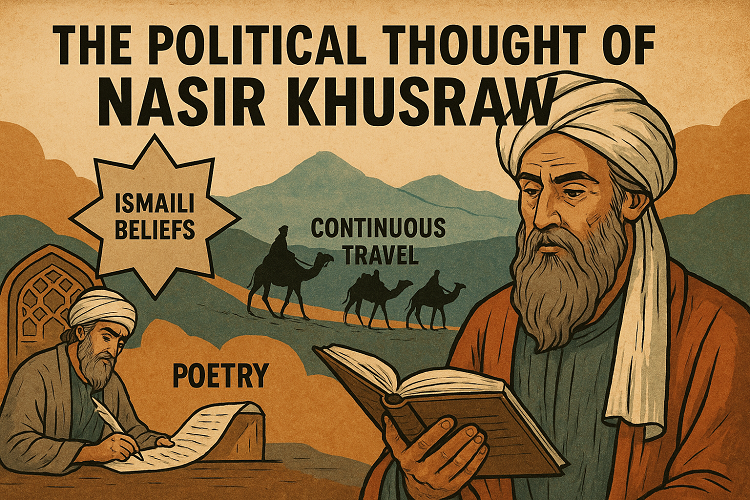
The political thought of Nasir Khusraw is one of the remarkable manifestations of the connection between wisdom, religion, and politics in Islamic civilization. Nasir Khusraw, a poet, philosopher, and Ismaili missionary, lived during a time of political and religious upheaval, which profoundly influenced his political views. In this article, we will explore the roots, key concepts, and the impact of Nasir Khusraw’s political thought on the history of Islamic thought.
Life and Historical Context of Nasir Khusraw’s Political Thought
Nasir Khusraw in the Context of the 5th Century AH
Nasir Khusraw Qubadiyani was born in 394 AH in Balkh, during a period when the Abbasid Caliphate was in decline, and the Fatimid Caliphate in Egypt had reached its zenith. This duality in the political landscape deeply influenced Nasir Khusraw’s political thought. After his famous journey to Egypt, he converted to the Ismaili faith and became a prominent missionary.
The Journey and Experience of the Fatimid State
A turning point in Nasir Khusraw’s political thought was his visit to the lands of Islam and his encounter with the Fatimid caliph, al-Mustansir Billah. He saw the Fatimid government as a model for the legitimate Islamic caliphate, founded on imamate and divine knowledge, and after returning to Khorasan, he eagerly promoted this system.
Philosophical Foundations of Nasir Khusraw’s Political Thought
Reason as a Tool for Governmental Legitimacy
In The Political Thought of Nasir Khusraw, reason holds a fundamental place. He regards reason as a divine gift that guides human beings toward the knowledge of the truth. For him, just as religion requires sharia, politics needs reason to avoid tyranny.
Revelation, Interpretation, and Imamate
According to Nasir Khusraw, based on Ismaili principles, interpretation (ta’wil) of religious texts is essential. He argues that the outer layer of religion is for the common people, while only the Imams, who are the heirs of esoteric knowledge, can understand the true essence of the faith. Thus, in Nasir Khusraw’s political thought, a legitimate government is one in which the Imam or a representative of the Imam leads.
Caliphate and Imamate in Nasir Khusraw’s Political Thought
Critique of the Abbasid Caliphate and Defense of the Fatimid Caliphate
Nasir Khusraw viewed the Abbasid caliphate as usurped, as its legitimacy was based on force and political maneuvering, not divine appointment. In contrast, he saw the Fatimid caliphate as a manifestation of a just government rooted in imamate and divine science.
The Imam, Divine Reason, and the Mediator of Divine Grace
In Nasir Khusraw’s works, the Imam is not just a political leader, but the intermediary between the created world and the divine, embodying divine reason. The Imam is the true teacher of religion and politics, and without him, society would descend into chaos and misguidance.
The Ideal Society in The Political Thought of Nasir Khusraw
Justice, Wisdom, and Stability
Nasir Khusraw describes an ideal society where justice prevails, leaders are wise, and the people are guided toward happiness through divine knowledge. In this society, the ruler governs not through force, but through reason and religious legitimacy.
Education, Guidance, and Political Responsibility
Nasir Khusraw believed that true politics lies not only in the exercise of power but in the moral responsibility of guiding the people toward truth. Hence, government is not only about exercising authority but also about the moral and educational duty of the ruler.
The Relationship Between Religion and Politics in Nasir Khusraw’s Thought
The Denial of the Separation of Religion and Politics
In The Political Thought of Nasir Khusraw, the separation of religion from politics is meaningless. Politics is an extension of religion in the social sphere, and religion without governance leads to corruption, while politics without religion leads to oppression.
Calling to the Truth: A Divine Politics
A key concept in The Political Thought of Nasir Khusraw is “Da’wa” (the call). Ismaili Da’wa is not only a religious call but a political-cultural process aimed at realizing divine governance. The Da’i (missionary) is the representative of the Imam and the medium through which divine light is transmitted to society.
Nasir Khusraw and the Relationship Between State and People
The People as the Audience of the Call and the Foundation of Politics
In Nasir Khusraw’s works, the people are not mere subjects of the government; they are the recipients of the call and the beneficiaries of guidance. Unlike many of his contemporaries, Nasir Khusraw recognizes the intellectual dignity of the people, provided they benefit from the guidance of the Imam or Da’i.
The Duty of Obedience Based on the Legitimacy of the Ruler
In The Political Thought of Nasir Khusraw, obedience to the ruler is only obligatory when the ruler possesses religious and rational legitimacy. If a ruler deviates from reason and religion, obedience to him is not only unnecessary but amounts to cooperation with falsehood.
Critique of Non-religious Monarchies
Power-hungry Rulers and the Lack of Guidance
Nasir Khusraw frequently criticizes the monarchs and emirs of his time. He believes that many of them were solely interested in power and lacked justice and wisdom. This critique forms the core of his ethical and political philosophy.
The Relationship Between Wealth, Corruption, and the Decay of States
Nasir Khusraw shows how the accumulation of wealth by rulers and their disregard for the people’s rights leads to the downfall of states and the degeneration of civilizations. In contrast, poverty and asceticism are attributes of true Imams and Da’is.
Analysis of Nasir Khusraw’s Works from a Political Perspective
The Political Aspect of “The Book of Travels” and “The Pilgrim’s Guide”
In “The Book of Travels,” Nasir Khusraw narrates his journey to the lands of the Fatimids and provides a vivid picture of the political order of that time. Similarly, in “The Pilgrim’s Guide,” he philosophically analyzes the status of the Imam, the duties of the ruler, and the necessity of reason in politics.
The Political Language of His Poetry
Nasir Khusraw’s poetry is a blend of wisdom, protest, and a call for a return to the truth. Through his poetry, he elegantly presents his political critiques, religious beliefs, and philosophical teachings.
The Impact of Nasir Khusraw’s Political Thought on Later Movements
Intellectual Legacy in the Ismaili Tradition
Nasir Khusraw’s thought, particularly regarding religious and political legitimacy, was a source of inspiration for later Ismaili movements. In later centuries, the Fatimids, the Nizaris of Alamut, and even some Shi’a movements benefited from his ideas.
Nasir Khusraw in Comparison with Farabi and Khwaja Nasir
In comparison with Farabi, who conceived of the “Virtuous City,” or Khwaja Nasir, who sought to reconcile philosophy and sharia in his “Naseri Ethics,” Nasir Khusraw’s approach was more focused on the practical realization of justice in a specific historical context.
Conclusion: The Place of The Political Thought of Nasir Khusraw in Islamic Tradition
The Connection Between Reason and Sharia
The political thought of Nasir Khusraw is an exemplary effort to link reason and sharia, wisdom and politics, and religion and justice. He offers a model of government that is rational, ethical, and grounded in religious legitimacy.
A Model for Meaningful Politics
In the contemporary world, revisiting Nasir Khusraw’s thought can inspire a model of politics that does not merely focus on power but centers around meaning, justice, and reason. This model continues to hold relevance against instrumental and authoritarian politics and can serve as the foundation for dialogue between tradition and modernity.