


Introduction
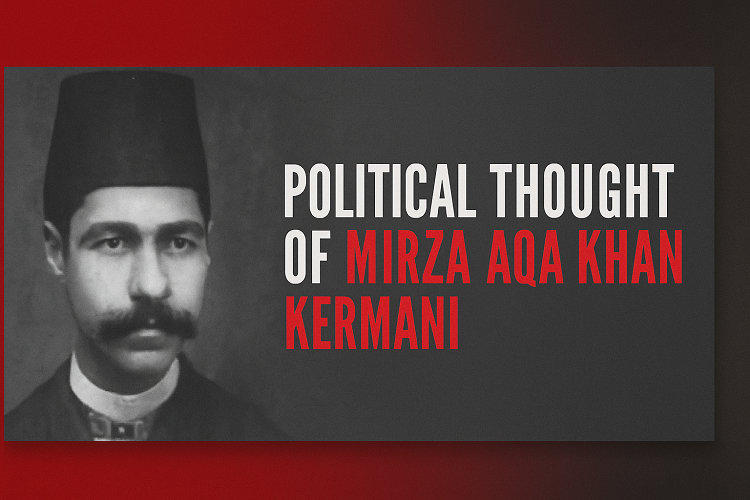
The political thought of Mirza Aqa Khan Kermani marks a turning point in the history of Iranian intellectual movements during the Qajar era. He was a reformist thinker who boldly criticized tyranny, called for rationality, emphasized freedom and national identity, and advocated religious reform. His writings and ideas provided the intellectual foundation for the Constitutional Revolution. Therefore, studying the political thought of Mirza Aqa Khan Kermani is essential for understanding the roots of modern political discourse in Iran.
Life and Intellectual Background of Mirza Aqa Khan Kermani
Childhood and Early Education
Mirza Aqa Khan Kermani was born in Kerman in 1853 (1270 AH) into a traditional and religious family. He initially studied Persian literature and Islamic sciences, but his questioning mind soon pushed him beyond conventional boundaries.
Travels and Encounters with New Ideas
During his youth, Kermani traveled to Istanbul and the Caucasus. These journeys exposed him to European modernity and the intellectual movements of Ottoman and exiled Iranian reformers such as Malkom Khan and Talibov. As a result, he realized the stark differences between Iran and modern states, fueling his determination for reform.
Socio-Political Context of Qajar Iran
To understand the political thought of Mirza Aqa Khan Kermani, one must consider the historical context of Qajar Iran. The country suffered from absolutist monarchy, foreign interference, economic dependency, and cultural stagnation. Military defeats against Russia and Britain revealed Iran’s weakness and created the urgency for reforms.
Core Principles of Mirza Aqa Khan Kermani’s Political Thought
Critique of Despotism
At the heart of Kermani’s political philosophy was a firm rejection of Qajar despotism. He regarded tyranny as the main reason behind Iran’s decline and argued that progress was impossible without constitutional limits on royal power.
Rationalism and Scientific Progress
Kermani promoted rationality and science as the foundation of a modern society. He denounced superstition and clerical ignorance, emphasizing that education and modern schools were crucial for national advancement.
Religious Reform and Criticism of the Clergy
Another essential element of his political thought was religious reform. Kermani argued that Islam was compatible with reason and progress, but rigid clerical interpretations prevented modernization. He thus called for reinterpretation of religion according to reason and contemporary needs.
Nationalism and Revival of Ancient Iran
Equally important was his emphasis on Iranian nationalism. Kermani glorified Iran’s pre-Islamic past, considering it a source of pride and national identity. He believed that reviving this heritage would inspire resistance against foreign domination and restore national dignity.
Mirza Aqa Khan Kermani and the Constitutional Movement
Influence on Constitutionalists
Although executed before the Constitutional Revolution, his writings significantly influenced constitutionalists. His repeated calls for law, freedom, equality, and civic participation shaped the intellectual foundation of the movement.
Concept of Freedom
For Kermani, freedom was not only an individual right but also a collective necessity. Without freedom of thought and expression, he argued, no society could advance.
Rule of Law
He consistently highlighted the necessity of law and justice. According to him, laws should be based on reason and public will, paving the way for the Constitutional Revolution’s legal framework.
Writings of Mirza Aqa Khan Kermani
Three Letters (Se Maktub)
His most famous work, Three Letters, presented a bold critique of Qajar Iran and proposed a vision for reform. It can be considered the manifesto of his political thought.
Glorification of Ancient Iran
In other writings, Kermani praised ancient Iran, contrasting its grandeur with contemporary decay. He used history as a tool for national awakening.
Essays and Treatises
Kermani also produced numerous essays on politics, religion, ethics, and society. These writings demonstrate his critical mind and reformist passion.
Comparison with Other Iranian Intellectuals
With Malkam Khan
While Malkam Khan focused on administrative and legal reforms, Kermani placed greater emphasis on religious reform and national identity. Nevertheless, both shared a deep opposition to tyranny.
With Talibov
Talibov, like Kermani, valued education and science. However, Kermani’s nationalism was stronger and more radical than Talibov’s pragmatic approach.
With Jamal al-Din al-Afghani
Unlike Afghani, who promoted pan-Islamic unity against imperialism, Kermani concentrated on Iranian identity and pre-Islamic heritage. This difference highlights the diversity of reformist thought in the Muslim world.
Criticism and Limitations of Kermani’s Political Thought
Opposition of the Clergy
His call for religious reform provoked strong resistance from traditional clerics, who accused him of heresy.
His Tragic Fate
In 1896 (1314 AH), Kermani was executed in Tabriz under the order of Mozaffar al-Din Shah due to his political activism. This event illustrates how dangerous his ideas were considered by the Qajar state.
Tension between Nationalism and Religion
Some scholars argue that his strong emphasis on pre-Islamic nationalism created tensions with Islamic traditions, reducing his acceptance among religious audiences.
Legacy of Mirza Aqa Khan Kermani
Inspiration for the Constitutional Revolution
His ideas inspired the constitutional movement and provided reformists with intellectual weapons against tyranny.
Place in Iranian Intellectual History
Kermani must be regarded as one of the founders of modern political thought in Iran. His work symbolizes the transition from traditionalism to modernity.
Relevance Today
Even today, debates on freedom, justice, rationality, and national identity in Iran resonate with the concerns raised by Kermani more than a century ago.
Conclusion
The political thought of Mirza Aqa Khan Kermani represents a bold attempt to rescue Iran from tyranny and backwardness. Through his critique of absolutism, advocacy of rationalism, call for religious reform, and emphasis on national identity, he paved the way for the Constitutional Revolution and modern political discourse in Iran. Although silenced by execution, his intellectual legacy endures as an essential chapter in the history of Iranian thought.

