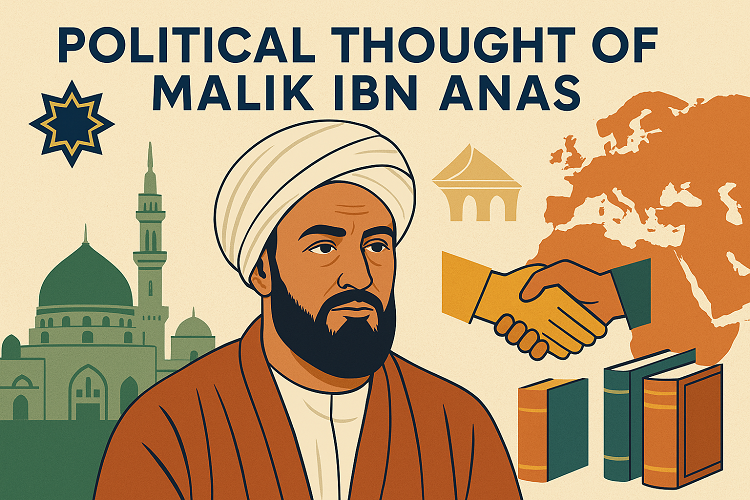
Introduction: Why is the Political Thought of Malik ibn Anas important?
In Islamic civilization, political theory emerged not from Greek-style philosophy but from legal reasoning (fiqh). Among the early Islamic jurists, Imam Malik ibn Anas (93–179 AH / 711–795 CE) was a foundational figure who embedded political dimensions into Islamic law. In the Political Thought of Malik ibn Anas, tradition takes precedence over theory. This article examines Malik’s political thought, contrasting it with other Sunni schools such as Hanafi, Shafi‘i, and Hanbali.
Who Was Malik ibn Anas and What Was His Political Relevance?
Malik was born and raised in Medina, the political capital of early Islam. He founded the Maliki school of jurisprudence, which is dominant today in North and West Africa. His legal philosophy was based on the living tradition of the people of Medina, which he considered a reflection of the Prophet’s model society.
The Political Thought of Malik ibn Anas: Sources and Principles: Tradition over Reason?
Did Malik Prioritize Tradition or Rational Deduction?
Unlike Abu Hanifa, who emphasized qiyas (analogical reasoning), Malik prioritized the actual practice of Medina’s community. He considered this to be a kind of practical consensus (ijma‘ amali) that trumped speculative reasoning.
Key Sources in Maliki Political Jurisprudence:
-
The Qur’an
-
The Sunnah
-
Practice of the People of Medina (unique to Maliki thought)
-
Consensus and Maslaha (public welfare)
Bay‘ah, Caliphate, and Political Legitimacy in Malik’s View
Did Imam Malik Accept Unjust Rulers as Legitimate?
Unlike revolutionary sects, Malik discouraged rebellion even against unjust rulers. He feared civil strife (fitna) more than tyranny. Legitimacy, for him, was grounded in public bay‘ah (allegiance) rather than moral perfection.
“Once a ruler has been given bay‘ah, breaking it is haram unless he commits open disbelief.” — (Attributed ruling)
Features of Maliki Political Jurisprudence: Conservative and Realist
What Makes Maliki’s Political Thought Unique?
-
Avoidance of political activism
-
No elaborate political theory
-
Emphasis on unity and societal order
-
Blend of shari‘ah and local custom within the prophetic tradition
These characteristics made Maliki fiqh a key tool in state-building in North Africa and Andalusia.
Comparing the Political Thought of Malik ibn Anas with Other Sunni Schools
“When examining the political thought of Malik ibn Anas, it becomes necessary to contrast it with Abu Hanifa, Shafi‘i, and Hanbali”.
1. Malik vs. Abu Hanifa: Tradition vs. Reason
-
Hanafi jurists emphasized rational methods; Malikis relied on living tradition.
-
Abu Hanifa rejected unjust rulers; Malik accepted de facto rulers for stability.
2. Malik vs. Shafi‘i: Systematization vs. Custom
-
Shafi‘i formalized usul al-fiqh; Malik followed customary Medina practice.
-
Shafi‘i gave structure to ijma‘ and qiyas; Malik was pragmatic and localist.
3. Malik vs. Hanbali: Quietism vs. Confrontation
-
Hanbali, like Ibn Hanbal, resisted rulers; Malik avoided confrontation.
-
Hanbali thought became literalist; Maliki stayed moderate and adaptive.
Maliki Political Influence in the Maghreb and Andalusia
How Did Maliki Fiqh Legitimize Power in the West?
Maliki scholars became state theologians under the Almoravids and Almohads, defining Islamic governance through traditionalist lenses. Political structure included:
-
Sovereignty under shari‘ah
-
Judicial authority to scholars
-
Maintenance of public order
-
Emphasis on unity over dissent
Criticism of Malik’s Political Doctrine
-
Too conservative? Critics say Malik’s passive stance enabled unjust rule.
-
Lack of political theory? No structured vision like al-Mawardi or al-Farabi.
-
Silent on reform? Malik prioritized order over political transformation.
Conclusion: Malik’s Legacy in Sunni Political Jurisprudence
Imam Malik’s political thought reflects a traditionalist, consensus-driven approach where public stability trumps political idealism. His framework remains relevant in debates about Islamic governance that value continuity, community, and shari‘ah-based legitimacy.”The political thought of Malik ibn Anas continues to influence Sunni Muslim governance debates today.”