Ibn Khaldun (732–808 AH / 1332–1406 AD) is one of the most prominent Islamic thinkers whose theories in history, sociology, and politics continue to inspire contemporary scholars. He is often regarded as the founder of political sociology, as his theories on the state, power, and social dynamics are grounded in empirical observations and meticulous historical analysis. Ibn Khaldun is one of the few Islamic thinkers who introduced new concepts that opened new intellectual horizons for humanity. Some of the key concepts in The Political Thought of Ibn Khaldun include the Knowledge of civilization (Ilm al-Umran), necessity, asabiyyah (social cohesion), Shari’a-based politics, and rational politics. This article aims to explore his political thought through these concepts.
Apart from his famous book Al-‘Ibar and its Muqaddimah (Prolegomena), Ibn Khaldun left behind other works that have not received as much attention. His name is closely associated with Kitab al-‘Ibar (The Book of Lessons), and more specifically, with its Muqaddimah, which has gained significant recognition. The Muqaddimah (Prolegomena) consists of a preface and six chapters. The preface provides an introduction to the science of civilization and explains the reasons behind writing the book. The six chapters cover, respectively: general aspects of civilization, nomadic civilization, states, urban civilization, crafts and professions, and sciences and related issues.
The Knowledge of Civilization in The Political Thought of Ibn Khaldun
In the preface to his Muqaddimah (Prolegomena), Ibn Khaldun explains the rationale behind establishing the “Knowledge of civilization” (Ilm al-Umran). While he had a deep interest in history, he questioned how one could trust historical accounts and how these reports could be refined to achieve certainty. Unlike most historians before him—except for figures such as al-Mas‘udi—he did not merely transmit historical reports without critically evaluating their plausibility and rational consistency. Instead, he sought to move beyond a superficial recounting of events.
From the outset, Ibn Khaldun differentiates between religious reports (akhbar shar‘iyya) and historical accounts (akhbar tarikhiyya). Religious reports are accepted based on the certainty of their transmission, whereas historical accounts must conform to reality. To ascertain this conformity, one must possess knowledge of human society and the natural qualities that emerge within it. According to Ibn Khaldun, the essence of history is the study of human society and its inherent characteristics, such as nomadism, asabiyyah (social cohesion), peace, and other social dynamics.
In The Political Thought of Ibn Khaldun primary goal in founding the Knowledge of civilization—a discipline unprecedented in its scope—was to engage in a systematic discussion of these subjects, namely human civilization and social organization.
The Difference Between the Knowledge of Civilization, Rhetoric, and Civil Politics in Ibn Khaldun’s Thought
In The Political Thought of Ibn Khaldun, the Knowledge of civilization (Ilm al-Umran) is distinguished from other related concepts such as rhetoric (khatabah) and Civil Politics (siyasat madani).
-
Difference from Rhetoric:
According to Ibn Khaldun, rhetoric is aimed at persuading people either to accept or reject a particular belief. It is inherently persuasive (iqna‘i) and lacks the rigor of demonstrative reasoning (burhan). In contrast, the Knowledge of civilization is based on the nature of phenomena and follows a method of logical reasoning and empirical analysis.
-
Difference from Civil Politics:
Ilm al-Umran also differs from Civil politics. While Civil Politics is ultimately practical and solution-oriented, focusing on governance and the management of affairs, Ilm al-Umran seeks to explain the nature of these affairs through systematic reasoning. Civil Politics is concerned with policy-making and social engineering, whereas the Knowledge of civilization is concerned with understanding historical and social realities as they occur. In this sense, Ilm al-Umran aligns more with natural philosophy, as it acknowledges the inherent nature (tab‘) of social and human phenomena rather than prescribing ways to alter them.
The Muqaddimah and the Knowledge of civilization are inseparably intertwined with politics, and Ibn Khaldun’s historical interests serve to reinforce this connection. His study of civilization begins with the natural disposition of humans and the necessity of social life. It traces the evolution of societies from their primitive and nomadic phases to urban civilization. Throughout this progression, Ibn Khaldun examines the economic and social necessities (natural logic) that shape each stage of development.
The Social Characteristics of Humans in Ibn Khaldun’s Political Thought
Since the Knowledge of civilization (Ilm al-Umran) is concerned with human social life, it is natural that Ibn Khaldun formulates a theory regarding the social characteristics of humans. His views on human social nature and its rationale align with those of earlier thinkers. He asserts that what distinguishes humans from animals is their intellect and the arts derived from thought. Moreover, human sociability arises out of the necessity to fulfill basic needs.
By emphasizing both intellect and social life, Ibn Khaldun differentiates human society from mere herd behavior or instinctive collective living seen in animals. Human social life is goal-oriented—it exists to satisfy needs—and differs fundamentally from the purely instinct-driven communal living of other creatures.
In this type of social existence, conflict (tazahum) is an inevitable consequence of human nature. Therefore, Ibn Khaldun argues that the presence of a ruler (hākim), an authority (rada‘), or a sovereign power (malik qahir) is essential to maintain social order and ensure the survival of human society.
At the beginning of the first chapter of the Muqaddimah, Ibn Khaldun further explains the necessity of human sociability by citing earlier philosophers:
“Man has a natural disposition for social life; that is, he is compelled to form a society, which in philosophical terminology is called madaniyyah (urban life or civilization). And this is precisely the meaning of civilization (Umran).”
Thus, for Ibn Khaldun, human civilization is both a natural necessity and a rational inevitability, arising from the intrinsic characteristics of human beings.
The Concept of “Necessity” in Ibn Khaldun’s Thought
In the Muqaddimah, Ibn Khaldun employs the term necessity (ḍarūrah) in three distinct senses:
- Natural Necessity (ḍarūrah ṭab‘īyah) – This refers to the inherent nature of things, determining their essential properties. It includes categories such as potentiality, movement, and natural transformation, like the process of a seed growing into a plant.
- Causal Necessity (ḍarūrah fī al-‘ilāqah al-‘illīyah) – This signifies a cause within civilization (Umran) or one of its components, demonstrating that it is a precondition for existence. For instance, food and shelter are necessary conditions for human survival.
- Necessity in Historical Logic (ḍarūrah fī sayr al-mantiq al-tārīkhī) – In this sense, <em>Umran</em> (civilization) and its intrinsic characteristics are the results of historical necessities, forming inevitably through the logical progression of historical events.
Thus, the necessity of social life falls under the first type (natural necessity). As a result of this necessity, the concept of division of labor emerges. The notion of division of labor was previously discussed by philosophers, especially Plato, in explaining the origins of the city (polis).
However, the Political Thought of Ibn Khaldun emphasizes that social life and division of labor are not merely instinctual behaviors, as seen in animals that live collectively. Rather, their purpose is to fulfill mutual human needs in a broad sense. Another dimension of this issue is the inevitable conflicts and rivalries that arise in human interactions, necessitating the existence of a ruler and laws to regulate these relationships and prevent disorder.
Nomadic and Urban Civilization in Ibn Khaldun’s Thought
In his science of civilization (Ilm al-‘Umran)—which can be described in modern terms as descriptive sociology—Ibn Khaldun categorizes societies into two main types:
- Nomadic Civilization (Badawi ‘Umran) – The simpler, more primitive form of social organization, often associated with Bedouin life.
- Urban Civilization (Hadari ‘Umran) – A more complex, settled, and structured form of social organization, centered around cities.
Ibn Khaldun explains the formation of states as occurring within the transition between these two forms of civilization. According to his theory, nomadic society precedes urban society, as human civilization historically evolves from tribal and pastoral life to city life. Since the foundation of states typically emerges from this shift, it is only natural that the discussion on governance and state formation takes place in this transitional phase.
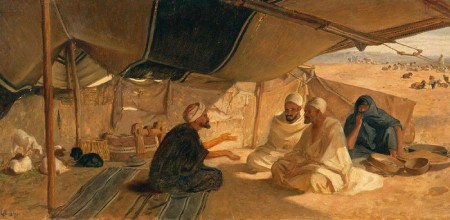
The primary distinction between nomadic and urban civilization lies in their mode of subsistence (ma‘āsh). Social life—whether in its nomadic or urban form—operates according to natural necessities, meaning that each society inevitably adopts a way of life dictated by its circumstances.
This “necessity” is the same first type of necessity (natural necessity) that Ibn Khaldun previously described, where social evolution follows an unavoidable, inherent trajectory shaped by human needs and environmental conditions.
Asabiyyah: The Central Concept in The Political Thought of Ibn Khaldun
Ibn Khaldun views Bedouins as naturally tougher and more aggressive than city dwellers due to their way of life. However, he also considers them closer to virtue and goodness because they live in a more natural state, uncorrupted by urban luxuries. Beyond these moral and temperamental differences, the most crucial concept Ibn Khaldun introduces when discussing nomadic life is Asabiyyah (group solidarity or tribal cohesion).
The Meaning of Asabiyyah
The linguistic root of Asabiyyah refers to kinship ties among male descendants through the paternal line. Ibn Khaldun considers kinship and blood relations a natural aspect of human society, except in rare cases. Therefore, he defines Asabiyyah as a form of social cohesion based on kinship and the collective defense of that kinship.
By linking this concept to nomadic life, Ibn Khaldun argues that nomadic societies depend on Asabiyyah for survival. Without a strong sense of solidarity, these societies would collapse when faced with external threats and hardships.
The Structure of Asabiyyah in Society
Asabiyyah functions inversely within nomadic societies. The closer one is to the core of a social group, such as a tribe or extended family, the stronger the sense of solidarity. However, as the circle expands outward, the strength of these social bonds weakens.
Asabiyyah follows a natural progression:
- It begins with familial defense – a small group defending its members.
- If favorable conditions exist, Asabiyyah expands, leading to political dominance.
- Eventually, it culminates in state formation and monarchy.
Each tribe consists of multiple families, but inevitably, one group within the tribe will possess stronger Asabiyyah than the rest. This dominant Asabiyyah either unifies the various groups under one leadership or leads to conflict between competing factions. When one Asabiyyah prevails, it expands its power and influence, ultimately resulting in the establishment of kingship and governance.
Asabiyyah and Civilization
Asabiyyah is deeply connected to civilization (Umran) and plays a crucial role in Ibn Khaldun’s understanding of human nature. He does not see humans as entirely peaceful and harmonious beings. Instead, he argues that the desire for domination and power is inherent in human nature. This drive for superiority manifests in two ways:
- Individually, it leads to monarchy and autocracy.
- Collectively, it results in group conflicts and the domination of one group over others.
For Ibn Khaldun, kingship is nothing more than the act of conquest and rule through force. By combining the philosophical framework of natural disposition (ṭab‘), the necessity of social life, and the role of Asabiyyah, he constructs a model explaining how nomadic society (Badawi ‘Imran) evolves into monarchy and ultimately transitions into urban civilization (Hadari ‘Imran).
The Rise and Fall of States According to Asabiyyah
Ibn Khaldun presents a cyclical theory of state formation and decline, which consists of five stages:
-
The Foundation Stage
A powerful group, relying on its strong Asabiyyah (social cohesion and tribal solidarity), seizes power. The leaders are typically hardworking, courageous, and capable rulers who unite their people through shared bonds and establish a new state.
-
The Consolidation of Power
Once in power, rulers focus on stabilizing governance, enforcing laws, and strengthening military and economic structures. During this stage, the government is strong, often deriving legitimacy from Asabiyyah and sometimes religion.
-
The Peak of Prosperity
The state reaches its height of development. Economic prosperity, trade, art, and culture flourish. A more sophisticated bureaucratic system emerges, transforming society from a nomadic (Badawi) state to an urban civilization (Hadari Umran). However, Asabiyyah starts to weaken as luxury and comfort increase.
-
Corruption and Decline
Prosperity leads to moral and political decay. Rulers become corrupt, indulgent in luxury, and detached from the people. The state bureaucracy becomes overly complex, corruption spreads, and taxation increases, causing public discontent. Asabiyyah fades, making the state vulnerable to external and internal threats.
-
Collapse and Overthrow
Due to weakening Asabiyyah, corruption, and administrative inefficiency, the state loses its strength. Eventually, a new group with stronger Asabiyyah emerges, topples the ruling power, and repeats the cycle.
This cyclical view of history helps explain why no state or dynasty lasts forever, as each government follows a natural trajectory from rise to fall.
Rational and Religious Politics in The Political Thought of Ibn Khaldun
Ibn Khaldun distinguishes between two types of politics: rational politics and religious politics. These two approaches are based on different principles for governance.
-
Rational Politics (Siyasat ‘Aqliyyah)
In rational politics, political laws are formulated based on reason and contemplation. An example of this is the ancient Iranian political system, where rulers devised laws and policies through logical reasoning, aiming to balance the needs of the state and its people.
-
Religious Politics (Siyasat Shar’iyyah)
In religious politics, shari’a and the lawgiver (the Prophet or a religious leader) are the foundation of political laws, guiding the state’s governance. Religious politics emphasizes the public welfare, with benefit in both worlds—this includes the spiritual and temporal dimensions of governance.
Ibn Khaldun, in his further discussion of the two types of politics, elaborates on the <strong>public interest (maslahah `ammah). He suggests that:
- In rational politics, the political system seeks to balance the general welfare of the people and the specific welfare of the ruler, ensuring the stability of the kingdom. He cites ancient Iran as a successful model of this approach.
- In the second form of rational politics, the welfare of the ruler takes precedence, and the public good is subordinated to the ruler’s interests.
Religious Politics and the Caliphate
In discussing religious politics, Ibn Khaldun introduces the concept of the Caliphate (Imamate). He views the caliph as the successor to the Prophet, responsible for protecting the religion and governing the world through religion. Like many other Muslims, Ibn Khaldun believes that it is obligatory to appoint a caliph, a duty that is either rationally grounded or subsidiary.
Ibn Khaldun, however, is a proponent of the religious obligation of the caliphate, emphasizing its role in both spiritual and worldly governance. He then discusses how the caliphate transformed into a monarchy in Islamic history, using the concept of Asabiyyah (tribal solidarity) to explain the shift, particularly in the Umayyad dynasty.
Conclusion
The political thought of Ibn Khaldun offers a sophisticated analysis of the cycle of power and the decline of states. By employing concepts such as the necessity of the state, the science of civilization, Asabiyyah, and stages of state development, he illustrates how governments emerge, prosper, and eventually collapse. His theories not only provide insights into Islamic political history but also offer valuable perspectives for analyzing modern political transformations.
Source:
Qaderi, Hatam. (2005). Political Thoughts in Islam and Iran. Samt Publication. Tehran. Iran. [In Persian].