


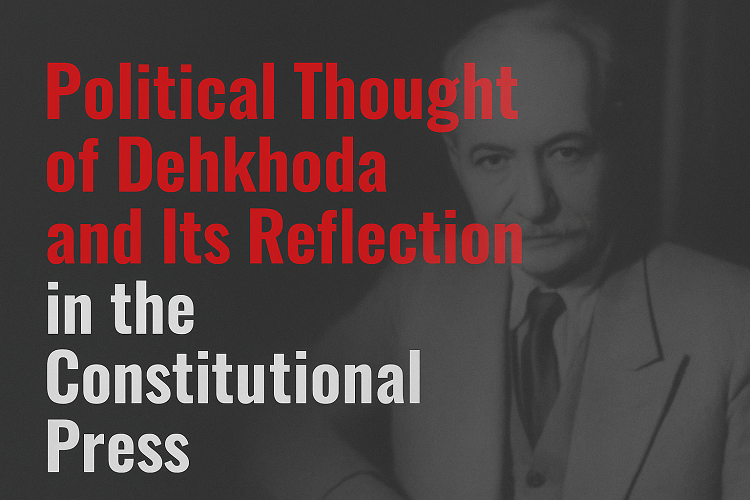
The political thought of Dehkhoda represents one of the most significant intellectual developments in Iran’s Constitutional Revolution. This thought, expressed most vividly in his writings for the journal Sur-e Esrafil, combined satire, social criticism, and political reasoning to challenge tyranny and advocate for justice, law, and freedom. Unlike many of his contemporaries who spoke only to elite circles, Dehkhoda transformed his pen into a weapon of enlightenment for the common people. This article explores his life and intellectual background, provides an in-depth analysis of his articles in Sur-e Esrafil, compares him with both contemporaries and predecessors, and finally evaluates the enduring legacy of his political ideas.
Life and Intellectual Background
Education and Formation of Character
Ali Akbar Dehkhoda was born in Tehran in 1879. He began his education in traditional schools but later entered the School of Political Science in Tehran. This institution, established to train modern diplomats, was one of the earliest European-style educational centers in Iran. Dehkhoda learned modern sciences, French, and political concepts, while also being familiar with Islamic scholarship. This hybrid education produced a critical and questioning mind that became evident in his later works.
Travels to Europe
Dehkhoda traveled to Europe with a group of constitutionalists and stayed in Switzerland and France. During these years, he studied the works of European thinkers such as Montesquieu, Voltaire, and Rousseau. The concepts of separation of powers, freedom of the press, and social contracts deeply influenced him. Upon his return to Iran, amid the unfolding Constitutional Revolution, he used his knowledge to craft political satire and journalistic critique that could resonate with ordinary people.
Sur-e Esrafil: Platform of Dehkhoda’s Political Thought
Sur-e Esrafil, first published in 1907 by Mirza Jahangir Khan Shirazi, was one of the most prominent journals of the Constitutional era. Dehkhoda’s celebrated column “Cherend o Parand” became the centerpiece of the paper, blending humor with sharp political commentary.
Satire as a Political Weapon
Dehkhoda turned satire into a vehicle for truth. In an era of censorship and repression, he employed allegory, irony, and caricature to expose corruption and autocracy. In one essay, he portrayed incompetent officials as grotesque and laughable figures, a humorous mask that nevertheless revealed the deep dysfunction of the state.
Bridging with the Masses
Unlike intellectuals who relied on high literary language, Dehkhoda deliberately wrote in colloquial Persian. He believed reforms would only succeed if the people themselves became aware and engaged. His satirical style thus created a vital link between political theory and popular understanding, making constitutional ideals accessible to all.
Analysis of Specific Articles in Sur-e Esrafil
Critique of the Minor Tyranny
When Mohammad Ali Shah bombarded the parliament in 1908, Dehkhoda responded with fierce criticism. He depicted the Shah as “a ruler who refuses to listen” and a symbol of reactionary politics. These articles circulated widely and established Dehkhoda not only as a humorist but also as a serious political activist.
On Justice and the “House of Justice”
Dehkhoda frequently wrote about the necessity of establishing a House of Justice. For him, justice went beyond judicial reform and included economic fairness, tax reform, and the elimination of class discrimination. He identified tyranny and administrative corruption as the roots of injustice, insisting that public oversight and the rule of law were indispensable.
Defense of the National Assembly
Dehkhoda regarded the parliament as “the meeting place of the people’s will.” He defended its independence as the cornerstone of the new constitutional order. In one article, he warned that without parliamentary autonomy, tyranny would inevitably return. This perspective highlights his belief in representative institutions as a safeguard for freedom.
Comparison with Contemporary Thinkers
Dehkhoda and Mirza Jahangir Khan Shirazi
Both contributed to Sur-e Esrafil, yet their methods differed. Shirazi wrote with direct political clarity, while Dehkhoda used satire to reach a wider audience. Together, they represented complementary approaches in the constitutional press: one openly confrontational, the other subtle yet equally effective.
Dehkhoda and Malek al-Motakallemin
Malek al-Motakallemin was a passionate orator who mobilized crowds with his speeches. Dehkhoda, by contrast, relied on the written word. Both emphasized law and liberty, but one worked through rhetoric in public spaces, while the other wielded satire in print. This dual strategy broadened the revolutionary movement’s reach.
Dehkhoda and Talibov Tabrizi
Talibov focused on education and social reform in works such as Masalek al-Mohsenin. While Talibov’s contributions were primarily theoretical and pedagogical, Dehkhoda engaged directly with daily politics. Yet both shared the conviction that reform was impossible without an informed public.
Comparison with Predecessors
Dehkhoda and Nizam al-Mulk
In his Siyasat-nama, Nizam al-Mulk stressed the importance of centralized authority and royal power. Dehkhoda, in sharp contrast, emphasized popular participation and freedom of the press. This opposition illustrates the intellectual transformation of Iran—from legitimizing absolute monarchy to advocating for democracy and constitutionalism.
Dehkhoda and Jamal al-Din al-Afghani
Al-Afghani focused on Islamic unity and the struggle against colonialism. Dehkhoda, however, concentrated on domestic reforms, civil liberties, and the empowerment of Iranian society from within. Both criticized despotism, yet their approaches diverged: one global and pan-Islamic, the other national and civic.
Core Elements of The Political Thought of Dehkhoda
- Critique of Tyranny: He regarded autocracy as a destructive disease corrupting all aspects of society.
- Public Awareness: Dehkhoda believed only an enlightened public could overthrow despotism.
- Freedom of the Press: For him, independent journalism was the lifeblood of liberty.
- Social Justice: He envisioned justice as not merely judicial but also economic and social.
- Rule of Law: Dehkhoda saw law as the sole foundation for a just and secure society.
Legacy of Dehkhoda’s Political Thought
Dehkhoda’s ideas extended far beyond the Constitutional Revolution. His writings inspired subsequent generations of journalists and political thinkers. His method of combining colloquial language with satire established a new tradition in Persian political literature. His defense of press freedom remains a cornerstone of debates about civil rights in Iran to this day. Even during later authoritarian periods, recalling Dehkhoda’s courage in Sur-e Esrafil became a rallying point for advocates of free expression.
Conclusion
The Political Thought of Dehkhoda represents both continuity and innovation: continuity with Iran’s long tradition of critical intellectuals, and innovation in making political ideas accessible to the masses. His articles in Sur-e Esrafil not only reflected the challenges of his time but also articulated a vision of a future based on law, justice, and liberty. Compared to his contemporaries and predecessors, Dehkhoda stands out as a unique figure who bridged elite discourse and popular understanding, transforming satire into one of the most powerful weapons of the Constitutional Revolution.

