Introduction
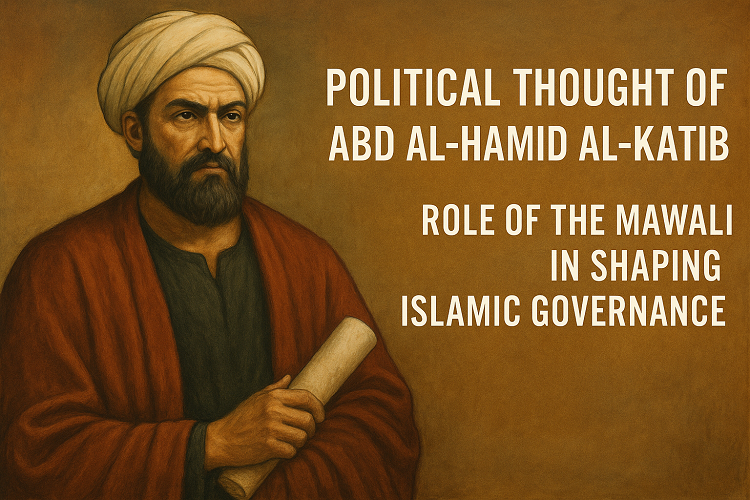
The political thought of Abd al-Hamid al-Katib marks one of the earliest developments of Islamic political rationalism and bureaucratic organization. Simultaneously, the role of the mawali in Islam—non-Arab converts integrated into Arab tribes—brought profound changes to the structure of Islamic governance.
This article analyzes how Abd al-Hamid al-Katib and the influence of the mawali shaped early Islamic political ideas.
The Mawali and Their Transformation of Islamic Political History
Definition and Social Status of the Mawali in Islam
In early Islam, mawali referred to non-Arab Muslims affiliated with Arab tribes. As Islamic conquests expanded, mawali entered the administrative and political structures of the caliphate.
As Ibn Khaldun notes in his Muqaddimah, the mawali’s intellectual capabilities and administrative expertise played a crucial role in organizing the Islamic state.
Cultural Influence of the Mawali on Islamic Governance
The role of the mawali in Islam extended beyond administrative tasks. They introduced sophisticated concepts such as bureaucratic organization, political rationality, and the pursuit of justice, primarily drawn from the Sasanian Iranian tradition, into Islamic political discourse.
Abd al-Hamid al-Katib: Pioneer of Rational Political Thought in Islam
Biography of Abd al-Hamid al-Katib
Abd al-Hamid ibn Yahya al-Katib, of Iranian descent, served as a high-ranking secretary under the Umayyad caliphate. Al-Tabari describes him as a highly skilled and eloquent bureaucrat who elevated the art of state correspondence to its zenith.
Abd al-Hamid’s Role within the Umayyad Political Structure
During the Umayyad caliphate’s political crises, Abd al-Hamid al-Katib played a central role in managing state affairs. He emphasized the critical importance of organized bureaucracy to preserve the caliphate’s authority.
Core Elements of Abd al-Hamid al-Katib’s
Political Thought of
Bureaucratic Order as the Heart of Abd al-Hamid’s Vision
The political thought of Abd al-Hamid al-Katib was rooted in the idea that governance without a structured bureaucracy was unsustainable. In one of his famous letters, he wrote:
“A kingdom without a bureaucracy is like a body without a heart.”
This view reflected the mawali’s inherited Iranian administrative traditions and their rational approach to governance.
The Political Thought of Abd al-Hamid al-Katib and
Rationalism
For Abd al-Hamid, politics without rationality was destined to collapse. Unlike the tribal traditions reliant on blood loyalty, he advocated for competence, efficiency, and political wisdom as the true bases of legitimate rule.
State Correspondence: A Tool of Power in Islamic Governance
Abd al-Hamid al-Katib saw formal correspondence as a fundamental tool of governance. Eloquence, clarity, and rhetorical mastery in official documents were vital for managing public opinion and securing the loyalty of administrators.
The Mawali’s Role in Developing Rational Politics in Islam
Bridging Iranian Tradition and Islamic Political Thought
The role of the mawali in Islam—especially within the political sphere—manifested in the transmission of Iranian rational bureaucratic practices into Islamic governance. Abd al-Hamid al-Katib embodied this synthesis.
As Patricia Crone discusses in Slaves on Horses, the mawali were crucial in building the administrative foundations of the Islamic empire.
Political Justice: A Mawali Legacy in Islamic Governance
Abd al-Hamid’s vision of political justice drew heavily on the long-standing Iranian tradition of justice-centered governance. This legacy would later become a core principle of the Abbasid caliphate.
Conclusion
The political thought of Abd al-Hamid al-Katib exemplifies the convergence of Iranian intellectual traditions with Islamic values in early governance models. Through, figures like Abd al-Hamid, the mawali elevated Islamic political structures from simple tribal frameworks to complex, rational, and justice-oriented systems.
Understanding the role of the mawali and studying Abd al-Hamid’s contributions are essential for appreciating the foundations of Islamic political evolution.