


Introduction
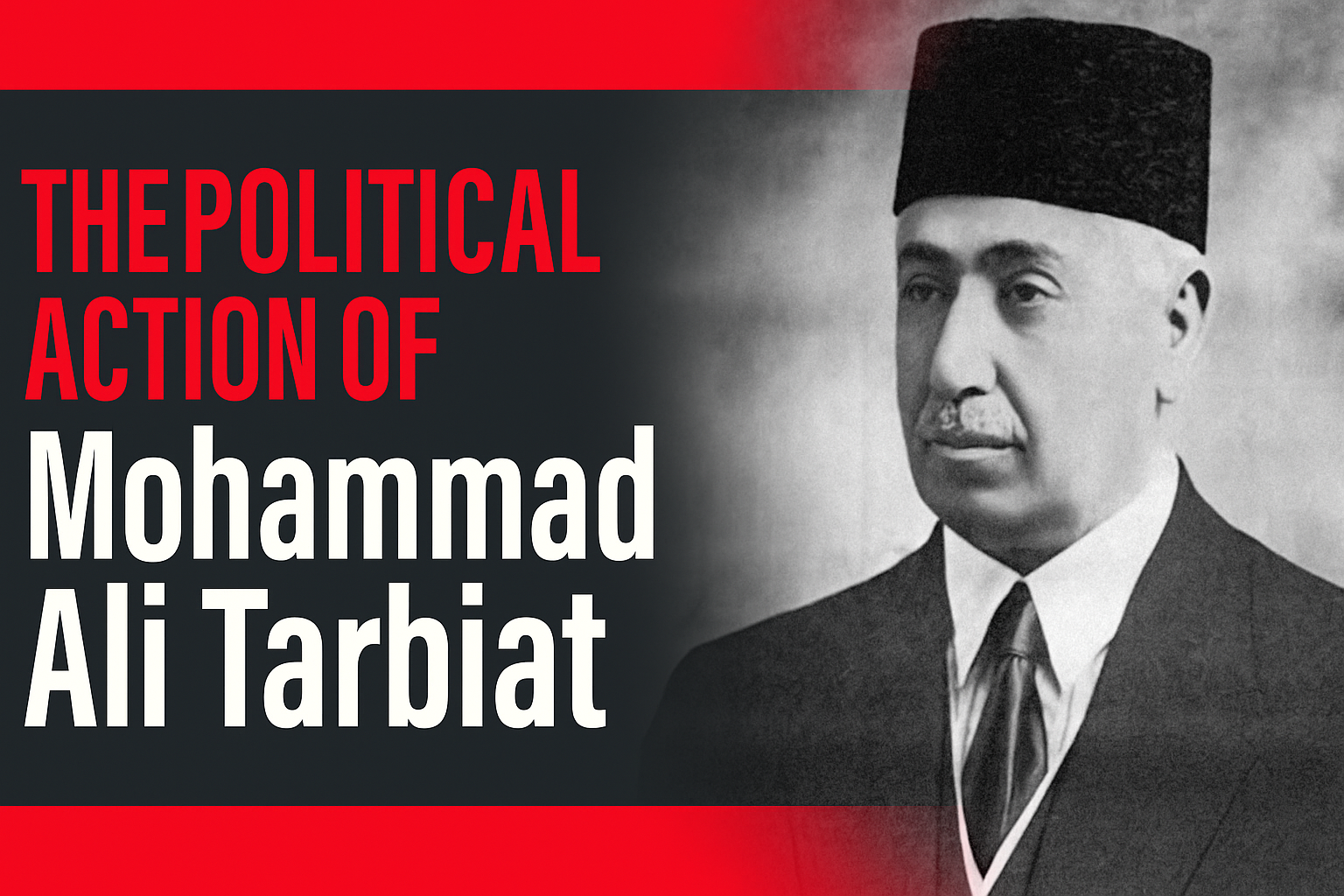
The political action of Mohammad Ali Tarbiat represents one of the most remarkable chapters in the history of Iranian intellectual and reformist movements in the early twentieth century. Tarbiat was not only a politician or a cultural figure but also an individual who bridged the gap between thought and action. Living through the turbulent period of the Constitutional Revolution, when Iran was struggling with despotism, foreign domination, and socio-economic crises, he chose a path that distinguished him from many of his contemporaries. Instead of turning exclusively to parliament, armed struggle, or confrontation with power, Tarbiat placed education, culture, and awareness at the center of his political struggle.
From the outset, Tarbiat believed that any sustainable transformation in Iranian society must be built on public awareness and the expansion of knowledge. As a result, he dedicated his life to cultural and educational reforms, seeing them as the foundation of genuine political progress. Newspapers, schools, libraries, and cultural associations became his main weapons, while his pen replaced the sword. In this way, the political action of Mohammad Ali Tarbiat was redefined as a form of cultural politics, making him a unique figure in modern Iranian history.
This article explores the different aspects of Tarbiat’s life and thought. It begins with his intellectual background, continues with a detailed examination of his political action, analyzes his political philosophy, and finally evaluates his place in the broader history of Iranian political thought. By doing so, it highlights how Tarbiat contributed to shaping a model of gradual reform in which culture and politics are deeply interconnected.
Life and Intellectual Background of Mohammad Ali Tarbiat
Understanding the political action of Mohammad Ali Tarbiat requires a look into his life and intellectual roots. Born in Tabriz in 1874, Tarbiat grew up in a city that was the beating heart of modern ideas in Iran. Tabriz, due to its proximity to the Caucasus and connections with Europe, had long been a center of intellectual exchange. Western-inspired ideas about liberty, law, and modernization circulated in the city, leaving a deep impression on Tarbiat during his formative years.
He began his education in traditional schools, studying classical subjects such as Arabic and Islamic sciences. However, his intellectual horizon soon expanded as he was exposed to modern sciences and foreign languages. Tarbiat acquired knowledge of European thought through translations and direct contact with intellectuals from the Caucasus. This dual exposure created a hybrid intellectual identity: rooted in Iranian-Islamic traditions while open to Western concepts of modernity.
Family background also played a significant role. Coming from an educated household, Tarbiat was encouraged to pursue learning and to value books as instruments of enlightenment. His lifelong passion for libraries and his eventual establishment of the National Library of Tabriz stemmed directly from this upbringing.
During his youth, the Constitutional Revolution of 1905–1911 erupted, profoundly shaping his worldview. In Tabriz, Tarbiat witnessed both the heroism of the revolutionaries and the violence of autocratic resistance. While many of his contemporaries turned to armed struggle, Tarbiat concluded that long-term change required something deeper: a cultural and educational awakening. This conviction guided the rest of his life.
Thus, Tarbiat’s intellectual formation shows that his emphasis on education and culture as tools of political change was not accidental. It was a conscious response to the challenges of his time and the realities of Iranian society.
Political Action of Mohammad Ali Tarbiat
The political action of Mohammad Ali Tarbiat manifested itself primarily in the cultural and educational spheres. He believed that political despotism thrived on public ignorance and that the first step toward freedom was to combat this ignorance. Consequently, his political activism revolved around journalism, education, and institution-building.
Journalism as a Political Tool
Tarbiat engaged in journalism as a form of political action. He edited and contributed to several newspapers, seeing them as vital platforms for raising awareness. His articles explained the meaning of liberty, criticized autocracy, and encouraged Iranians to demand constitutional rights. Unlike the complex rhetoric of some intellectuals, Tarbiat used a clear and accessible style so that ordinary readers could understand his message.
Censorship and restrictions often challenged his efforts, yet he persisted. For Tarbiat, the newspaper was not merely an organ of information; it was a battlefield where ideas clashed and public opinion was shaped. By using the press, he sought to create a politically conscious society capable of resisting tyranny.
Libraries and the Spread of Knowledge
One of Tarbiat’s most enduring contributions was his establishment of the National Library of Tabriz. For him, a library was more than a cultural institution; it was a political tool. By giving people access to books and modern knowledge, he sought to empower them against despotism. In Tarbiat’s view, books cultivated critical thinking, which in turn undermined authoritarian rule.
This effort reflected his broader philosophy: political action through education. By institutionalizing libraries, Tarbiat ensured that knowledge would reach beyond elites and become available to ordinary citizens. The library thus became a symbol of his reformist struggle.
Educational Initiatives
Alongside his library work, Tarbiat supported modern schools and teaching methods. He believed that Iran’s future depended on a new generation educated in science, rational thinking, and civic responsibility. His political action in education was not confined to establishing institutions; he also advocated reforms in curricula to include subjects that would prepare students for modern life.
By promoting education, Tarbiat targeted the structural roots of despotism. He argued that only a literate and informed population could demand its rights and protect the constitution from collapse.
Social Associations and Civil Participation
Tarbiat also engaged in cultural and political associations. These forums allowed intellectuals and citizens to discuss national issues freely and to cultivate habits of civic participation. Through such associations, Tarbiat fostered a political culture based on dialogue, cooperation, and gradual reform.
Thus, his political action was not confrontational in the violent sense but transformative in the cultural sense. His battlefield was the mind of society, and his weapons were books, newspapers, and schools.
Political Thought of Mohammad Ali Tarbiat
Tarbiat’s political thought was deeply tied to his reformist activities. He envisioned politics not as a struggle for power but as a process of cultivating enlightened citizens.
Liberty and Justice
Central to his political philosophy were liberty and justice. Tarbiat argued that no society could achieve progress without freedom of speech, a free press, and individual rights. However, he also emphasized justice as the foundation of liberty. For him, freedom without justice would only benefit the powerful, while justice without freedom would reduce citizens to passive subjects. The balance between the two was essential.
Education as Political Empowerment
Education occupied the heart of Tarbiat’s political thought. He regarded ignorance as the true enemy of Iranian society, even more dangerous than foreign domination or autocratic rulers. Education, in his view, was the ultimate political weapon. It produced rational citizens who could participate in governance and resist tyranny.
Religion and Politics
Unlike some secular intellectuals who dismissed religion altogether, Tarbiat adopted a nuanced approach. He saw value in the moral and ethical dimensions of religion but opposed its uncontrolled dominance over politics. He believed religion should inspire social ethics while remaining separate from direct political authority. This position reflected his pragmatic outlook: respecting cultural traditions while pushing for rational governance.
Gradual Reform
Tarbiat rejected both radical revolution and blind submission. His model was gradual reform—a step-by-step transformation achieved through education, awareness, and institution-building. This incrementalism was not a sign of weakness but a realistic assessment of Iran’s conditions. For Tarbiat, sudden revolutions risked producing chaos and new forms of tyranny, whereas cultural reform promised durable change.
Methods and Strategies of Political Action
The distinctiveness of the political action of Mohammad Ali Tarbiat lay in his methods.
- Journalism: He used newspapers as instruments of resistance and education, ensuring that his message reached wide audiences despite censorship.
- Libraries: By founding public libraries, he institutionalized access to knowledge, democratizing learning for all classes of society.
- Educational Reform: He promoted schools and modern curricula, ensuring that future generations would be better prepared for citizenship.
- Civil Associations: Through cultural and political associations, he created forums for dialogue and collective engagement.
- Non-violence: Above all, Tarbiat consistently avoided violence. He saw violent struggle as reproducing authoritarian patterns, while peaceful cultural reform offered a sustainable path.
These strategies made his political action unique in the Iranian context and underscored his belief in the transformative power of knowledge.
The Place of Mohammad Ali Tarbiat in Iranian Political Thought
Mohammad Ali Tarbiat occupies a special place in the intellectual history of Iran. While many constitutional-era activists focused on armed resistance or parliamentary debates, Tarbiat pioneered what might be called “cultural politics.” His emphasis on libraries, education, and awareness gave Iranian reformism a different dimension.
Comparisons with his contemporaries, such as Akhundzadeh and Malkam Khan, reveal that Tarbiat was less confrontational but more enduring in his influence. His legacy did not lie in temporary victories but in the long-term cultural infrastructure he established. The National Library of Tabriz and the tradition of civic associations in the city stand as monuments to his vision.
Later generations of Iranian intellectuals, especially during the Pahlavi era, were inspired by his example. Many reformists who emphasized education and cultural modernization considered themselves heirs to his approach.
Thus, Tarbiat should be remembered not only as a reformer of his time but also as a foundational thinker in Iran’s tradition of cultural politics.
Conclusion
The political action of Mohammad Ali Tarbiat reveals the power of culture and education in shaping political life. Instead of pursuing violent confrontation, Tarbiat chose the path of gradual reform through knowledge, libraries, schools, and journalism. His political thought emphasized liberty, justice, education, and moderate reform, positioning him as both a realist and a visionary.
His place in Iranian history demonstrates that political change need not always emerge from revolution; it can also arise from cultural transformation. The legacy of Mohammad Ali Tarbiat reminds us that the pen, the book, and the school can be just as powerful as the sword in the struggle for freedom.

