


Introduction: The Problem of Faith and Reason in Modern Politics
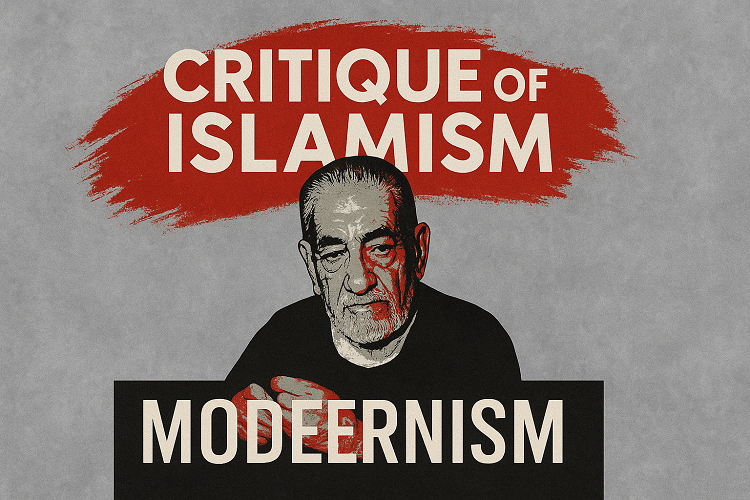
Omar al-Tilmisani, the third General Guide of the Muslim Brotherhood, has often been portrayed as the “moderate” face of political Islam. His leadership after the repression of the Nasser era marked a crucial attempt to restore the Brotherhood’s public legitimacy and to integrate Islamic activism into the political system of modern Egypt. However, despite his reputation for moderation, Omar al-Tilmisani represents a paradox that lies at the heart of Islamism itself: the impossible reconciliation between the divine order of faith and the human-centered rationality of modern politics.
The following analysis argues that even in its most reformist forms, Islamism cannot coexist with the core values of modernity—namely, human autonomy, secular law, and universal human rights. In fact, the project of al-Tilmisani reveals the structural limits of Islamic reformism, which seeks to modernize politics without secularizing it. This inherent contradiction explains why Islamism, despite its rhetorical adaptability, remains incompatible with the rational and pluralistic foundations of the modern political order.
The Historical Context: From Repression to Revival
The Post-Nasser Era and the Return of the Muslim Brotherhood
After years of brutal suppression under Gamal Abdel Nasser, the Muslim Brotherhood re-emerged during the presidency of Anwar al-Sadat. The regime’s political liberalization and alliance with religious forces allowed figures like Omar al-Tilmisani to rebuild the organization’s structure and moral image. Al-Tilmisani promoted a discourse of legalism and peaceful participation, presenting the Brotherhood as a social movement rather than a revolutionary force.
However, this strategic adaptation did not signify a departure from the ideological foundations of Islamism. On the contrary, it demonstrated the movement’s capacity to reframe its traditional goals in a modern vocabulary while preserving the central belief that sovereignty belongs to God (ḥākimiyya). Thus, the “moderation” of al-Tilmisani was not a rejection of theocratic politics but rather its tactical refinement.
Islamism and the Modern Political System
Al-Tilmisani sought to navigate the emerging Egyptian political system, which was gradually opening space for limited pluralism. He encouraged participation in unions, professional associations, and parliamentary politics. Nevertheless, his concept of political engagement remained anchored in religious legitimacy. Politics was not an autonomous human domain but a field subordinate to divine law.
In this sense, the reformist discourse of al-Tilmisani served as a bridge between the old Islamist ideal and the institutional frameworks of the modern nation-state—a bridge built on unstable philosophical ground.
The Concept of Rationality in al-Tilmisani’s Thought
Religious Reason versus Modern Reason
One of the most revealing aspects of Omar al-Tilmisani’s intellectual legacy is his conception of reason. For him, reason is a servant of revelation, not an independent source of moral or legal authority. Rational inquiry is acceptable only insofar as it confirms the truth of divine revelation and assists in understanding it. This definition of reason fundamentally differs from the modern concept of rationality, which assumes human autonomy and the capacity of individuals to establish laws and norms independently of metaphysical authority.
Consequently, al-Tilmisani’s appeal to reason and dialogue must be understood within a limited epistemological framework: it is a religious rationality, not a political rationality. It does not challenge the supremacy of revelation but reinforces it. This is precisely where the ideological boundaries of Islamic reformism become visible.
The Philosophical Impasse of Islamic Reformism
In modern political philosophy, rationality implies self-legislation—the idea that human beings are the source of their own norms. This principle underlies concepts such as constitutionalism, the rule of law, and human rights. Yet in al-Tilmisani’s worldview, human reason remains subordinate to divine command. The divine text precedes and limits all political deliberation. As a result, the attempt to modernize Islamism without secularization leads to an internal contradiction: a rationalized form of the irrational.
Omar al-Tilmisani and Sayyid Qutb: Two Faces of the Same Ideology
The Illusion of Opposition
In public perception, Omar al-Tilmisani is often contrasted with Sayyid Qutb—the radical ideologue whose writings inspired waves of Islamist militancy. Al-Tilmisani, by contrast, called for patience, gradual reform, and social activism. Yet, beneath this apparent opposition lies a shared metaphysical foundation. Both thinkers reject the autonomy of politics and insist on the subordination of human law to divine sovereignty. Their disagreement concerns the method of transformation, not its goal.
Al-Tilmisani believed that an Islamic state could be achieved through moral education and democratic participation; Qutb saw revolution and struggle as necessary. Nevertheless, both assumed that legitimate authority derives only from God’s law. In both frameworks, the notion of secular political legitimacy—based on human consent and reason—remains inconceivable.
From Radicalism to “Soft Theocracy”
It would be a mistake to view al-Tilmisani as a liberal democrat. His vision of pluralism was instrumental: tolerance was acceptable as long as it did not challenge the supremacy of Islam. He opposed violence, but not the ideological claim that Islam provides a total and final political order. Thus, his reformism represents a soft theocracy—a moderated, but not transformed, version of the Islamist project.
By replacing revolution with gradualism, al-Tilmisani gave Islamism a modern appearance without altering its pre-modern essence.
The Structural Limits of Political Islam
Human Rights and the Limits of Theological Sovereignty
Despite his emphasis on civic engagement, al-Tilmisani’s discourse could not accommodate the universality of human rights. In his writings, rights and freedoms are meaningful only within the framework of divine law. The notion of individual autonomy, the cornerstone of modern humanism, remains alien to his thought. Freedom is interpreted as obedience to God, not as self-determination. This conceptual reversal explains why Islamist reformism fails to produce a consistent theory of citizenship and equality.
The deeper problem lies in the theological foundation of political Islam itself. When sovereignty is attributed to God, the human subject loses its status as the ultimate source of normativity. Consequently, no genuine human rights—understood as inalienable and pre-political—can exist. They are always conditional, contingent upon divine approval.
Politics and the Sacred: The Risk of Absolutism
The fusion of politics and the sacred carries an inherent risk of absolutism. When political authority is sanctified, it becomes immune to critique and accountability. Even when expressed in moderate terms, this fusion undermines the pluralistic structure of modern governance. History has repeatedly shown—whether in Iran after 1979 or Egypt after 2012—that religious politics tends to reproduce authoritarian forms, regardless of initial intentions.
Al-Tilmisani’s project, though peaceful, was not immune to this dynamic. By grounding political legitimacy in divine law, he inadvertently perpetuated the very logic of domination he sought to soften.
The Failure of Reconciliation: Islamism and Modernity
The Theological Resistance to Secularization
Islamism emerged in the twentieth century as a response to colonial domination and cultural dislocation. Yet its intellectual premise—the aspiration to restore divine sovereignty—makes it resistant to the epistemological shift that defines modernity: the secularization of knowledge and power. Al-Tilmisani’s reformism represents an attempt to adapt Islamism to modern institutions without undergoing this transformation. The result is a hybrid discourse that borrows the language of democracy while rejecting its philosophical foundation.
From Reformism to Post-Islamism
Scholars such as Asef Bayat and Olivier Roy have described the contemporary decline of Islamism as a move toward “post-Islamism”—a pragmatic disengagement from the utopian dream of an Islamic state. In this light, al-Tilmisani appears as a transitional figure: the last representative of an era when Islamism could still present itself as a viable political project. His failure to resolve the contradiction between divine command and human autonomy illustrates why Islamism, as an ideology, cannot be reformed from within.
Conclusion: The Dead End of Religious Politics
Omar al-Tilmisani’s legacy encapsulates the enduring paradox of modern Islamism. His reformism softened the tone of Islamist discourse, yet it did not alter its metaphysical foundation. By insisting on the primacy of divine law, al-Tilmisani perpetuated the subordination of human reason to revelation. As a result, his project could not sustain the principles of secular governance, pluralism, or universal human rights.
The crisis of rationality in Islamism, therefore, is not the result of misinterpretation or extremism; it is inscribed in the very logic of the ideology. Whether through the radicalism of Sayyid Qutb or the moderation of al-Tilmisani, the outcome remains the same: a refusal to grant autonomy to human reason and a resistance to the secularization of political life.
In the final analysis, Islamism’s attempt to merge faith and politics leads not to moral renewal but to the re-sacralization of power—a process that ultimately erodes both religion and democracy.

