


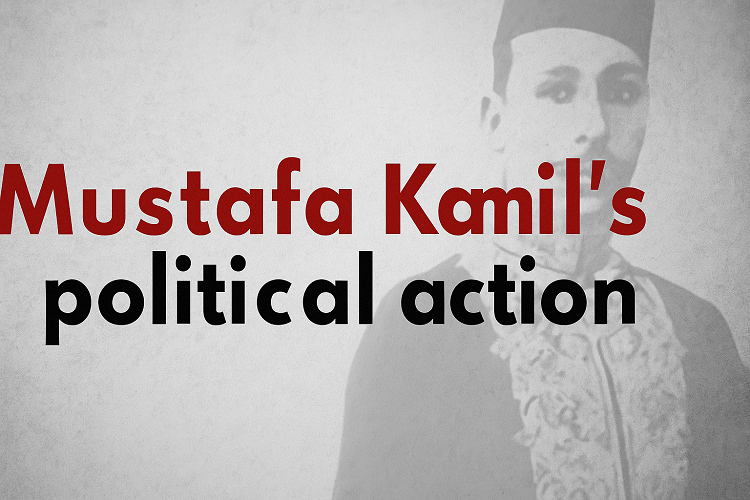
Mustafa Kamil’s political action represents a turning point in the history of modern Egypt and the Arab world. At the dawn of the twentieth century, Egypt was under British occupation, and the issue of independence defined national debate. Kamil emerged not as a detached theorist but as a committed activist: a journalist, party organizer, and international campaigner who translated nationalist ideals into practical action. His life was brief—he died in 1908 at only 34—but his political activity shaped the trajectory of Egyptian nationalism for decades. This article examines the scope of Mustafa Kamil’s political action, its historical context, the principles guiding it, its achievements and shortcomings, and its long-term legacy.
Historical Background: Egypt Under Occupation
The British Presence
Following the 1882 occupation, Britain controlled Egypt’s administration and economy, reducing the Khedive’s authority to a façade. The Suez Canal made Egypt strategically indispensable, and national sovereignty was increasingly undermined.
Growth of Nationalism
In this environment, nationalist currents gained strength. Intellectuals and professionals called for independence, while newspapers and student associations became hubs of resistance. Within this ferment, Mustafa Kamil’s political action took shape as one of the clearest voices of opposition.
Early Life and Education
Childhood and Studies
Mustafa Kamil was born in Cairo in 1874. He studied law in Egypt, showing early interest in politics and literature.
Years in France
His studies in Paris exposed him to European political thought, particularly republican ideals of liberty and civic duty. These influences sharpened his sense of the contradictions of colonialism and prepared him to return to Egypt as an activist.
First Steps in Politics
On his return, Kamil embraced journalism and public speaking as his main instruments. From the beginning, his focus was on direct political action to end British rule.
Forms of Mustafa Kamil’s Political Action
Journalism and al-Liwa’
A central component of Mustafa Kamil’s political action was journalism. In 1900, he launched al-Liwa’ (“The Standard”), a nationalist newspaper that sharply criticized colonial policies and encouraged Egyptians to see themselves as part of a united nation.
Founding the Watani Party
In 1907, Kamil created the Watani Party to channel nationalist sentiment into organized politics. The party demanded full independence, promoted education, and worked to mobilize public opinion.
International Engagement
Kamil also took his campaign abroad. He traveled to Europe to publicize Egypt’s cause, meeting politicians and journalists. While these efforts yielded limited diplomatic results, they succeeded in raising global awareness of the Egyptian question.
Principles Guiding Political Action
Egyptian Nationalism
National identity was at the heart of his activism. Kamil stressed Egypt’s unique history and culture, urging citizens to rally around a distinctly Egyptian nationalism.
Independence as a Goal
For Kamil, nothing less than full independence was acceptable. He opposed gradual reforms or compromises under colonial control.
Education and Awareness
He linked political action to education, believing that only an enlightened population could sustain independence. Schools and newspapers were, in his view, essential tools for national revival.
Social Concerns
Kamil also emphasized fairness and justice. While not a radical socialist, he tied the struggle for independence to improving conditions for the broader population.
Solidarity with the Islamic World
Although his message was primarily Egyptian, Kamil saw value in cooperation with other Muslim societies against imperialism. However, this dimension remained mostly rhetorical.
Achievements and Legacy of Political Action
Inspiration for the 1919 Revolution
Kamil’s activism laid the groundwork for later movements, most notably the 1919 Revolution led by Saad Zaghlul. His insistence on independence and popular mobilization resonated long after his death.
Defining Egyptian National Identity
His writings helped solidify the idea of an Egyptian national identity distinct from both Ottoman authority and European colonialism.
Broader Arab Impact
Beyond Egypt, his example inspired nationalists in Syria, Iraq, and North Africa, making his influence part of a wider anti-colonial current.
Cultural Contribution
By using journalism as a weapon, he helped establish the press as a powerful political institution in Egypt. His articles remain important historical documents.
Criticism of Mustafa Kamil’s Political Action
Limited Mass Base
Kamil primarily mobilized urban elites and educated youth. His political action rarely penetrated deeply into rural communities, which limited its breadth.
Reliance on Foreign Support
Critics argue that by appealing to European governments, Kamil contradicted his own nationalist message. Depending on outside sympathy was a structural weakness of his strategy.
Unfinished Projects
His death at 34 left many initiatives incomplete. The Watani Party was too young to mature, and its educational programs were still embryonic.
Lack of Concrete Programs
Though he advocated social justice and education, Kamil rarely provided detailed plans for their realization. Much of his action remained inspirational rather than programmatic.
Comparative Perspective
With Saad Zaghlul
Zaghlul expanded the nationalist base by mobilizing peasants and workers in the 1919 Revolution. Compared to Kamil, his political action was more inclusive and mass-oriented.
With Gamal Abdel Nasser
Decades later, Nasser transformed nationalism into a state-led project, emphasizing economic reform and Arab unity. While on a different scale, many of Nasser’s themes—sovereignty, independence, resistance—echoed Kamil’s earlier political action.
Why His Political Action Still Matters
Kamil’s career highlights the role of activism, journalism, and education in anti-colonial movements. It shows both the power and the limits of political action under foreign domination. His experience remains relevant for understanding how national identity is forged under conditions of struggle.
Conclusion
Mustafa Kamil’s political action stands as a landmark in Egypt’s modern history. Through newspapers, party organization, and international campaigning, he translated nationalist ideals into concrete initiatives. His contributions lay in defining Egyptian nationalism, inspiring subsequent revolutions, and embedding the demand for independence into public discourse. Yet his activism was constrained by its elite base, reliance on foreign sympathy, and his premature death.
Ultimately, Kamil’s importance lies not in immediate victories but in laying the foundations of Egyptian political activism. His example illustrates how sustained action, even when incomplete, can shape the course of a nation’s history.

