


Introduction
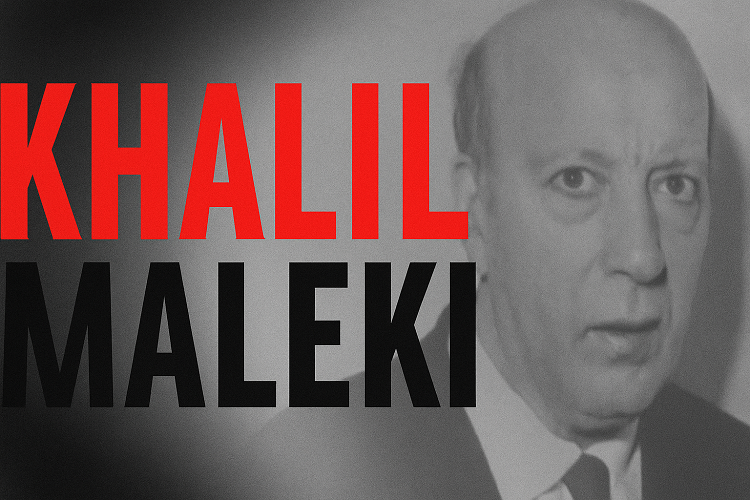
Khalil Maleki, one of the most prominent figures in the intellectual and political history of modern Iran, is widely recognized as a nationalist intellectual and an independent socialist. During the first half of the twentieth century—when Iran was undergoing rapid political, social, and cultural transformations—Maleki managed to establish a distinctive position in Iranian political thought through his critical reasoning and his unique perspective, which differed from both the dominant leftist and right-wing ideologies. The political thought of Khalil Maleki and his life serve as a rare example, for political scientists, sociologists, and those interested in modern Iranian history, of an effort to synthesize the ideals of social justice with intellectual independence and genuine nationalism.
Maleki is often referred to as the founder of “Independent Iranian Socialism”—a doctrine that was neither aligned with the Soviet Union nor bound within the framework of Western capitalism. He sought an indigenous path toward development and social justice in Iran, which led him to break away from the Tudeh Party and later establish the “Toilers Party of the Iranian Nation.” This intellectual stance made Khalil Maleki one of the earliest theorists of political and intellectual independence during the Pahlavi era.
The importance of studying the political thought of Khalil Maleki and his life is not confined to the past. Many of the fundamental questions he raised between the 1940s and the 1960s—such as the relationship between freedom and justice, national independence and social equality, and the role of intellectuals in relation to power—remain deeply relevant to Iranian society today. Thus, revisiting Maleki’s life and ideas is not merely a historical exercise but a continuous dialogue with Iran’s present and future.
This article offers an analytical and documented exploration of Khalil Maleki’s life, political activities, intellectual ideas, and legacy in order to present a comprehensive picture of one of the most influential Iranian intellectuals of the twentieth century.
-
Life and Early Years of Khalil Maleki: From Tabriz to Tehran
Khalil Maleki was born in 1901 (1280 in the Iranian calendar) in Tabriz, one of the major centers of intellectual and political transformation during the Constitutional Revolution. His birth in a city that had long been a cradle of the movements for freedom and social justice undoubtedly had a profound influence on the formation of his social and political outlook. Maleki’s family belonged to the educated middle class, which provided him with an environment conducive to engagement with intellectual, social, and political discussions from an early age.
In his youth, Maleki pursued studies in natural sciences at the Dar ul-Moallemin (Teachers’ College) in Tehran and later worked as a chemistry teacher. Yet, his interest in social and political issues gradually surpassed the boundaries of formal education. During this period, socialist and social-justice-oriented ideas were spreading among educated Iranian youth, and Maleki, through his study of European thinkers such as Marx, Engels, and the German democratic socialists, became familiar with the intellectual foundations of socialism.
In the early 1920s—when Iran’s political atmosphere was tightly controlled under Reza Shah’s authoritarian regime—Maleki was among those intellectuals who, although refraining from open political activity, participated in cultural and intellectual circles discussing and critiquing social issues. He believed that genuine societal progress could only be achieved through the growth of public awareness and cultural development, not merely by political decrees or top-down reforms. This critical view toward the concentration of power would remain a consistent feature of his political stance throughout his life.
After the abdication of Reza Shah in 1941 and the subsequent political liberalization, Maleki began his public political activity. Together with a group of intellectuals, writers, and university graduates, he joined the newly founded Tudeh Party of Iran. His entry into the party was not driven by ambition or a thirst for power, but by a sincere belief in the necessity of achieving social justice in Iran. However, he soon realized that the Tudeh Party, in practice, was more an instrument of Soviet policy than a genuine representative of Iranian workers and the toiling masses. This realization led to the first major ideological rupture in Maleki’s life—the separation from a movement he had once viewed as the embodiment of justice.
During this period, Maleki gradually emerged as one of the Tudeh Party’s most prominent theoreticians and intellectuals. Yet, his spirit of independence was fundamentally incompatible with Moscow’s dictates. Maleki believed that socialism in Iran must be constructed based on the nation’s own historical and cultural context rather than imposed foreign models. This belief—later crystallized in the concept of “Independent Iranian Socialism”—became the central core of his political and intellectual endeavors in the following years.
Maleki’s early life and initial political activities reflect both his engagement with global movements for social justice and his persistent effort to find an independent, indigenous path within Iranian society. He was neither a hasty revolutionary nor a cautious conservative; rather, he was an intellectual who sought to institutionalize justice and freedom in Iran through science, logic, and dialogue.
-
Khalil Maleki’s Separation from the Tudeh Party and the Formation of Independent Iranian Socialism
In modern Iranian history, few political ruptures have been as influential and controversial as Khalil Maleki’s departure from the Tudeh Party of Iran. In the early 1940s, Maleki was one of the party’s most prominent activists and played a key role in shaping its cultural and social programs. However, over time, deep ideological differences emerged between him and the party leadership concerning Iran’s political and intellectual independence. These disagreements not only led to his separation from the party but also gave birth to one of the most important intellectual movements of twentieth-century Iran: Independent Iranian Socialism.
2.1. Intellectual and Political Foundations of the Separation
From the very beginning, Khalil Maleki viewed social and political issues through a critical lens. He believed that no doctrine or ideology could be successfully implemented in a country like Iran unless it was adapted to local conditions. Therefore, when he observed that the Tudeh Party aligned its policies entirely with those of the Soviet Union and lacked true intellectual independence, he began to voice his criticisms.
In his writings and speeches, Maleki repeatedly emphasized that intellectual and political dependence on foreign powers—even under the banner of socialist solidarity—was fundamentally incompatible with the ideals of justice and freedom. In his view, justice without national independence was nothing more than an illusion. This conviction ultimately led Maleki, in 1947 (1326 in the Iranian calendar), to formally break away from the Tudeh Party.
2.2. Founding the “Third Force” and Redefining Iranian Socialism
Following his departure, Maleki, together with a group of independent intellectuals and activists, founded the movement known as the “Third Force” (Niruye Sevvom). The name symbolized his desire to create an alternative path distinct from the two dominant poles of global politics at the time: the Soviet Union and the West. The Third Force was neither an advocate of Western capitalism nor a follower of Soviet state socialism; rather, it sought to establish a socialism rooted in independence, freedom, and social justice—grounded in Iran’s own culture and history.
During this period, Maleki developed the theoretical foundations of Independent Iranian Socialism. In his writings, he explained that for socialism to succeed in Iran, it had to be compatible with the country’s traditions, beliefs, and social realities. According to him, the Iranian people had an inherent belief in social justice, but they could not accept totalitarian or dictatorial systems—even those calling themselves “workers’ states.” Therefore, the ideal socialism had to be popular, democratic, and national.
2.3. Critique of Dependence and Defense of Intellectual Independence
A defining feature of The political thought of Khalil Maleki was his candid critique of all forms of political dependency. At a time when most Iranian intellectuals were divided between the two ideological camps of East and West, Maleki firmly upheld the principle of intellectual independence. In his writings, he repeatedly reminded readers that Iranian intellectuals must “rely on the power of national reason” and avoid blind imitation of foreign models. This perspective was both innovative and unconventional in his time, and it later influenced subsequent generations of Iranian thinkers.
Despite his departure from the Tudeh Party, Maleki never abandoned the ideals of justice and equality. He believed that social justice could only be sustained when combined with political freedom and national independence. This triad—freedom, justice, and independence—formed the core of all his writings and political activities.
Maleki’s separation from the Tudeh Party was not an endpoint but rather the beginning of a new phase in the evolution of Iranian political thought. With intellectual courage, he proposed an indigenous model of socialism that continues to inspire debates among Iranian intellectuals to this day. The concept of Independent Iranian Socialism represented, in essence, an attempt to answer a fundamental question: How can a society be both just and free without losing its national and cultural independence?
-
Khalil Maleki and the Nationalization of the Oil Movement: Cooperation and Tensions with Dr. Mossadegh
The period of the oil nationalization movement marks one of the most illustrious chapters in Iran’s modern history, and Khalil Maleki occupies a unique position among the intellectuals and political figures of that era. After his separation from the Tudeh Party and the establishment of the Third Force, Maleki followed Iran’s political developments with both attention and hope. He was among the first to support the leadership of Dr. Mohammad Mossadegh in his struggle for Iran’s political and economic independence and joined the nationalization movement. Nevertheless, while Maleki and Mossadegh shared mutual respect, their collaboration was not without challenges—stemming from fundamental differences in their theoretical approaches to politics.
3.1. Maleki’s Support for the Nationalization of Oil
At the outset of the oil nationalization movement in the early 1950s, Khalil Maleki and his colleagues in the Third Force were among its most active supporters. For Maleki, the nationalization of oil was not merely an economic reform but a decisive step toward achieving genuine independence for Iran. In his articles, he emphasized that economic colonialism could not exist without political domination, and thus the struggle against the British oil company was, in essence, a fight to reclaim the Iranian people’s national dignity.
Maleki believed that the oil nationalization movement needed to be accompanied by a social and justice-oriented program so that it would not remain confined to a purely political act. In his view, economic independence could not be sustained without social and cultural reforms. Consequently, even as he supported Mossadegh, Maleki persistently advocated for structural reforms in Iran’s educational, administrative, and economic systems.
3.2. Differences with Mossadegh and the National Government
Despite sharing the overarching goal of securing Iran’s independence, Maleki disagreed with certain aspects of Dr. Mossadegh’s leadership. He believed that Mossadegh’s government needed to rely more strongly on the organization of popular forces and civil institutions in order to solidify the foundations of the nationalization movement among different social classes. In his writings, Maleki warned that if the movement remained overly centered on individual leadership and lacked a broad social base, it would become vulnerable to both internal and external pressures.
Maleki also warned against the ambiguous behavior of the Tudeh Party toward Mossadegh’s government, criticizing its inconsistency—supporting Mossadegh at times and undermining him at others. He argued that the party’s actions ultimately served Soviet interests rather than those of the Iranian nation. This critical stance further elevated Maleki’s reputation among nationalist and independent intellectual circles.
3.3. The Coup of August 19, 1953, and Maleki’s Response
The events of August 19, 1953 (28 Mordad 1332)—which led to the overthrow of Mossadegh’s government—marked a turning point in Khalil Maleki’s political life. He openly condemned the coup and, in his articles, described it as “the return of reaction and colonialism.” Yet, unlike many political figures who succumbed to despair or withdrew from public life, Maleki chose to continue his intellectual and political struggle. He believed that the defeat of the nationalization movement should not signify the end of the fight for freedom and justice but rather an opportunity to reevaluate future strategies and methods of struggle.
After the coup, Maleki and his colleagues in the Third Force reorganized their movement and sought ways to carry forward Mossadegh’s national and social ideals. It was during these years that Maleki increasingly emphasized the concept of intellectual and social independence, writing:
“If a nation is not independent in thought, its political independence will not endure.”
This statement encapsulates Maleki’s worldview: the nationalization of oil was not merely a political battle but a vital stage in the long journey toward the intellectual and cultural independence of the Iranian nation.
-
Khalil Maleki After the Coup: Perseverance, Thought, and Political Legacy
The coup d’état of August 19, 1953 (28 Mordad 1332) not only brought an abrupt end to the nationalization movement but also pushed many of Iran’s political and intellectual forces to the margins. Amid this climate of repression, Khalil Maleki stood out as one of the few intellectuals who, despite severe political and security pressures, refused to abandon his critical reflections on Iran’s situation. Following the coup, Maleki was briefly imprisoned, but upon his release, he resumed his activities through the Toilers Party of the Iranian Nation (the political branch of the Third Force). Although the political environment had become more restrictive, Maleki continued, through his writings and discussions, to seek a rational balance between idealism and realism.
4.1. Perseverance Amid Isolation and Political Repression
In the years following the coup, many intellectuals either emigrated or withdrew entirely from political life. Maleki, however, chose to remain in Iran despite the limitations and continued to communicate his message through intellectual and social engagement. He believed that real transformation in Iranian society could only emerge from within, through the growth of popular awareness—not through sudden revolutions or the intervention of foreign powers.
During this period, Maleki gradually distanced himself from formal party politics and concentrated on analyzing Iran’s social and cultural conditions. As a prolific writer, he published numerous essays criticizing despotism, public distrust, and the intellectual dependency of Iranian thinkers on imported ideologies. In his view, one of the greatest weaknesses of Iranian society was the lack of national self-awareness—the inability to think in accordance with indigenous needs and realities.
4-2. Khalil Maleki’s Political Thought: Independence, Justice, and Social Rationality
If we were to summarize Khalil Maleki’s political thought in a few key concepts, three fundamental pillars stand out:
A. Intellectual and political independence
B. Social justice rooted in freedom
C. Rational and gradual reformism
A. Intellectual and Political Independence
Maleki viewed independence not merely as a political condition, but as a deeper cultural and intellectual one. He argued that as long as Iranian society remained intellectually and culturally dependent, no form of political independence could be stable or meaningful. From this perspective, he was among the first Iranian theorists to articulate the concept of intellectual independence for Iranian thinkers in the face of imported ideologies.
In his criticism of both the Soviet-aligned left and the Western-oriented right, he described both as followers rather than thinkers, believing that Iran must discover its own path based on its historical experiences and cultural realities. For Maleki, genuine independence meant the ability to think, decide, and act in accordance with the nation’s own social and historical context.
B. Social Justice in Connection with Freedom
Unlike many socialists of his era, Khalil Maleki believed that justice cannot exist without freedom. He maintained that any form of socialism that leads to dictatorship or the suppression of dissent loses its moral foundation. For this reason, Maleki advocated a model of democratic socialism in which citizens would enjoy not only economic rights but also freedom of thought, expression, and choice.
From his point of view, true justice could only be achieved when every individual played an active role in determining their social destiny. In this vision, freedom and justice are inseparable: removing one renders the other meaningless.
C. Rational and Gradual Reformism
A central feature of Maleki’s thought was his emphasis on gradual, rational reform grounded in social reality. He opposed any form of hasty or violent revolution, arguing that Iran’s progress toward political and social development required cultural growth, public education, and the gradual cultivation of civic participation.
For this reason, Maleki was recognized among his contemporaries as a moderate and rational intellectual. He believed that lasting change would only occur when the people themselves reached a level of awareness that made them seek reform voluntarily, rather than having transformation imposed from above or from outside.
In this sense, Maleki’s reformism represented both a moral and intellectual stance: a belief that meaningful progress arises through understanding, education, and collective maturity—not through coercion or upheaval.
4.3. Khalil Maleki and Later Generations of Iranian Intellectuals
Khalil Maleki’s ideas profoundly influenced many intellectuals and political figures of subsequent generations. Thinkers such as Ali Shariati, Jalal Al-e Ahmad, and even Mehdi Bazargan, in various ways, reflected his impact in their works and speeches. The concept of “returning to one’s self,” which later became popular in Iranian intellectual discourse, was essentially a continuation of the idea of intellectual independence that Maleki had articulated decades earlier.
Maleki believed that Iranian intellectuals must strike an intelligent balance between tradition and modernity, between justice and freedom, and between reality and idealism. He was neither a traditionalist nor a Westernized thinker; rather, he sought a synthesis between global experience and Iran’s indigenous needs. This intellectual position would later come to be known as “indigenous intellectualism” or “nationalist socialism.”
4.5. The End of His Life and the Continuity of His Ideas
Khalil Maleki passed away in 1969 (1348 in the Iranian calendar), weakened by illness and withdrawn from formal political life. Yet, his ideas lived on. Even his ideological opponents acknowledged his honesty, moderation, and intellectual independence.
Today, Maleki’s intellectual legacy continues to resonate—particularly in discussions surrounding reformism, civil society, and the intellectual independence of Iranian thinkers. His enduring influence lies in his unwavering effort to combine freedom, justice, and independence into a coherent vision for Iran’s future—one rooted in reason, integrity, and faith in the transformative power of the people.
-
The Intellectual Legacy of Khalil Maleki in Contemporary Iran: The Intellectual Between Idealism and Reality
More than half a century after his death, the name of Khalil Maleki remains alive and influential in Iran’s intellectual and political discourse. His significance lies not only in his political activities but, more importantly, in his distinctive way of thinking about the problems of Iranian society. Maleki was one of the rare intellectuals who managed to maintain a delicate balance between idealism and realism, between freedom and justice, and between indigenous identity and global perspective. This intellectual equilibrium has ensured that his ideas continue to occupy an important place in Iranian thought today.
5.1. Khalil Maleki: An Intellectual Between Two Worlds
Khalil Maleki lived in an era when Iran found itself caught between two powerful global forces—the Soviet communist bloc and Western capitalism. Taking an independent stance in such a polarized environment was no easy task. Yet Maleki, with his characteristic intellectual courage, chose a third path and articulated the concept of Independent Iranian Socialism—a vision aligned with neither the Eastern bloc nor the Western camp.
Drawing upon Iran’s historical experience and his deep understanding of the country’s social structure, Maleki sought to integrate social justice and development with cultural identity and political independence. For this reason, he can rightly be regarded as one of the first theorists of indigenous, justice-oriented development in modern Iran.
5.2. The Continuity the Political Thought of Khalil Maleki in Contemporary Iranian Intellectual Discourse
After the 1960s, many Iranian thinkers—from nationalist to reformist movements—were directly or indirectly influenced by the Political Thought of Khalil Maleki. His emphasis on gradual reformism, his critique of intellectual and political dependency, and his defense of freedom alongside justice formed the intellectual foundation of numerous civil movements that emerged in Iran after the revolution.
In recent decades, Maleki’s writings and ideas have once again attracted scholarly attention, particularly in discussions concerning civil society, political development, and cultural independence. Many scholars describe him as the embodiment of a “responsible intellectual”—one who neither sought power nor fame, but whose main concern was the advancement of social awareness and the genuine progress of Iranian society.
5.3. The Relevance of the Political Thought of Khalil Maleki to Contemporary Iran
Looking at Iran’s present condition, one realizes that the fundamental questions Maleki raised remain as urgent as ever:
- How can a balance be achieved between social justice and political freedom?
- Is development possible without intellectual independence?
- How can genuine reform be attained without falling into the traps of violence or dependency?
The answers Maleki offered in the mid-twentieth century continue to inspire reflection today. He demonstrated that rational reformism, grounded in education, awareness, and the growth of civic institutions, is the only sustainable path to change. In essence, Maleki represented a generation of intellectuals who believed that social transformation arises not from sudden revolutions but through the gradual moral and political cultivation of the people.
5.4. The Ethical and Intellectual Legacy of Khalil Maleki
One of the most enduring aspects of Khalil Maleki’s life was his unwavering honesty and moral integrity. Throughout his political career, he neither accumulated wealth nor sought personal power. He stood as an example of an intellectual who lived according to his convictions and maintained consistency between thought and action. In an era when many politicians and intellectuals succumbed to opportunism or foreign dependence, Maleki courageously upheld his intellectual independence and humanistic principles.
From this perspective, his legacy is not limited to the realm of political thought—it extends into the sphere of intellectual ethics.
Final Conclusion
Revisiting the life and the political thought of Khalil Maleki is, in fact, a reexamination of one of the most significant chapters in the history of Iranian intellectual life. He was an intellectual who strove to find a middle way between East and West, between justice and freedom, and between tradition and modernity. The Independent Iranian Socialism that he envisioned was not a rigid ideology but an ongoing intellectual effort to understand Iran’s complexities and to chart a homegrown path toward progress.
Today, as Iran continues to grapple with questions of justice, development, freedom, and identity, Khalil Maleki’s ideas are perhaps more relevant than ever. His voice—rooted in reason, independence, and moral responsibility—remains a guiding light for those seeking a just and free future for Iran.

