


Introduction
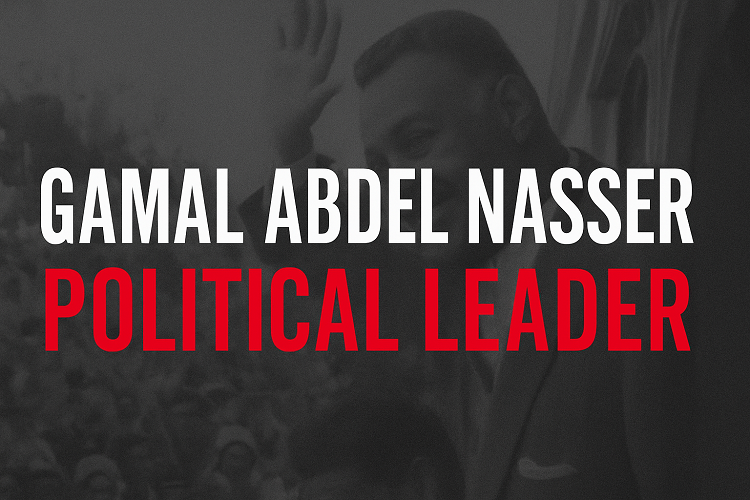
Gamal Abdel Nasser political leader, one of the most prominent politicians of the twentieth century, is a figure whose name is inseparably tied to the major transformations of the Arab world and the Middle East. From Egypt’s 1952 Revolution to the nationalization of the Suez Canal and the emergence of the Non-Aligned Movement, Nasser became a symbol of independence, social justice, and resistance against colonialism — not only in his own country but across the entire Third World.
However, in assessing his historical position, a fundamental question always arises: Should Gamal Abdel Nasser political leader be regarded as a political thinker who offered a coherent theory of the Arab world, or as a revolutionary activist striving to transform the existing order? Or perhaps, above all, was he a pragmatic politician who placed ideas in the service of power?
Answering this question requires examining the course of his life, words, and actions. Nasser emerged in a period when the Arab world was overshadowed by colonial domination, economic backwardness, and the rule of Western-aligned elites. From within the military, he rose to prominence by invoking Arab nationalism and faith in social justice, rallying vast sections of the population behind him. Yet, on the practical stage of politics, he faced severe trials — from the triumph of nationalizing the Suez Canal to the bitter defeat in the 1967 war. These experiences molded him into a figure who remains both admired and criticized: a leader of grand ideals who did not always succeed in realizing them.
Nevertheless, Nasser’s influence on the political and cultural identity of the Middle East is so profound that he cannot be confined merely to the role of a national leader. Studying Gamal Abdel Nasser political leader as a thinker, activist, and politician not only reflects his personal trajectory but also mirrors the transformation of the Arab world in the latter half of the twentieth century. The purpose of this article is to explore these three dimensions to show how Gamal Abdel Nasser political leader forged a distinctive link between thought and political action, leaving behind a lasting legacy for the Arab world.
The Historical Context and the Formation of Gamal Abdel Nasser political leader
To understand Nasser’s political thought and action, we must first return to the historical and social context of Egypt in the first half of the twentieth century. Although Egypt had nominally achieved independence, in reality it remained deeply under British influence. The monarchy of King Farouk symbolized a corrupt and dependent system far removed from the daily realities of the impoverished majority. Within this environment, a generation of young army officers emerged, angered by the inefficiency of the political system and its subservience to foreign powers.
Gamal Abdel Nasser, born into a middle-class family in Alexandria, was one of these officers. In his youth, he personally experienced poverty, inequality, and national humiliation. Within the army, he and a group of like-minded comrades — later known as the “Free Officers” — formed a secret organization. Their goal was not only to overthrow the monarchy but to completely rebuild Egypt’s political and social structure. The humiliating defeat of the Egyptian army in the 1948 Arab–Israeli War became a turning point in shaping Nasser’s character. He saw this defeat as evidence of deep political corruption and the incompetence of the country’s leadership. Consequently, a strong connection between national liberation, social justice, and reforming the structure of power took root in his mind — a connection that would later form the core of his political philosophy and action.
Following the success of the July 23, 1952 Revolution and the fall of the monarchy, Nasser gradually evolved from a revolutionary officer into a national figure. Although General Muhammad Naguib was initially recognized as head of state, Nasser soon consolidated power through his personal influence and organizational capability. Meanwhile, the Egyptian public — weary of decades of humiliation and dependency — was ready for new leadership. Nasser realized that his legitimacy would not stem solely from military strength, but from addressing the social demands of the people. Therefore, he swiftly initiated a series of economic and social reforms to distinguish the new government from the old order.
From a political-psychological perspective, Nasser exhibited an ambivert personality: on one hand, a drive for order and control; on the other, a deep belief in collective ideals. Both traits were reinforced during his youth and military career. In his speeches and writings, he frequently invoked “national dignity” and “social justice,” though these concepts, for him, were rooted more in lived experience than in abstract theory. Nasser rarely spoke in philosophical terms; instead, he sought to realize his ideas through concrete political action. For this reason, the traits of a pragmatic politician were visible in him from the very beginning.
Yet Nasser’s path was never free of challenges. Conservative forces tied to the former monarchy were alarmed by his reforms, while Islamist movements such as the Muslim Brotherhood regarded his goals and methods as incompatible with their principles. Nevertheless, Nasser demonstrated remarkable skill in balancing competing factions and gradually solidified his position. In 1954, he officially became Prime Minister, and two years later, President of Egypt. This marked the beginning of a new era in Middle Eastern history — one in which Gamal Abdel Nasser political leader emerged not only as Egypt’s ruler but as a regional and global figure.
In conclusion, the formation of Nasser’s character can be attributed to three key factors: his lived experience in an unequal society, the discipline and structure of military life, and his direct confrontation with the failures of the old political system. These elements combined to produce a leader whose political practice was deeply rooted in the everyday realities of his people. Thus, an examination of his life’s trajectory reveals that Gamal Abdel Nasser political leader was not the product of theory but of lived experience — a leader who learned politics not from books but from the realities of life itself.
Gamal Abdel Nasser political leader as a Political Activist
With Nasser’s consolidation of power, a new stage of his political life began. Although the 1952 Revolution appeared to mark the end of an old regime, Nasser viewed it merely as the beginning of a long journey toward rebuilding Egyptian society. For him, the revolution was not only about governing a country but about fundamentally transforming the structure of power in Egypt and the Arab world. From this perspective, Gamal Abdel Nasser political leader was, above all, a political activist whose ideas were born out of action itself.
In the early years of his rule, Nasser faced serious domestic challenges. Egyptian society in the early 1950s was marked by sharp class inequalities, the economic dominance of the aristocracy, and the pervasive influence of foreign investors. He knew well that a revolution without social justice was meaningless. Consequently, he initiated a series of land and economic reforms aimed at breaking the power of large landowners and redistributing wealth among the lower classes. Although these measures provoked opposition from the wealthy elite, they earned Nasser immense popularity among the masses. In fact, for the first time, he managed to give the lower classes a sense of participation in power.
During this period, the Suez Canal Crisis of 1956 occurred — a turning point in Nasser’s political life and in Middle Eastern history. By making the historic decision to nationalize the Suez Canal, Nasser directly challenged the colonial interests of Britain and France. This move came in response to the sudden withdrawal of American and British funding for the Aswan Dam project, which Nasser saw as a national humiliation. The nationalization of the canal was not only his boldest decision but also the moment that transformed him from a national leader of Egypt into a heroic figure across the Arab world. Although Britain, France, and Israel launched a joint military attack, Egypt’s resistance — coupled with international pressure, especially from the Soviet Union and the United States — ultimately forced the aggressors to withdraw. This political victory cemented Nasser’s position as the leader of the anti-colonial movement.
At the same time, Nasser capitalized on this success to expand his political influence across the Arab world. In his speeches, he repeatedly emphasized the necessity of Arab unity and liberation from Western domination. This vision later crystallized into what became known as “Pan-Arabism” or “Nasserism,” a movement seeking political and economic unity among Arab nations based on independence, socialism, and justice. In 1958, this idea materialized in practice with the establishment of the United Arab Republic between Egypt and Syria, though the union lasted only three years. Nevertheless, even its failure did not diminish the appeal of Nasserism among Arab peoples. Nasser skillfully transformed a shared sense of oppression and hope into a powerful political force throughout the Arab world.
During the same period, Nasser also played an active role in the global Non-Aligned Movement. Alongside Nehru of India and Tito of Yugoslavia, he sought a “third way” between the Eastern and Western blocs that would ensure the independence of newly liberated nations. This policy not only strengthened Egypt’s international position but also demonstrated that Nasser aimed to base his foreign policy on moral and justice-oriented principles. On the other hand, this orientation brought him closer to the Soviet Union and opened the door for the growing influence of leftist thought within Egypt’s domestic politics.
Nevertheless, as a political activist, Nasser constantly oscillated between idealism and reality. On one hand, he saw himself as the leader of the Arab world and a champion of Palestine’s liberation; on the other, he faced Egypt’s deep economic and structural challenges. The gap between his pan-Arab slogans and political realities became the greatest challenge of the Nasserist movement. At times, his commitment to Pan-Arab ideology led to costly decisions for Egypt — such as military involvement in Yemen and support for various regional movements. These actions, while reinforcing his image as a heroic Arab leader in the short term, placed heavy economic and military burdens on Egypt in the long run.
Despite these contradictions, Nasser remained in the hearts of Arabs not as a power-hungry politician but as a committed and idealistic activist-leader. On the world stage, he became the voice of the oppressed and an inspiration to a new generation of leaders. Even Egypt’s defeat in the Six-Day War of 1967 did not destroy his charismatic authority. On the contrary, his temporary resignation following the loss — and his return after massive public demonstrations — revealed that Nasser’s bond with his people was not merely political but deeply emotional and historical.
Ultimately, as a political activist, Nasser succeeded in building a bridge between the ideals of independence, justice, and human dignity through concrete action. He viewed politics as a field of experimentation and transformation, not mere theorizing. In this sense, Gamal Abdel Nasser political leader, was, at his core, a revolutionary activist who sought truth and meaning not in books but in the arena of struggle and political action.
Gamal Abdel Nasser political leader, and His Conflict with the Islamists
With Nasser’s full consolidation of power after 1956, a new chapter in Egypt’s history began — one in which Gamal Abdel Nasser political leader, sought to strike a balance between the ideals of revolution and the realities of governance. Having been known until then as a charismatic revolutionary, he now stood as president and had to demonstrate how the principles of freedom, justice, and independence could be implemented within a modern state. This transition — from revolutionary leadership to governmental statesmanship — became the most significant intellectual and practical challenge of his era.
Domestically, Nasser adopted a policy known as “Arab Socialism.” He aimed to combine social justice and public ownership with the cultural and religious values of Egyptian society, offering a locally grounded model of development. Land reforms, the nationalization of major industries, the expansion of public education, and the development of social services were the core elements of this policy. As a result, new classes of workers and civil servants emerged, and the gap between rural and urban life began to narrow. Meanwhile, the Egyptian central government grew more powerful than ever, giving rise to an extensive bureaucratic system reminiscent of modern European states.
However, this push toward a modern and secular state led to a profound conflict with Islamist movements, particularly the Muslim Brotherhood. The dispute was not merely political but also philosophical and epistemological. Since the 1920s, under the leadership of Hassan al-Banna, the Brotherhood had called for a return to “Islamic government” and the implementation of Sharia as the foundation of political order. In contrast, Nasser — a nationalist military officer influenced by twentieth-century modernist thought — saw the state not as an extension of religion, but as an instrument for achieving social justice and national independence. To him, the state had to be secular in order to embrace all citizens equally, regardless of religion or sect. Thus, his political legitimacy stemmed from “the people,” not from religious law or clerical authority.
While the Islamists defined social order in terms of divine command and obedience to scripture, Nasser believed in modern rationality and scientific planning as the path to national development. He spoke frequently of “progress,” “industrialization,” and “modern education” as the tools for rescuing the Arab nation. Consequently, the intellectual gap between the two camps widened dramatically: one rooted in traditional religious past, the other oriented toward a modern, rationalist future. This epistemological divide gradually took on a political dimension. The Muslim Brotherhood, which had initially supported the 1952 Revolution, soon realized that Nasser did not intend to build their envisioned Islamic state, but rather a modern nationalist one.
Nasser, for his part, repeatedly warned against the intrusion of religion into politics. In one of his famous speeches, he mockingly said:
“They say we must force women to wear the veil. I asked their leader: can you even force your own daughter to do so? He said: no. Then how can you compel all the women of Egypt?”
This statement clearly illustrated the deep social and ideological divide between Nasser’s civic vision and the Brotherhood’s jurisprudential worldview. Nasser regarded the state as a human, civil institution, while the Islamists saw it as an extension of divine authority.
As tensions escalated, the Muslim Brotherhood turned to clandestine activities in the mid-1950s. The conflict reached its peak in October 1954, when a member of the Brotherhood attempted to assassinate Gamal Abdel Nasser political leader during a public speech. Although the attempt failed, it marked the complete rupture between the two sides. Nasser responded decisively — hundreds of Brotherhood members were arrested, and the organization was dissolved. From that point on, Egypt witnessed the expansion of the security apparatus and intense political control — a process many historians consider the beginning of Nasserist authoritarianism.
From an intellectual standpoint, however, this confrontation was less a struggle for power than a clash over the meaning of modernity. Nasser saw modernity as a historical necessity for liberation from colonialism and for national development, while the Muslim Brotherhood regarded it as a threat to faith and tradition. In other words, Nasser sought to separate politics from religion without resorting to anti-religious sentiment, whereas the Islamists categorically rejected any separation between the two. This epistemological divide became the root of many later conflicts in the Arab world — a legacy that persists to this day.
On the international stage, Nasser pursued a multifaceted foreign policy. While strengthening ties with the Soviet Union to advance Egypt’s industrial and military programs, he also sought to expand relations with the Arab world and African nations. In this context, he turned the Non-Aligned Movement into a platform for amplifying the voices of newly independent countries. Yet, Nasser’s foreign policy was not without contradictions. On the one hand, he presented himself as the leader of the Arab movement; on the other, he faced deep domestic political and economic challenges. Egypt’s defeat in the 1967 war with Israel severely damaged his military and political credibility, although his popular appeal endured until his death in 1970.
Ultimately, as a statesman, Nasser sought to maintain a difficult balance between the ideal of justice and the necessity of power. He neither aimed for personal dictatorship nor pursued Western-style liberal democracy. Instead, he envisioned a distinctive model of a strong national state infused with social justice. Within this framework, his confrontation with the Islamists was not merely an act of political repression but an attempt to defend the concept of the modern state against a return to pre-modern religious traditionalism. For this reason, in modern history, Gamal Abdel Nasser political leader remains a symbol of the struggle to achieve modernity in a society still torn between faith and reason, tradition and progress.
Conclusion: Gamal Abdel Nasser — The Legacy of a Pragmatic Leader
A study of the life and career of Gamal Abdel Nasser political leader reveals that he cannot be confined to a single role. Nasser was neither a classical political theorist nor a purely abstract thinker; he was a political activist and pragmatic statesman who derived his ideas and ideals from historical experience and the concrete needs of the Egyptian and Arab peoples. From the defeat of the Egyptian army in 1948 to the leadership of the 1952 Revolution and the nationalization of the Suez Canal, Nasser repeatedly demonstrated that political action was his primary instrument for realizing his vision.
Through his domestic reforms and the establishment of modern state institutions, Nasser showed that social justice and economic development could be pursued within a powerful and modern national framework. It was in this context that his conflict with the Islamists, particularly the Muslim Brotherhood, emerged — a conflict rooted in the fundamental divide between modernist and traditionalist views of state and power. Nasser viewed modernity and the national state as vehicles for independence and justice, while the Islamists centered politics around religious authority and tradition. This intellectual rift ultimately led to the failed assassination attempt against him but did not diminish his place in Egyptian and Arab history.
At the regional and international levels, Nasser’s leadership of the Non-Aligned Movement and his advocacy of Pan-Arabism amplified the voice of the Arab world on the global stage, making him an enduring model for subsequent generations of nationalist and anti-colonial leaders. His legacy has persisted in Middle Eastern politics and culture long after his death in 1970.
In conclusion, Gamal Abdel Nasser political leader stands as a remarkable example of a pragmatic yet idealistic leader who built a lasting bridge between thought, action, and power. He demonstrated that political ideals can only be realized through lived experience and practical struggle — and his influence on Middle Eastern politics remains deeply felt to this day. In other words, Nasser was not merely a historical figure but a lasting symbol of politics grounded in action and social responsibility.

