


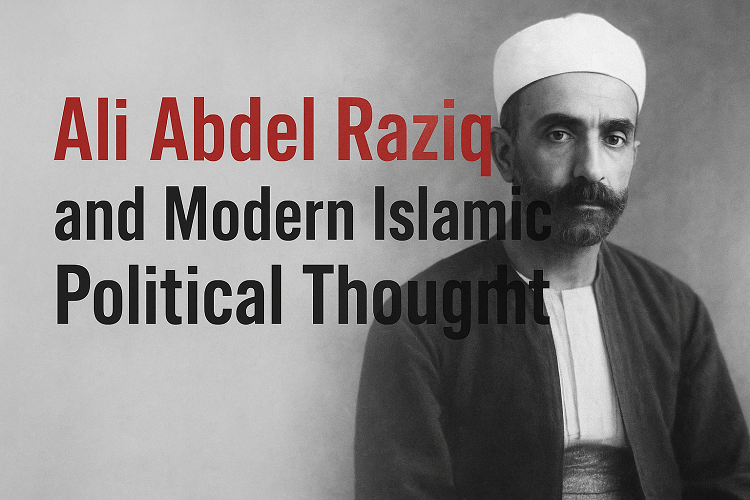
Introduction
Ali Abdel Raziq’s political thought remains one of the most original and controversial contributions to modern Islamic intellectual history. Unlike many reformers who relied on external philosophies or purely secular reasoning, Abdel Raziq stayed rooted in traditional methods of religious interpretation—careful reading of the Qur’an, hadith, and early Islamic history. Yet, by employing this traditional framework, he reached conclusions that were remarkably consistent with modern political life and the structures of secular governance. This unique synthesis made him a groundbreaking figure, though also the target of harsh criticism from conservative scholars who, bound by a reactionary mindset, failed to grasp the depth of his reasoning.
In what follows, we will examine Ali Abdel Raziq’s political thought in detail: his intellectual background, his famous book Islam and the Foundations of Governance, his method of deriving modern results through traditional tools, the backlash he faced, and his comparison with contemporaries such as Rashid Rida and Muhammad Abduh. Finally, we will explore his intellectual legacy and its continuing relevance today, particularly in light of political developments in countries such as Iran and the rise of extremist groups like al-Qaeda and ISIS.
Life and Intellectual Background
To appreciate Ali Abdel Raziq’s political thought, it is essential to situate him in his historical context. Born in 1888 in Egypt, Abdel Raziq was educated at al-Azhar University, one of the most prestigious centers of Islamic scholarship. Egypt at the turn of the twentieth century was a society in flux, shaped by three interrelated forces:
- Colonial domination: British imperial presence in Egypt generated political upheaval and provoked debates about national independence.
- Islamic reform: Thinkers such as Jamal al-Din al-Afghani and Muhammad Abduh sought ways to reconcile Islam with modern science, education, and governance.
- Encounter with Western modernity: Intellectuals were increasingly exposed to European political philosophies and models of the nation-state.
In this turbulent environment, Abdel Raziq stood out. Unlike many contemporaries who either fully embraced Western ideas or fully rejected them, he sought to work from within the Islamic tradition itself. His aim was not to imitate the West but to demonstrate that Islam, properly understood, did not require political institutions such as the caliphate.
The Book؛ Islam and the Foundations of Governance
Abdel Raziq’s most famous and controversial work, al-Islam wa Usul al-Hukm (Islam and the Foundations of Governance), was published in 1925—just one year after the formal abolition of the Ottoman caliphate by Mustafa Kemal Atatürk in Turkey.
In this book, Abdel Raziq made three groundbreaking arguments:
- The Prophet’s mission was purely religious, not political. He argued that Muhammad was sent as a spiritual and moral guide, not as a founder of a state.
- The caliphate is a historical construct, not a religious obligation. It was created by Muslims in response to political needs after the Prophet’s death, but it carries no divine mandate.
- Legitimate governance must be based on reason and public interest, not on claims of sacred authority.
This was a radical departure from dominant views, which considered the caliphate an indispensable pillar of Islam. Abdel Raziq’s argument destabilized centuries of consensus and gave intellectual legitimacy to secular models of governance in Muslim societies.
Traditional Method, Modern Results
What makes Ali Abdel Raziq’s political thought especially remarkable is his method. He did not borrow arguments wholesale from European Enlightenment thinkers, as some reformers did. Instead, he used the tools of traditional Islamic scholarship:
- Textual exegesis of the Qur’an and hadith.
- Critical study of Islamic history, especially the period of the Rightly Guided Caliphs.
- Juridical reasoning within the framework of Islamic law.
By working strictly within these parameters, Abdel Raziq demonstrated that the absence of a divinely mandated political system is entirely compatible with the Islamic tradition. This allowed him to arrive at conclusions that supported secular governance and modern political institutions while avoiding accusations of outright Westernization.
In other words, his achievement was to show that Islam itself contains the resources for modernization. This is precisely why his work was so threatening to conservative scholars: it undercut the religious legitimacy of political theocracy from within the tradition.
Reactions and Backlash
Unsurprisingly, Abdel Raziq’s book triggered an uproar. The conservative establishment at al-Azhar condemned him, stripped him of his status as a religious scholar, and accused him of heresy.
Reasons for the Backlash
- Collapse of the caliphate: The Ottoman caliphate had just been abolished in 1924. Many Muslims saw this as a catastrophic loss, and Abdel Raziq’s book—arguing that the caliphate was never religiously required—was received as an attack on Muslim unity.
- Threat to clerical authority: By arguing that governance was a human matter, Abdel Raziq undermined the role of religious scholars as guardians of political legitimacy.
- Fear of Western dominance: Conservatives worried that accepting secular governance would open the door to cultural and political colonization by the West.
Critique of His Opponents
However, the criticisms leveled against Abdel Raziq reveal a reactionary mindset. His opponents failed to distinguish between sacred texts and historical practices. They conflated Islam as a religion with Muslim political history, treating human institutions as if they were divinely mandated. This inability to separate tradition from history left them incapable of grasping Abdel Raziq’s intellectual breakthrough.
Comparison with Contemporaries
Abdel Raziq and Rashid Rida
Rashid Rida, a disciple of Muhammad Abduh, was one of the most prominent advocates for reviving the caliphate after its abolition. He argued that the caliphate was necessary for the unity of the Muslim community. Abdel Raziq, by contrast, used the same sources to argue that no such obligation existed. Their debate symbolized the larger conflict between revivalist and reformist interpretations of Islam.
Abdel Raziq and Muhammad Abduh
Muhammad Abduh sought to reconcile Islam with modern values, but he stopped short of advocating for secular governance. Abdel Raziq went further, making explicit what Abduh only implied: that religion and politics could, and perhaps should, be institutionally separate.
Abdel Raziq and Taha Hussein
Taha Hussein, another Egyptian intellectual, also challenged traditional views, especially regarding literature and history. Yet, unlike Abdel Raziq, Hussein relied heavily on Western historical criticism. Abdel Raziq’s reliance on Islamic texts and tradition gave his conclusions greater legitimacy in religious debates.
Connection with Modern State Concepts
Ali Abdel Raziq’s political thought aligns in many ways with the principles of the modern state:
- Popular sovereignty: Governance should be based on the will and consent of the people, not on divine appointment.
- Rational lawmaking: Laws should be grounded in reason and public interest, not in claims of immutable religious authority.
- Separation of powers: While religion can guide moral values, the state should remain neutral in political authority.
Though he did not directly cite Western thinkers such as John Locke or Jean-Jacques Rousseau, his arguments resonate with the idea of the social contract and rational legitimacy.
Why Abdel Raziq’s Thought Is Unique
Several features make Abdel Raziq’s contribution unique in Islamic intellectual history:
- First insider critique of the caliphate: He was the first traditional scholar to challenge the religious necessity of the caliphate from within Islamic sources.
- Internal critique of tradition: He demonstrated that the Islamic tradition itself provides tools for separating religion from politics.
- Bridge between tradition and modernity: By grounding modern political principles in religious scholarship, he offered a synthesis unmatched by either purely secular reformers or purely traditionalist scholars.
Legacy and Contemporary Relevance
Ali Abdel Raziq’s political thought continues to inspire reformist scholars today. At a time when many Islamist movements insist on the inseparability of religion and politics, his writings show that Islamic tradition itself allows for political secularism.
If Abdel Raziq Had Been Taken More Seriously
The tragedy of modern Muslim history is that Abdel Raziq’s voice was marginalized. If his ideas had been embraced more widely, the trajectory of political Islam might have been profoundly different.
- Iran and the rise of religious government
The 1979 Iranian Revolution established the principle of wilayat al-faqih (guardianship of the jurist), creating a system where political power is legitimized through religious authority. This model has led to authoritarianism, suppression of dissent, and deep social divisions. Abdel Raziq’s argument—that religion does not prescribe a form of government—could have provided an intellectual foundation for resisting such a system. His insistence on distinguishing between prophetic mission and political authority would have undermined the theological justifications of Iran’s clerical regime. - The emergence of extremist groups
Organizations such as al-Qaeda and ISIS are built on the belief that Islam requires a unified caliphate and that violence is justified to achieve it. Abdel Raziq’s work dismantles this very assumption. By showing that the caliphate is a human invention, not a divine command, he removed the theological legitimacy for such movements. Had his arguments been more widely disseminated, the ideological appeal of these groups might have been drastically reduced. - Broader identity crises in the Muslim world
In the postcolonial period, many Muslim societies faced the dilemma of choosing between Western-inspired secularism and traditional religious politics. Abdel Raziq offered a third way: preserving Islamic moral identity without politicizing it. This path could have helped avoid the cycles of authoritarianism and sectarian conflict that have plagued many Muslim-majority states.
Reactionary Criticism and Missed Opportunities
The backlash Abdel Raziq faced illustrates the intellectual stagnation of parts of the Islamic scholarly establishment. By silencing him, they ensured that Muslim societies would lack a powerful internal critique of political theocracy. The cost of this failure can be seen in decades of political turmoil, from theocratic authoritarianism in Iran to militant extremism in the Arab world.
Why His Ideas Matter Today
In the twenty-first century, as Muslim societies grapple with authoritarianism, failed states, and extremist violence, revisiting Ali Abdel Raziq’s political thought is not just an academic exercise—it is a necessity. His ideas provide:
- A model for religious pluralism: By separating governance from theology, he created space for diverse communities to coexist.
- A defense of democracy: His emphasis on reason and public interest aligns with democratic principles.
- A safeguard against extremism: His rejection of divinely mandated political systems denies extremists the theological legitimacy they seek.
In short, his intellectual legacy is a “lost opportunity” of the twentieth century—one that, if recovered, could still shape the future of Muslim political thought.
Conclusion
Ali Abdel Raziq’s political thought represents a watershed moment in modern Islamic intellectual history. By using traditional methods of religious interpretation to reach modern conclusions, he bridged the gap between faith and modernity in a way that remains unmatched. His rejection of the caliphate as a religious obligation and his insistence on reason and public welfare as the foundations of legitimate governance were revolutionary ideas that still resonate today.
The fierce opposition he faced from conservative scholars reflects the inability of reactionary forces to distinguish between divine revelation and human history. In contrast, Abdel Raziq’s genius lay in recognizing that Islam does not prescribe a specific form of government, leaving Muslims free to adopt systems suited to their time and place.
Comparisons with contemporaries such as Rashid Rida, Muhammad Abduh, and Taha Hussein reveal his unique courage in pushing Islamic thought beyond the boundaries of compromise and toward genuine modernization. More importantly, his legacy offers lessons for our own time: had his ideas been more widely embraced, tragedies such as the authoritarian religious regime in Iran or the rise of extremist groups like ISIS might have been avoided.
Today, revisiting Ali Abdel Raziq’s political thought is crucial for Muslims seeking a balance between faith and modern governance. His message is clear: Islam’s spiritual and moral mission must not be conflated with political power. By recovering this insight, Muslim societies can escape the cycle of authoritarianism and extremism and move toward a future where religion inspires values but politics remains the realm of reason, justice, and human choice.

