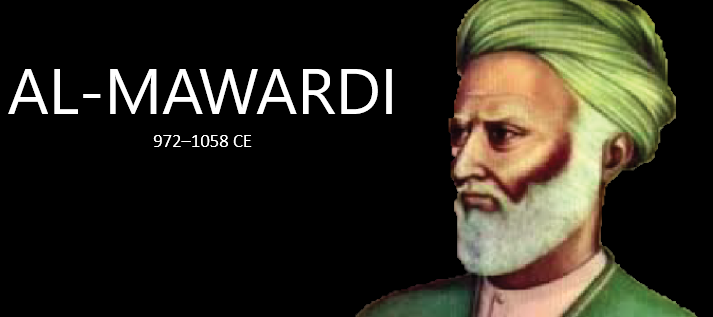
Abu al-Hasan Ali ibn Muhammad al-Mawardi (972–1058 CE) was one of the most prominent political thinkers and Shafi’i jurists during the Abbasid Caliphate. He played a crucial role in defining Islamic political theory, particularly at a time when the caliphate was weakening and military rulers were gaining power. The political thought of Al-Mawardi sought to provide a framework that legitimized governance while preserving the authority of the caliph, all while considering the political realities of his time.
The political thought of Al-Mawardi is best reflected in his seminal work, Al-Ahkam al-Sultaniyya wal-Wilayat al-Diniyya (The Ordinances of Government), which remains one of the most important texts in Islamic political jurisprudence. This article explores the political thought of Al-Mawardi, focusing on his theories of the caliphate, governance, and the relationship between religion and politics.
-
The Theoretical Foundations of Al-Mawardi’s Political Thought
As a jurist, Al-Mawardi analyzes politics through the lens of Islamic law (Sharia) and considers political authority essential for implementing divine commandments and social order. His theory rests on three main principles:
1.1 The Necessity of Government in Islam
Al-Mawardi argues that governance is not only a social necessity but also a religious obligation. He believes that without political authority, the implementation of Islamic laws and the establishment of justice would not be possible. He justifies the necessity of government based on three primary reasons:
- To preserve religion and enforce Islamic laws.
- To establish justice and prevent oppression.
- To maintain security and public order.
1.2 The Legitimacy of the Caliphate and Government
Al-Mawardi maintains that the legitimacy of the caliphate is derived from both divine principles and the acceptance of the people (bay’ah). In his view, an ideal Islamic government conforms to Islamic law while also enjoying public legitimacy.
1.3 The Duties of an Islamic Ruler
Al-Mawardi outlines several responsibilities for the ruler, including:
- Protecting religion and preventing heretical innovations.
- Ensuring justice and eliminating oppression.
- Defending Islamic territories from external threats.
- Maintaining security and public order.
- Overseeing the economy and ensuring people’s welfare.
He also emphasizes that a ruler must possess not only political power but also religious knowledge, ethical integrity, and administrative competence.
-
The Caliphate and Governance in The Political Thought of Al-Mawardi
In Al-Ahkam al-Sultaniyya, Al-Mawardi presents the concept of the caliphate as the central pillar of Islamic governance, outlining its duties and conditions.
2.1 The Qualifications of a Caliph
Al-Mawardi sets forth several conditions for a legitimate caliph, including:
- Justice and piety – The caliph must be morally upright.
- Knowledge of Islamic law – He must have a sufficient understanding of jurisprudence.
- Physical and mental soundness – To effectively fulfill his responsibilities.
- Courage and leadership skills – To protect the Muslim community.
- Descent from the Quraysh tribe – Based on Islamic tradition.
2.2 The Process of Electing a Caliph
Al-Mawardi describes two main ways for a caliph to come to power:
- Election by Ahl al-Hall wa al-‘Aqd – A council of elite scholars and leaders who confirm the caliph’s legitimacy.
- Appointment by the Predecessor – The previous caliph designates his successor.
2.3 The Role of Ministers and Administrators
Al-Mawardi highlights the significance of ministers in governance and categorizes them into two types:
- Wazir Tafwid (Delegated Minister): A high-ranking official with full executive authority, akin to a prime minister.
- Wazir Tanfidh (Executive Minister): A lower-ranking official with limited administrative powers under the caliph’s supervision.
-
The Concept of Emirate by Seizure (Imarat al-Istila’)
One of Al-Mawardi’s most pragmatic contributions to political thought is his acceptance of non-ideal governments. He introduces the concept of “Emirate by Seizure” (Imarat al-Istila’), which justifies the rule of military leaders who come to power by force, provided they maintain order and uphold Islamic principles.
This theory was particularly relevant during Al-Mawardi’s time, as powerful military dynasties such as the Buyids and Seljuks overshadowed the Abbasid caliphate. Al-Mawardi bridged the gap between political realities and Islamic legal theory by legitimizing their rule under certain conditions.
-
The Influence of Al-Mawardi’s Political Thought on Islamic Governance
Al-Mawardi’s ideas had a lasting impact on the political structures of the Islamic world, particularly during the Abbasid era and later under the Seljuks and Ottomans. His theories on the relationship between the caliphate and military rulers provided a framework for legitimizing governance structures that, while not ideal from a purely Islamic standpoint, were necessary for political stability.
The Ottoman Empire, for example, applied several of Al-Mawardi’s principles, particularly regarding the role of ministers and the delegation of power within the government.
- Conclusion
Al-Mawardi’s political thought remains one of the most comprehensive theories of Islamic governance, striking a balance between religious ideals and political realities. His emphasis on the necessity of government, the legitimacy of the caliphate, and the acceptance of non-ideal rulers reflects a pragmatic approach to governance.
His ideas continue to be studied in the fields of Islamic jurisprudence and political science, offering insights into the enduring questions of legitimacy, governance, and the role of religion in politics.